

Donegal man shares what 'changed everything' after life-changing accident

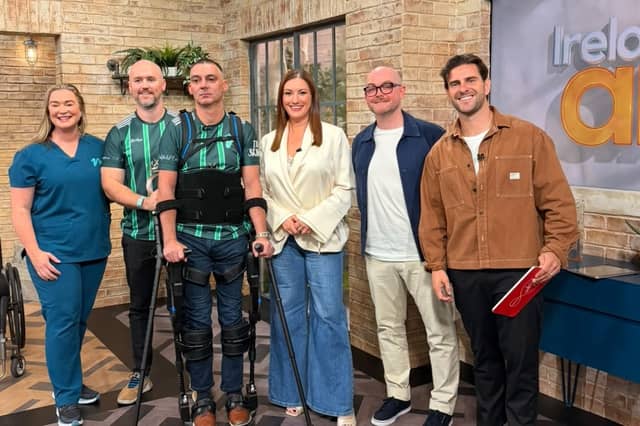

Daniel Gallagher of Meenakillew, Ardara, was involved in a serious road traffic accident in Orlando, Florida, while on holidays with family in December 2023 - today he told Ireland AM just how vital the support is that he is receiving from the No Barriers Foundation in Letterkenny
A Donegal man has said the positive impact a Letterkenny health facility has made on his life has “changed everything.”
Daniel Gallagher of Meenakillew, Ardara, was involved in a serious road traffic accident in Orlando, Florida, while on holidays with family in December 2023.
Despite initial fears for his life, Daniel made remarkable progress within a month of the accident. He was cleared by American doctors for discharge in 2024 to continue his rehabilitation at home.
Daniel shared his story on Ireland AM on Virgin Media, with co-hosts Eric Roberts from Glen and Elaine Crowley, on his journey since and how Letterkenny’s No Barriers Foundation has helped his recovery.
The No Barriers Foundation is a registered non-profit organisation and inclusive health facility located at Pinehill Business Park in Letterkenny. It bridges the gap in neuro-rehabilitation and fitness by providing affordable specialist equipment, including a robotic exoskeleton, for adults and children with physical and intellectual disabilities.
Daniel said that without the No Barriers’ exoskeleton suit, he would be permanently wheelchair-bound. An exoskeleton suit enables users to stand and walk, providing support and strength to help regain independence and improve overall physical health. Daniel provided a demonstration in front of the Ireland AM cameras, with No Barrieres’ rehabilitation and exercise coach, David Hone.
“I was up in the rehab, in the NRH (National Rehabilitation Hospital) and a fella used to come and meet a friend of mine every week, and he kept telling me about No Barriers, which I hadn't heard of, to be honest, and his brother went there,” Daniel said.
“He said it was great, so when I got home from the rehab, I didn't really think much about it, but he kept saying to me: ‘Did you ever get in contact with No Barriers?’
“I basically had to, because he kept asking me! I was down then, and I was all green, had a couple of sessions, and it kind of grew from there, over the space of a year and a half, and I ended up going every week.
“I didn't know what to expect, because I was never in that kind of situation. I had no idea, very nervous. It’s changed everything. Beforehand, there was nothing happening; you had nothing to do, nowhere to go. Even getting into the car to go down there twice a week, it's something to do. You end up looking forward to it, and it's like a new calendar of stuff to do.”
CEO and founder of No Barriers, Johnny Loughrey from Letterkenny, shared the journey of the facility.
“My own mum would have been sick quite a lot when I was growing up, so it was something I really cared about,” he said. “Trying to think about how we could maybe access specialist equipment and be delivering services in the best way possible in Donegal, but at the lowest price point possible. I set up the No Barriers Foundation in 2016 as a not-for-profit organisation, but the idea is just that if everyone pulls together and unites - government and grants and fundraising and social enterprise - that we could try and make this type of service available.
“We convinced my mum to come on as a co-director and we had this idea. So it took about two years of putting the committee together and doing public fundraising, and we managed to get our first exoskeleton in 2018. At that stage, we had no, I suppose, facility to run it from, and we had no staff members, so it just organically grew from there.
“Initially, we were very focused on neurological rehabilitation and physical disability, but now in 2026, we operate out of a 13,000-square-foot facility, and we deliver services to people with physical disability, intellectual disability, and mental health, and we're also looking at students from poverty.
“We're quite unique in the way we operate. We have as much privacy as people need in the initial stages of their rehab, but as and when they feel comfortable, we have another commercial gym facility, and essentially people can transition and transfer into the mainstream gym.
“We operate as many services in the mainstream gym as we possibly can, and that creates inclusion, it creates a revenue stream, and it creates, a situation whereby people without a disability in Donegal can pay a normal gym membership, they can attend classes in our gym, they can be exercising besides someone with a disability, and their gym membership is actually helping to make it cheaper for people with disabilities to access the services.”
Expert Neuro Physiotherapist Marina Kennedy-Quick explained her role at No Barriers.
She said: “I have a huge variety. I'm really lucky in my work, no two conditions are the same, so it's very much dependent on what the client wants, what their goals are.
“I start with an initial assessment meeting for a new client coming through the doors, and it's about trying to look at them holistically, being very patient-centred, and it can be very daunting to be in a gym environment for a lot of people that have never been in a gym before, so it is about creating a safe, supportive space for them,
Then it’s really listening to what people want and need, and what's meaningful, because as a physio, I have my own ideas of what I think this person could be working on, but actually that may not be what they're interested in, so we do lots of classes; we are using the exoskeleton, which is obviously amazing. I could be working with people, working with their family about how to get the back off the floor, or I could be doing balance work, so it's hugely broad and really rewarding.
“We have really kind, caring people who are obviously very specialist, but that's really important to us: that we build a great team, and then it's about having a space. If somebody comes in and they're not having a great day, then we know ways to motivate them, to support them, and people usually, or always, if they come in in bad form, they always leave in much better form, and that's what we're all about generally.
“I do feel very privileged, and very blessed, like all our team, to be involved in somebody's journey, and sometimes we are the cheerleaders; it's about giving people hope, it's about listening to what's important, and trying to guide people to maximise their potential.
“That's huge stuff, and there's lots of happy tears, so seeing somebody stand for the first time, walk for the first time, those are hugely important, and we have a lovely community in No Barriers, and we really get to know our clients and their families really, really well.”
Johnny continued: “We used the exoskeleton as part of a pilot program that was funded last year, and we were actually able to show that using this type of equipment in a rehabilitation setting, for every one year that was invested in the program, it gave a social return on investment of €22, so for every one year invested, it saved €22.
“And this equipment, unfortunately, is hugely expensive, so what we in No Barriers are trying to do is to be able to give people access to this equipment, which is hugely important for the rehab, and can make lots of changes, but at an accessible price point. And to date, we're just coming up now on having saved people in Donegal close to a million euros in terms of accessing services like this.”
Marina explained that the exoskeleton is “a wearable robotic device that helps people stand and walk, so that people will get the huge benefits that there are to standing and walking, and the repetition of walking.”
“So us as physios and coaches, to try and get somebody to do all those steps, it would be very difficult to facilitate, so it's a lot of holding,” she added. “The exoskeleton does all the work for us, so that we can focus then on making sure that we're getting really good quality steps, and that we're looking at posture, we're looking at all those types of things. So we have two streams of people who use the exoskeleton. So we have somebody who is hoping that they're going to get back to walking, and then we have other people who are using it because they need all these benefits, like for their blood pressure, for their bone density, for all of those types of things.”
“It's tiresome, but you definitely feel better afterwards,” Daniel added. “And when you stand up, your blood goes to flow around your body, into areas it hasn't been, or is only trickling, and it's really working. The whole system is really working. When you're walking, chatting, the fact that you're having a chat point, you're on the same level.”