

Dramatic increase in women seeking Domestic Violence Centre help

Many woman are contacting the service for the first time
There has been a dramatic increase in the number of women seeking support from the Donegal Domestic Violence Services from the onset of the pandemic, with more than 100 women contacting the essential service a month, according to its manager Doctor Marie Hainsworth.
Dr Hainsworth said that in Donegal 20% of those who were contacting the service, on a monthly basis, are doing so for the very first time.
She added that the new cases are being viewed by many as being more complicated as a result of conditions relating to the pandemic.
She said the fact that families are contained within a home, with no respite from an abusive partner, where there is alcohol or drug misuse, and possible mental health issues combined with the pressure affected by the pandemic, has caused “an explosion” in the number of new families using the service.
Pushed people to their limits
Commenting on one of the knock-on effects of living during the Covid pandemic, Dr Hainsworth said: “It pushed people to the limits quicker than normally. Families suddenly found they didn’t have that space to make decisions … perhaps guards were called out. We had a lot more clients coming into the service from gardaí call-outs or social work call outs,” she stated.
Many of these cases which were introduced to the system were new.
“These were all new clients … so it has been an eye opener not only for ourselves,” she said adding that one of the positives gleaned from this situation was that links between agencies were forged and strengthened.
“There is a consistent number of new callers every month and you would think you would have months where it would drop off but no, there are consistently 25 maybe new callers who have had no contact with the service coming through every month.
“Then you obviously have clients you are working with on a more regular basis and then you’ve got women that outreach staff are working with so you are working with upwards of over one hundred women a month. A fifth of those are new clients to the service,” she said.
Donegal almost always ranks third nationally
In terms of statistics relating to domestic and sexual violence Donegal almost always ranks third in the country after Dublin and Cork which means it requires substantial investment, Dr Hainsworth said.
Findings contained in a national report by Safe Ireland show an average of almost 2,000 women and 411 children were in receipt of some kind of support from domestic violence services, such as a refuge, counselling, accompaniment, information or advice, each month since last March.
Dr Hainsworth added that Donegal also has more urban-style statistics.
Accommodation
The increase in demand for services led to the exploration of a different approach to accommodating families. She said that while their approach would not traditionally be to seek accommodation for families, across the county, the pandemic and the restrictions affiliated with it dictated that they had to. The approach highlighted, once again, the dire need for affordable housing for families. Dr Hainsworth pointed out that an increase in the cost of renting in the private housing sector and too little social housing has and will continue to cause problems for families seeking to find essential new homes: “The lack of social housing also means that the private rental market is going up to the point that is almost not reachable anymore by clients who are social welfare recipients, because the cost of renting is more than a mortgage at this stage.”
Significant gaps
As a result the domestic violence service is in the process of purchasing additional accommodation in the Letterkenny area and this will be available for families to use in the future. Areas in the south of the county, such as Bundoran, can often offer off-peak accommodation to families in need and B&Bs in the area can also be used when needed. Other areas of the county still have significant gaps in accommodation availability, such as Buncrana.
“Accommodation is always the big problem and we have certainly doubled the number of women we have supported in accommodation this quarter compared to Q1 in 2020,” Dr Hainsworth said.
In the former premises two families were afforded shared communal living whereas now the centre has the capacity for four families to live in independent units.
Tusla helped
During Covid, Tusla (the state Child and Family agency) supported the centre and helped accommodate women and families in the community through B&B and hotel accommodation.
The refuge in Letterkenny homes women and families from across Donegal and at present clients are aged from 18 - 80.
Dr Hainsworth said that Safe Ireland has been very supportive during the difficult period.
Food bank
She also said that the Food Bank in Letterkenny has been vital.
“Women are obviously struggling to get food on the table … Domestic violence does push people into that poverty trap. People always say why don’t they leave, but for women to take on that huge leap of managing their own accommodation, their own food ... to be a lone parent and to take on all those responsibilities on is quite difficult and challenging.”
She said that for many women being a lone parent, and prioritising the needs of the children can see the mother of the household do without. At times, women return to homes where they are being hurt simply because they cannot afford to live outside of it.
“That shouldn’t be a reason for people not to be able to leave a domestic violence situation,” she said.
Go Purple Day
Gardaí across the county will take part in an initiative to promote and support Domestic Violence Support Services on Friday, April 23. The theme of the event will be a “Go Purple Day.”
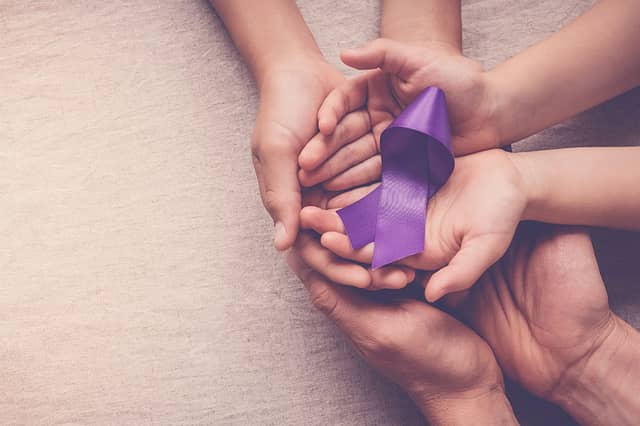
The ‘Go Purple Day’ will involve working gardaí wearing a purple ribbon on Friday as a conversation starter in relation to the topic of domestic violence.
"The colour purple is a symbol of peace, courage, survival, honour and dedication to ending violence. It is a salute to survivors and those we have lost to domestic violence and raising awareness of domestic violence is an important part of working to end the cycle of violence," Letterkenny based Garda Sergeant Eunan Walsh said.
‘Go Purple Day’ is being viewed as a positive initiative to promote awareness in relation to domestic violence and all of the support services available to people in need of them. The Donegal Garda Síochána social media pages will post photos of the ‘Go Purple Day’ and details of all support services available locally on Friday.
Donation
Staff at the Donegal Domestic Violence are funded though Tusla (the national Domestic, Sexual & Gender Based Violence Services programme) and receive some support from Victims of Crime for their legal support work. They apply for smaller grants and are always open to receiving donations. The website gives women lots of advice and information and includes the option to translate the help and advice into any language. Their website (www.donegaldomestic violenceservice.ie) has a donate button where you can make a donation.
Contact
Donegal Domestic Violence Services provides 24-hour crisis support and information for women and their children who are experiencing domestic abuse. It works to empower and support women to regain, reclaim and retain control of their lives and to live free from the fear of violence and of abuse.
The 24-hour helpline is 1800 262677 and gives access to a trained worker.