

NATURE WATCH: Are there plants that we could really do without?
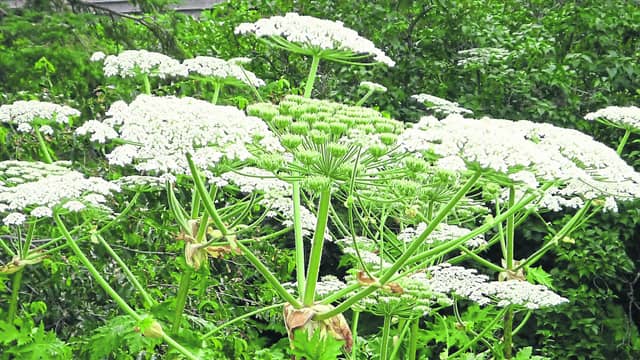

Jimmy Scott from Copany on invasive plants
On the island of Ireland the top three invasive plant species are usually listed as Japanese Knotweed, Giant Hogweed and Himalayan Balsalm.
In our local Laghey-Ballintra area Japanese Knotweed is quite prevalent and high profile. Over the growing season it forms a very dense canopy that virtually blocks out any other plant life. It has a great capacity to spread and cutting or digging up is not recommended as any even tiny bits of the rhizomes can easily regrow.
The shoots from the underground rhizomes are so vigorous and aggressive that they can come up through hardcore, tarmac and even concrete. This can present a threat to the foundations of structures and then this in turn can have implications as regards insurance cover for buildings.
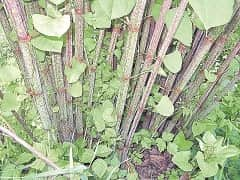
Japanese Knotweed
Giant Hogweed is somewhat similar in appearance to ordinary Hogweed but can grow to over 3m (10 ft ) tall. It is of note in particular as contact with this plant can cause a very severe and lingering skin rash. It tends to be found growing along river banks but thankfully it is not that common locally. However, because of its risk to human health any feedback from our readers in regard to where it occurs would be appreciated.
Himalayan Balsam is perhaps the least well known of the top three invasive plant species. Unlike Japanese Knotweed it reproduces by seed only. Seeds germinate in the spring and produce dense stands which shade out competing vegetation. It exhibits an impressive growth rate and can grow quite tall before flowering from about July onwards. The flowers are shades of pink through purple and have a somewhat distinct shape often described as resembling a policeman’s helmet. Plants produce many seeds that can be spread quite a distance from the parent plant.
Two other plants found locally may also come under the broad heading of invasive species. One is Gonnera or so called Giant Rhubarb and the other is the common or garden Rhododendron. A stand of the Giant Rhubarb can be seen on the way down to the old Drumholme graveyard. It truly stands out due to its huge size but is not edible unlike ordinary rhubarb. Achill Island in Co. Mayo is well known for the prevalence of the Giant Rhubarb growing there.
Rhododendron is common locally and seems to grow well on a range of soils from the good limestone land around Ballintra to the blanket bog up the ‘broad road‘.
Attempts have been made to eradicate Rhododendron from the Killarney National Park in Kerry.
Some may put forward the argument that these invasive plant species add to biodiversity. There may be some truth in this but on balance both Japanese Knotweed and Giant Hogweed are two we could probably well do without!