

Forget Taylor Swift and her wedding! These Swifts face a Donegal housing crisis

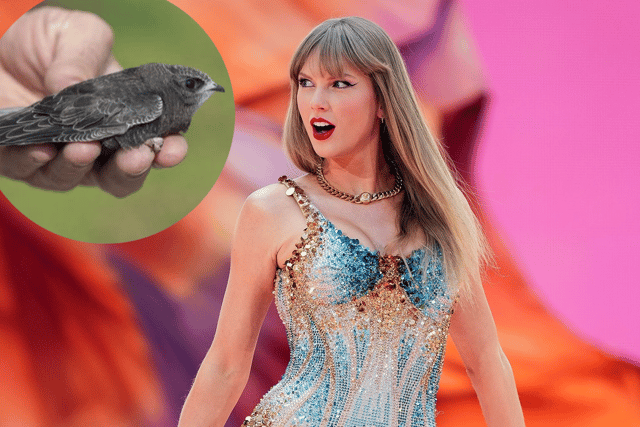

BirdWatch survey to locate nest sites of endangered Swift species across County Donegal
Forget the headlines about Taylor Swift's latest romance, wedding rumours or world tour. The Swift we should really be talking about is the one disappearing from Donegal's skies.
While the pop superstar dominates the news cycle, our native Swift bird has suffered a staggering 69 per cent population decline in just 25 years, driven largely by a housing crisis of our own making.
Now, BirdWatch Ireland is asking the Donegal public to help locate nesting sites across the county before one of nature's most extraordinary aerial acrobats vanishes right under our noses.
In an uncanny echo of our own housing crisis, we have created a housing crisis for Swifts, in many cases removing their existing nesting habitat and not providing new space for them to bring the next generation into the world.
To help find nesting Swifts, BirdWatch Ireland is carrying out Swift surveys in Donegal, Wexford, and South County Dublin and at several Office of Public Works sites across Meath, Cavan and Tipperary, this summer, and needs your help.
Swifts are a small, chocolate brown coloured migratory bird, with a distinctive sickle-shaped silhouette. Their sickle-shaped silhouette is one of nature's most clever evolutionary tricks, as the Swift’s aerodynamic shape means it is perfectly adapted to life in the air.
In fact, Swifts sleep, eat, and drink on the wing, flying continuously from the moment they jump from the nest at six weeks old until they are ready to nest at around 3 years of age. Outside of the breeding season, all Swifts spend all day and all night in the air.
During the breeding season, Swifts traditionally nested in old growth forest and cliff faces, and there are still some remnant populations nesting in these habitats, but the vast majority have adapted to nest in our buildings.
This strategy probably served them well over millennia. However, in more recent decades, the standard and frequency of building renovations have significantly increased, often excluding Swifts and other cavity-nesting birds from their nest sites.
“To make things even more challenging, new-builds tend to be very tightly sealed,” says Tara Adcock, BirdWatch Irelands Urban Birds Project Officer. “This is fantastic from an energy efficiency perspective, but catastrophic for Swifts as these buildings offer no space for them to raise the next generation.”
The reduction in available nest sites, coupled with declining insect populations and climate change, is pushing Swifts to the brink of extinction.
BirdWatch Ireland estimates that between 1998 and 2023, 69 per cent of Swifts disappeared from our skies. Protecting Swift nest sites is one of the most important conservation measures for this species.
To protect these nest sites, we first need to know where they are. To this end, BirdWatch Ireland Swift Surveyors have been working with the Office of Public Works since 2015, surveying OPW sites for Swifts, with 50 surveys carried out to date.
On a wider level, there is hope for the Swift, as there are practical solutions to the Swift housing crisis. Homes for Swifts can literally be built into our buildings using Swift bricks (bricks with cavities for nesting Swifts, which blend into the fabric of the wall), or they can be provided with nest boxes, which are placed on the exterior of the building at appropriate sites.
As Swifts are a clean and quiet species, they are perfect house guests, and these bricks and boxes can be used on buildings from hospitals to schools, to private residences.
Government and public bodies have the ability to maintain and build Swifts and wider biodiversity into the buildings they manage, a responsibility and privilege which Lorcan Scott, OPW’s Biodiversity Officer recognises.
“The relationship between Swifts and many of the OPW’s built and cultural heritage properties is well known and understood”, says Lorcan. “The OPW has been partnering with BirdWatch Ireland since 2015, carrying out surveys of Swifts at many of our sites. In more recent years, we have begun to resurvey some key Swift sites to see how these sites fare, and to look at opportunities to adapt some of our modern buildings to support Swift populations. We are very much looking forward to continuing to partner with BirdWatch Ireland to use our combined skills and knowledge for the betterment of our Swifts and indeed a host of other species in 2026 and beyond.”
Beyond BirdWatch Ireland, the OPW, and several councils, there are a variety of other groups and individuals working hard to reverse the plight of the Swift in Ireland.
By working together, highlighting the plight of the Swift and the practical measures that can be put in place to save these remarkable birds, there is hope for this species on the island of Ireland.
If you are aware of nesting Swifts, would like to get involved as a volunteer surveyor or would like more information on installing Swift nest boxes or bricks, please contact [email protected].
OPW Swift site surveys are funded by the Office of Public Works, and the 2026 County Swift Surveys are funded by Donegal County Council, South Dublin County Council, and Wexford County Council, through the National Parks and Wildlife Service Local Biodiversity Action Plan.
Meanwhile, Taylor Swift is very much flying high too!