

What about safety every day - rather than special campaigns?

It Occurs to Me
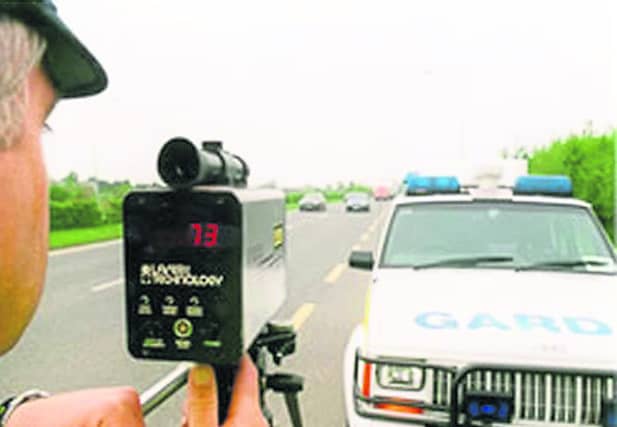
Last Friday morning, Gardaí and GoSafe checked the speed of 105,567 vehicles and a total of 133 were detected travelling in excess of the applicable speed limit.
All very admirable, but as a friend in the Traffic Corps told me years ago: “Because we don’t have the resources for daily checks, the spin and publicity is all important.” Another cynic said to me: “Ah sure, the following day, you could drive at any speed...no more overtime, so no more checks!”
Not too many weeks ago, I witnessed some appalling driving between Kilmacrenan and Letterkenny. Coupled with the infuriating roadworks everywhere, the roads are deadly at the moment.
Ten years ago, in the wake of five road deaths in Inishowen, I heard Father Walsh from Buncrana on RTÉ radio talking about the success of the relevant authorities in Victoria, Australia at curbing road deaths. I looked into this and it is quite staggering. The rate of deaths per 10,000 vehicles in Victoria fell by 28 percent, from 1.34 in 2001 to 0.96 in 2004.
To update matters, the annual death rate is a third of what it was in 1989. Why?
SEE ALSO: Pat McArt column
It’s because of an innovative strategy which includes:
Speed Limit reductions: introduction of the default 50km/h speed limit for roads in built up areas, school speed zones, 40km/h speed limits in metropolitan shopping strip centres and 50km/h speed limits in rural and outer metropolitan town centres.
Alcohol interlocks: introduced for repeat and serious first time drink driving offenders returning to driving as a condition of re-licensing.
Random drugs testing: legislation to detect drivers travelling under the influence of the illicit drugs cannabis and methamphetamine.
Vehicle safety: The launch of Victoria’s Vehicle Safety Strategy which includes actions to increase consumer demand for safer vehicles.
Road infrastructure programmes: A $240 million Statewide Blackspot Program, and a Federal Black Spot Programme - $130 million program to address road crashes and $10.7 million to address road crashes on curves on rural highways.
Also, the past 25 years have seen significant improvements in road safety in New South Wales. The road fatality toll has been cut by more than 60 percent while estimated motor vehicle travel has doubled.
The fatality rate is now similar to levels in the late 1940s, even though six times as many licenses have been issued, and eight times as many vehicles are on the roads. Random Breath Testing was introduced in 1982 and the initial impact of its introduction translated into an estimated overall drop of 19.29% in accident numbers and a 47.98% drop in fatal accidents in the first 4.5 months.
How do the authorities in Victoria and New South Wales enforce this? With enforcers! I’m not convinced that education alone will penetrate the heads of young male drivers.
Rocket science
Some years ago on Highland Radio, I interviewed Assistant Commissioner Noel Ashby, Victoria’s traffic Czar, and what he told listeners was not rocket science. In August this year, Victoria’s death toll stood at 201, 31 fewer than last year and 23 fewer than at the same time in 2003, the year the state recorded a low of 330 deaths.
The biggest gains were in the 18 to 25 age group, which has long been disproportionately represented in road trauma statistics.
He said: “There’s no doubt the four causes of road trauma are alcohol and drugs, speed, (unworn) seatbelts, and fatigue.” Interestingly, he stressed that part of his successful strategy was a lesser reliance on unmarked patrol cars, and a corresponding increase in marked cars, including highway patrol pursuit cars.
Traffic research had indicated that even the brief appearance of a police vehicle can create a moderating effect on driver behaviour for up to 20 kilometres. High visibility cars then, police reason, are likely to significantly improve driving.
Also, many deaths might have been avoided had car occupants been wearing seatbelts, made compulsory more than 30 years ago, when Victoria's annual toll topped 1000.
Unrestrained drivers and passengers still make up about 10 percent of all deaths.
He added: “Now we are at the stage where people regard not driving with your seatbelt as generally stupid. And drink-driving is no longer merely a social offence, which it was. We are going through a similar debate now.
The threads of the debate are probably the same. People did not think they would be injured without a seatbelt, or a significantly increased risk if they drink-drive.
That’s the same as now, but there is absolutely no doubt on all the evidence that speed is the major cause of road trauma.”
He also talked about the introduction of random drug testing and the success of Booze Buses. In 2006, his officers have used the buses to blitz areas at high-alcohol-use times.
Instead of dotting buses across the state, police have locked down smaller geographical areas or used them to breath-test every motorist on all freeways exiting the city during high-risk hours.
Victorian research suggests that being stopped for a random breath test remains at the forefront of a driver's mind for several weeks after.
In the late 1980s one in every two dead drivers was over the legal blood-alcohol limit: by the early 1990s it was one in five.
Ashby stressed again and again the importance of the three E’s – Education, Engineering (road improvements) and Enforcement, but acknowledged that the latter needed will and resources.
And so say all of us.