




1.
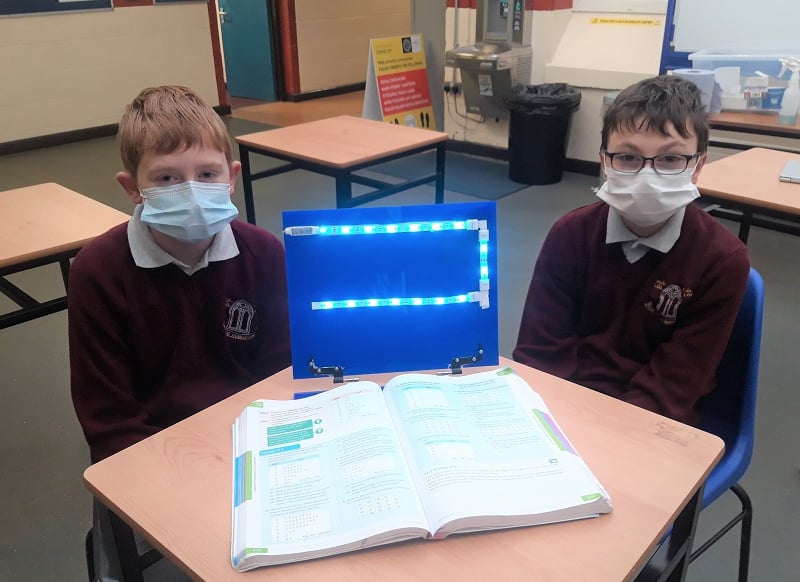
STUDENTS: Micheál Deely and CJ Burke CATEGORY: Junior Technology PROJECT TITLE: A dyslexia light with a difference APPROACH: After speaking to an optometrist who specialises in colorimetry testing about the benefit he has seen of coloured lighting in helping the children with dyslexia to improve their reading and writing fluency, we decided to build a portable, robust and user friendly lamp with a multi-colour function to assist children reading text of different colours on different backgrounds. To develop our light, we will get advice from a family friend who is a mechanic and he will help assist us in building the lamp if needed. When we are satisfied with our lamp prototype, we will test our lamp with a focus group to see if it is fit for purpose and to see if it is more useful than single coloured lamps on different reading and writing backgrounds. If we see any snags in our design at that point we will modify our lamp design to resolve these issues and make it a better aid to help children with dyslexia to read and write more fluently.
2.
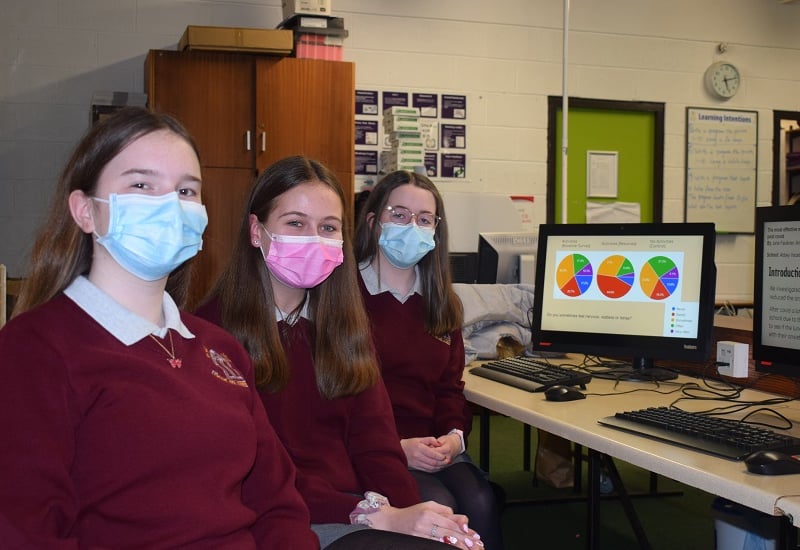
STUDENTS: Jane Faulkner, Jayne Glenn and Amy McGroary CATEGORY: Intermediate Social and Behavioural Biological and Ecological PROJECT TITLE: The most effective method of reducing anxiety in secondary school students post Covid APPROACH: Following our return to school after the second lockdown, we became more aware of the level of anxiety related issues among our school peers. A lot of our friends were anxious about coming back into a crowded school community and consequently really struggled academically. In a survey conducted online by the Irish Second-Level Students’ Union, the National Parents’ Council Post-Primary and the Institute of Guidance Counsellors three-quarters of respondents indicated the pandemic had an impact on their mental health. Almost half said the impact was mild (45%), with a significant proportion (23%) indicating there were moderate impacts on mental health. A smaller proportion (7%) reported a severe impact. Several studies show that exercise intervention results in superior anxiety outcomes compared to those of the control groups. Our school runs a programme of lunch time activities and we wish to investigate which school activities are most effective in reducing anxiety levels. We aim to approach students in each activity group to see if they are interested in taking part in the survey and hope to re-survey at least twice to see if the activities are impacting anxiety levels.
3.
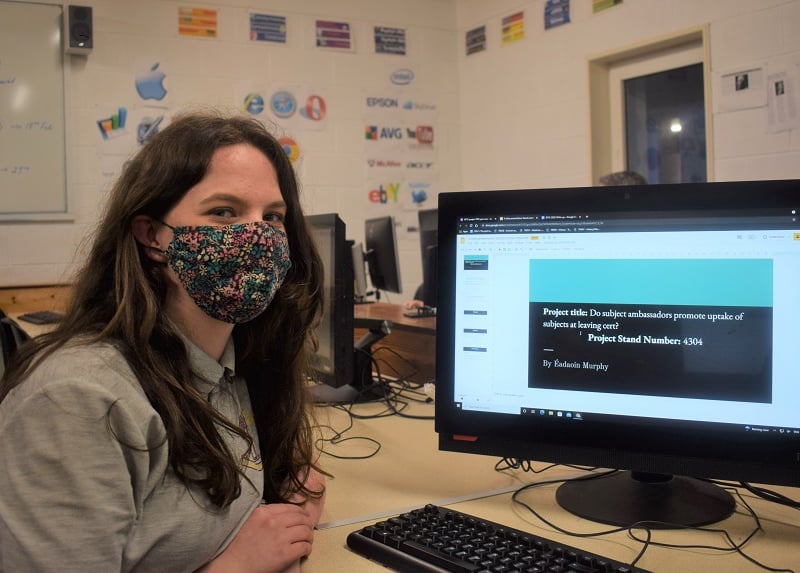
STUDENT: Eadaoin Murphy CATEGORY: Senior Social and Behavioural Biological and Ecological PROJECT TITLE: Do subject ambassadors promote uptake of subjects at Leaving Cert? APPROACH: After I came up with the idea of investigating if subject ambassadors influenced student subject choice, I found a Masters Thesis by by Sinéad O’Sullivan from the University of Limerick which investigated the factors that Influence Students in their Choice of Music as a Senior Cycle Subject in Post Primary Education. In her findings she quoted parental influence as one of the main factors in deciding Leaving Cert subjects. I have also discovered that students that study STEM (Science, Technology, Engineering and Maths) subjects are more likely to have some Science capital where they would know someone in a STEM related career and I think it would be interesting to see if science capital also influences subject choice in my secondary level .I intend on surveying all Third, TY, Fifth and Sixth year students to gain an insight into the factors that will influence or have influenced their subject choices. In total I will sample 600 students consisting of 300 students who have already made their subject choices and 300 students who have yet to make their subject choice so I will use targeted sampling of all 3rd to 6th year students in my school. This way I will generate a lot of data from a large same size which should reduce bias. Then I will carry out my statistical analysis to see if there is significance in my findings.
4.
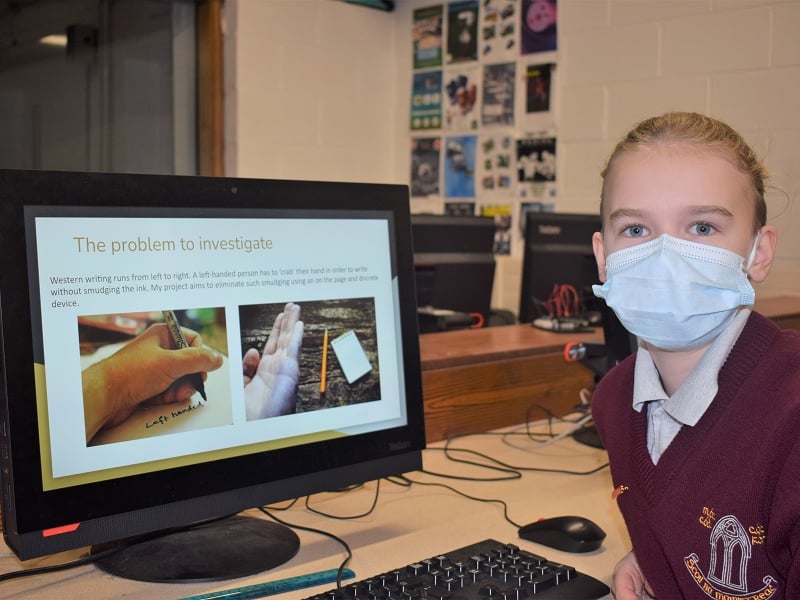
STUDENT: Michael Masterson CATEGORY: Junior Technology PROJECT TITLE: Ciotach clean APPROACH: As a leftie I have always struggled to keep my hand clean as I write and through primary school I have used several different types of hand guard to prevent smudging on my hand and on my written work. Currently all commercially available left hand smudge guards are designed to fit on the student's hand which is non-discrete and can be uncomfortable for the student to wear all day. Also, they still cause smudging because they are usually made of a rubber or silicone material. I want to develop an on-page smudge protector that would not interfere with the student as they write from left to right across the page. This on-page smudge guard would allow for more discrete use and because of the smooth finish would eliminate the smudging that still occurs with currently available products. To help me to design and develop my prototype, I have contacted Michael McHugh of Moll Industries Ireland to investigate the materials that I could access through them, to make my device from. I have also asked them for their assistance in using computer aided design to draw out plans for my prototype and they have shown me how to use SCI Solid Works. I aim to create a cardboard model of my design and when I am happy that I have a cardboard prototype that passes focus group testing, I will then make it in plastic and test it again for durability and its anti-smudge effectiveness.