

IT OCCURS TO ME: The Michael Fish effect
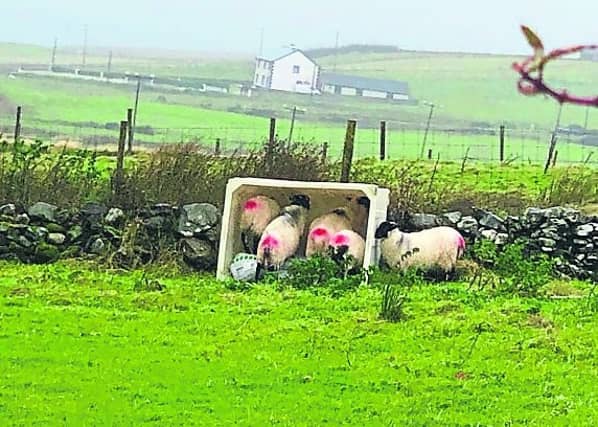

Frank Galligan on how we prepared ourselves for Storm Lorenzo
Are you one bit surprised? In the aftermath of Storm Lorenzo, you couldn’t move for Dublin media types in Donegal town.
The previous night, I watched correspondents on TV in Clare, Galway, Mayo...even Howth. The north-west hardly got a mention.
According to the Irish Times: ‘No major reported incidents’ as a result of Storm Lorenzo. There was “very little damage” done to property as a result of Storm Lorenzo, the Government’s National Emergency Co-operation Group (NECG) stated.
In the same Irish Times, we read: ‘It’s total devastation’, says Donegal woman as home flooded by Storm Lorenzo.
Eoghan Murphy, Minister for Slate Roofs and Monsoons, and his friends in the Government’s National Emergency Co-operation Group (NECG) put away their wellies.
Incredibly, Caroline O’Doherty wrote in the Indo: “Sure, there are householders in Donegal left cleaning up after flood waters poured into their homes.
“Yes, thousands woke up to darkness and a cold breakfast when damaged power lines cut off their electricity. But where was the real drama?”
We’ve been here before. When six inches of snow falls, as long as it doesn’t adversely affect the Big Smoke, sure it doesn’t matter a damn about the wee forgotten corner.
“Earlier on today apparently a woman rang the BBC and said she had heard a hurricane was on the way.”
So began the most infamous weather bulletin in British history on the lunchtime news in 1987. “Well I can assure people watching,” smirked weather forecaster Michael Fish, “don’t worry, there isn’t.”
Just a few hours following that fateful broadcast in the early hours of October 16, 1987, the south coast of England was battered by the greatest storm witnessed in nearly three centuries. Gales reaching 115mph caused utter devastation across the southern half of the country, leaving 18 people dead, 15 million trees flattened, and a repair bill totalling £2bn.
Fish later reflected: “When I saw what happened, I thought, 'oh s***!”
It was his colleague Bill Giles, Fish pointed out, who was on duty the evening before the storm struck and also failed to properly forecast the storm.
“His forecast said it would be a little bit breezy up the Channel which is something of an underestimate but for some reason the press never latched on to that,” he said. The real villain of the piece was the Met Office computer (and the senior forecaster who interprets the data).
“In a way it was a bit unfair and unfortunate,” he said. “You shouldn’t really target the messenger.
“The thing that should have been criticised was the computer at Met Office HQ. It was that which got the forecast wrong and Bill Giles and I were just purely the mouthpieces. We had no input whatsoever into the computer or anyway of arguing with it. We just had to say what it said.”
The storm prompted the launch of a public inquiry, as well as an internal Met Office investigation into why forecasters (both human and artificial) missed it so badly.
In reaction to the controversy, the term ‘the Michael Fish effect’ has been coined, whereby British weathermen are now inclined to predict “a worst-case scenario in order to avoid being caught out”.
Is that what happened in Dublin last week? Did they succumb to the Micheál an t-Iasc syndrome? And did the banks of Loch Iasc (Lough Eske) overflow in sympathy?
Answers on a wet postcard please to Evelyn Cusack, Met Office, Glasnevin Cemetery, Dublin 9.
THE LAND OF THE RISING BALL
I heard an awful lot of patronising balls from some rugby types after the defeat by Japan.
Let us remind ourselves of the pecking order. The origin of rugby football is reputed to be an incident during a game of English school football at Rugby School in 1823, when William Webb Ellis is said to have picked up the ball and run with it.
The English Rugby Football Union was formed in 1871 and the Ireland national rugby union team began in 1875, when Ireland played its first international match, a 0–7 loss against England.
The Rugby World Cup trophy is named after Webb Ellis. The generally held belief was that rugby had been introduced to Japan in 1899 by two Cambridge graduates, Edward Bramwell Clarke and Ginnosuke Tanaka but historian Mike Galbraith has found evidence that it had actually been played much earlier.
An article dated 26 January, 1866 speaks of a “football” club, as rugby was known then, founded in the port of Yokohama.
That was five years before England’s Rugby Football Union was founded and earlier than any known club in Wales came into existence.
Ten years ago, Galbraith helped organise a tour of Japan for a British rugby team. A history graduate, he offered to contribute an article on the origins of Japanese rugby to the tour programme.
Thrilled to have achieved the historian’s ultimate goal - finding a new source of evidence - Galbraith took his discovery of the Yokohama Football Club (YFBC) to the Japan Rugby Football Union (JRFU).
But, he says, “they weren’t interested” and “insisted that Japanese rugby started in 1899”.
And so he set out to change their mind. He continued to gather evidence, piecing together the story behind the creation of the first Japanese club and concludes that 1866 may be the date that Japan’s first rugby club was formed, but it seems the sport was actually being played in 1863.
In an 1873 article Galbraith uncovered in The Japan Weekly Mail it stated that someone “caught the ball, made a good run through his opponents and, with a fine drop kick, scored a goal”.
Rugby was introduced to Samoa in 1920 by the Marist brothers. It was also a Marist, Brother Walfrid, who co-founded Glasgow Celtic in November 1887. Let’s hope the Irish connection doesn’t come back to haunt us on Saturday!
THE BREXIT BLAME GAME
A week ago, the Tory papers and tabloids took a leaf out of Boris’s book and began to blame Leo ahead of a No-Deal Brexit.
The lead story in the Telegraph attempted to put pressure on the Taoiseach stating: “It means Leo Varadkar, the Taoiseach, is now the main obstacle in the way of Britain leaving the EU with a deal on Oct 31.”
Bullshit, of course and to add fuel to the fire, Arlene Foster accused the Irish Government of ‘riding roughshod over unionism’. God spare us, she has a neck like a Lough Erne swan!
Not to be outdone, Nigel Dodds accused Leo of “intransigence” over the UK’s Brexit proposals and claimed he could go down in history as the Taoiseach who restored a harder border in Ireland. That is rich indeed, coming from a party whose favourite words are ‘No!’, ‘No Surrender!’ and ‘Never, Never!’
If it suits him, Boris will hang them out to dry on a sagging frontier clothes line between Roslea and Clones, hanging beside their soggy sashes.