

The slow-fading of Ireland's kitchen door calendar tradition


Eamonn Coyle, who has released a calendar for 2026 to showcase the country’s photographic beauty and to help promote the Irish language, admits the landscape is changing
Growing up in the Gaoth Dobhair Gaeltacht in the 1970's and 1980's I lived within a pattern of well-established customs and rituals that shaped the year.
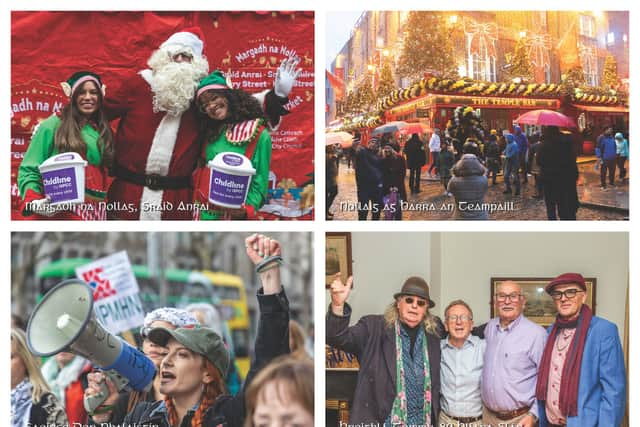
The calendars were produced with two objectives in mind, to showcase the country’s photographic beauty and to help promote the Irish language. Sadly, many of the traditions and rituals that defined those earlier ages have now faded to the margins.
The first calendar focused on the Donegal islands of Tory, Gola and Inis Oirthear. As my initial production it attracted strong local and national interest. I kept the work centred on Donegal, learning from the process and observing the reaction. The calendar included age old Irish proverbs and sayings along with historical dates and quotations.
It's success encouraged me to continue and Féilire 2021 followed soon after. This time I expanded outward. I developed an online sales platform, widened my advertising and promotion strategies through social media and several local newspapers reported on the project. Traditional Gaelic gift shops including Siopa Leabhar, Siopa Gaeilge and An Cheathru Poili accepted bulk copies. Orders also arrived from Australia, Canada, America, Brazil, Japan and all parts of Europe which demonstrated a global appetite for images of Ireland and Gaelic language products from home.
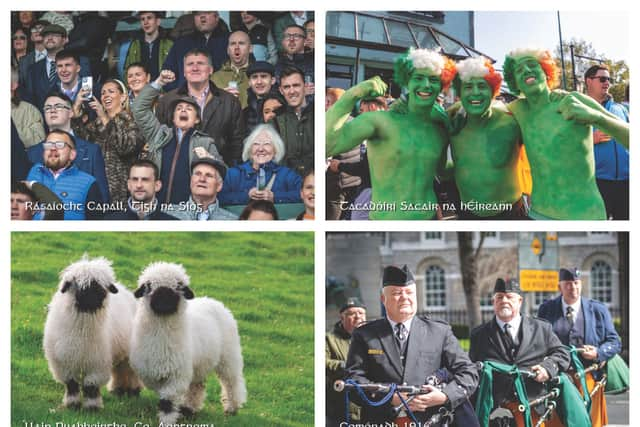
By 2023 the Irish language calendar had become well established. Cultural shops across the country stocked it, Siopa Leabhar at Conradh na Gaeilge, Siopa Gaeilge in Gleann Cholm Cille, An Cheathru Poili in Belfast and Siopa An Carn in Derry all sold substantial quantities.
My own website attracted sales from the four corners of the globe. I became known as Fear na Feilire. A weekly Irish language class in California organised by Sue Murphy even began using the calendar's historical text and proverbs as the basis of their lessons. It seemed to have become a consistent and reliable annual production that connected communities, the diaspora, language and culture.
The Decline of a Tradition and The Rise of the Digital Age
From 2024 onward a noticeable shift appeared. Sales declined despite sustained marketing, extensive promotion and much enhanced product quality. The long-standing ancient custom of buying and hanging physical calendars was disappearing. Homes that once relied on the simple act of turning a page were now turning to screens, automated reminders and digital planners.
Language, Identity and the Limits of Revival
My interest in producing the calendar was driven not only by tradition but also by a commitment to the Irish language. Despite major efforts at national and community level the language is sadly spoken daily by only about 1.5 percent of the population.
The dominance of the new digital culture is one factor in the decline of hard copy Irish language calendars, the reduced spoken use of the language is another.
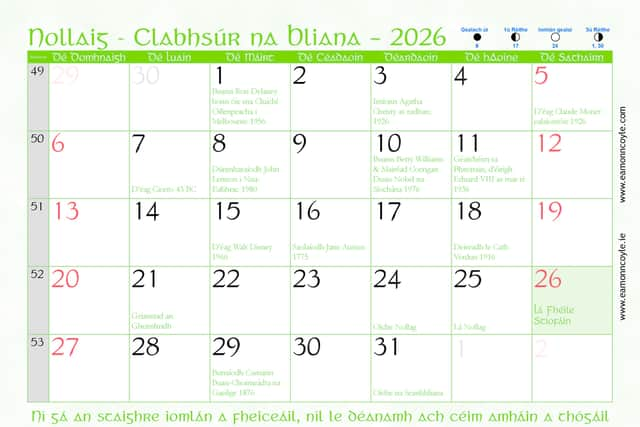
Féilire 2026 is now on the market and achieving steady sales. It is by far my best production and I hope that people will see it as a collector’s item because it will be the last. The work demands a full year, photographs captured between February and June, production completed between June and August, and advertising, promotion and sales occupying the remaining months.
Although I carried out most of the work, I did not do it alone. My sincere gratitude goes to Colm O Baoill, Reamonn O Ciarain, Daniel O Donnell, Maire Dinny Wren, Maire Una Ni Bheaghlaigh, Gearoid O Broin, an t Athair Brian O Fearraigh, the Donegal Democrat and Tommy Curran. Additionally, and since the calendar was never a profit making venture it could not have been produced without the support of Gael Linn, Oideas Gael and Siopa Gaeilge whose sponsorships made the work possible.
Go raibh mile maith agaibh uilig.