Search


18 Apr 2026
Search
18 Apr 2026

Please allow ads as they help fund our trusted local news content.
Kindly add us to your ad blocker whitelist.
If you want further access to Ireland's best local journalism, consider contributing and/or subscribing to our free daily Newsletter .
Support our mission and join our community now.
To continue reading this article, you can subscribe for as little as €0.50 per week which will also give you access to all of our premium content and archived articles!
Alternatively, you can pay €0.50 per article, capped at €1 per day.
Thank you for supporting Ireland's best local journalism!

Kilcar's first textile factory in the 1920s

Findings from the 1926 Census, which was released today, show that Donegal had a population of 152,508 a century ago.
That marked a significant decrease of 9.5% from the 1911 census, which recorded 168,537. In fact, Donegal’s all-time population in record was 296,448 in 1841.
The first numbers on record show Donegal had 248,270 in 1821, then 289,149 in 1831, the aforementioned high of 296,448 in 1841, before a steady decline, with 255,258 in 1851; 237,395 in 1961; 218,334 in 1871; 206,035 in 1881; 185,635 in 1891; 173,722 in 1901 and 168,537 in 1911.
The 1926 Irish Census was the first census taken in the newly established Irish Free State, and was conducted on the night of Sunday, 18 April 1926, making it a landmark record of a nation emerging from years of war and revolution. Under the "100-year rule," these personal records were legally protected until now.
There was no Irish census in 1921 primarily due to the severe political instability and violence of the Irish War of Independence from 1919 to 1921.
The 2022 Census, the most recent on record, stated Donegal has a population of 167,084 - 84,289 females and 82,795 males.
From Donegal’s 152,508 in 1926, the male population in 1926 was 78,100, with the female population being 74,408.
Nationally. 1926 Irish census recorded a population of 2,971,992, a decrease of 5.3% from the 1911 census. The 1926 census data is currently controlled by the Central Statistics Office (CSO) and has been transferred to the National Archives.
Only two districts in Donegal in 1926 saw population increases from 15 years beforehand.
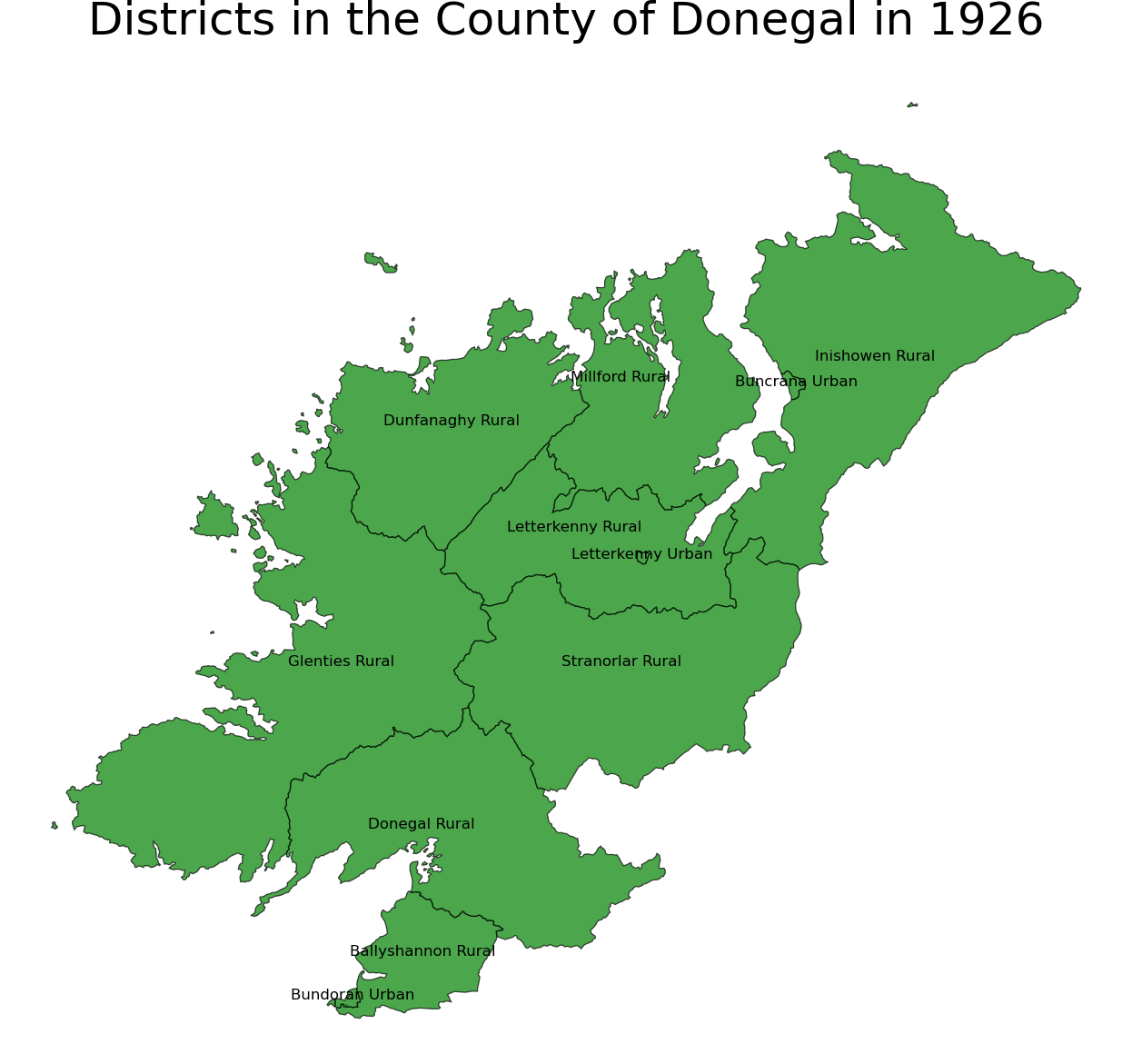
The Buncrana Urban District in 1926 had a population of 2,309, which was up 23.2% from 1911’s 1,897 and Letterkenny Urban was 2,308, up 5.2% from 2011’s 2,194.
Ballyshannon Rural in 2026 was 7,509, down 3.4% from 7,772 in 2011; Stranorlar Rural down 6.6% to 21,947 from 23,503; Dunfanaghy Rural down 7.9% from 15,471 to 14,252; Glenties Rural decreased by 8.3% from 32,800 to 30,081; Inishowen Rural went down 9.7% to 30,545 from 22,837; Letterkenny Rural decreased by 11.8% from 9,961 to 8,782; Milford Rural was snapshotted at 16,684, which was 12.9% less than its 19,393 in 2011; Donegal Rural’s fall in numbers was from 19,616 to 16,552, a 15.6& drop and Bundoran Uban, which was 2,116 in 2011 was 1,339 in 2026, 36.7% less.
In 1926, the total number of houses in Donegal was 35,600, a change of -4.92% since 1911. For context, there were 37444 houses in 1911. In 1926, 89.92% of houses were inhabited. The majority of those houses were in Inish Rural, 7,088, with 6,895 in Glenties Rural and 5,087 in Stranorlar Rural.
Bundoran Urban was the lowest in terms of houses, with 377, followed by Buncrana Urban with 441 and Letterkenny Urban with 474.
In terms of religion, in 1926 Donegal was 81.9% Catholic, with 124,941; some 13,774 were Protestant Episcopalians, 9%; Presbyterians made up 8% with 12,162; Methodists were 0.8% on 1,202 and the remaining 429, which is 0.3% were others.
-1776508918992.jpg)
Steam drifters at the Killybegs Town pier in the 1920s. Photo: Eugene McHugh
In 1926, at county level, a breakdown was provided on the location of birth for each resident in Donegal. While typically grouped by county, the statistics are also grouped by province, or by country if beyond the Irish Free State. Some 139,853 of Donegal’s population (91.7%) was born in the county. Taking a sprinkling, 2,282 were born in Scotland and 747 in the United States.
In terms of occupation, 48,898 people (32.1%) from the 1926 population of 152,508 were involved in agriculture, with 6,660 (4.3%) in trades or manufacturing and 47,571 (31.2%) termed as unoccupied, with 35,889 under the age of 12, making 23.5%.
Another important insight from 1926 is the statistics concerning the industries in which the population of Donegal were working at the time. This is separate from occupation; similar occupations can occur in different industries.
Specifically for Donegal, the top industries that the entire population were employed in were Agriculture at 71.59%, Personal Service at 6.59%, and Public Administration and Defence at 4.62%.
The 1926 census grouped speakers into 'Irish only', 'Irish and English', and 'Non-Irish speakers'. In Donegal, 52,408 people spoke Irish, which was 34.4% of the population.
The entire county covered 1,193,573 acres and had a total valuation of 322,013 pounds. Moreover, Donegal had a valuation per person of 2.11, while the valuation per acre was 0.27 pounds.
-1776508951351.jpg)
Strikers at St Conal's Hospital in Letterkenny in 1924
Director of the National Archives, Orlaith McBride, from Ballybofey, said: “As we open these census records to the public, we honour those who came before us, their resilience, their ambition, and their contribution to the Ireland we know today.
“But perhaps most importantly, today reminds us that the history of Ireland is not only found in great events or political milestones — it is found in the lived experiences of its people. Every entry in this census represents an individual life, a family unit, a shared human story that together forms the fabric of our nation.”

Subscribe or register today to discover more from DonegalLive.ie
Buy the e-paper of the Donegal Democrat, Donegal People's Press, Donegal Post and Inish Times here for instant access to Donegal's premier news titles.
Keep up with the latest news from Donegal with our daily newsletter featuring the most important stories of the day delivered to your inbox every evening at 5pm.

This publication supports the work of the Press Council of Ireland and Office of the Press Ombudsman, and our staff operate within the Code of Practice of the Press Council. You can obtain a copy of the Code, or contact the Council, at www.presscouncil.ie, Lo-call 1800 208 080 or email: info@presscouncil.ie.