

Nature-based solutions recommended to prevent Donegal flooding

Opportunities for nature-based flood alleviation in Donegal
An organisation dedicated to the the conservation and protection of the peninsula's rivers, lakes and coastal areas has highlighted “opportunities for nature-based flood alleviation measures.”
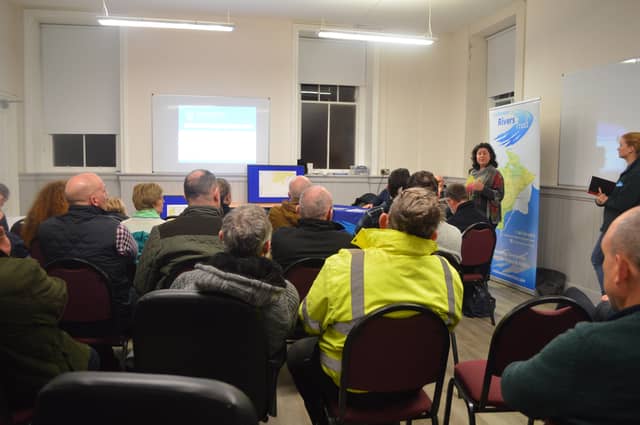
Inishowen Rivers' Trust (IRT), publicised its research into Natural Water Retention Measures (NWRM) at a community event in Carndonagh's Colgan Hall on February 14.
IRT aims to advance the understanding of rivers and river catchments through such free training events, support and advice.
According to IRT director, Dr Trish Murphy, the Colgan Hall event was attended by a “diverse range of interested parties from across the peninsula.”
Dr Murphy added: “The study, produced by the IRT in collaboration with Trinity College Dublin and funded by the OPW, was launched by OPW representative Conor Galvin. Mr Galvin commended the Trust and the community on bringing this research forward.
“The report, entitled ‘The Opportunities for Natural Water Retention Measures in Inishowen’, recommended nature-based solutions, which would be suitable to implement in Inishowen. These include: offline ponds, bunds and leaky dams.
“The main author of the report, Professor Mary Bourke, described the types of measures and how they worked. Her colleague, Dr Paul Quinn, from the University of Newcastle, elaborated on his experience of implementing measures in Britain.
“Such measures have been shown to reduce flooding in smaller catchments such as Belford in north east England,” said Dr Murphy.
Professor Bourke said: “Our climate has already changed. Floods will happen and doing nothing is not an option. The solutions we are suggesting in our report are simple, sustainable and proven elsewhere.”
Dr Quinn added: “These solutions essentially ‘slow the flow’ and increase the length of time it takes the water to travel through the system, thus reducing the impact of the flood downstream.”
Speaking to Inish Times, Dr Murphy said the community had then engaged in a wide-ranging discussion sharing stories on the fear of living with floods; issues with obtaining insurance; a lack of engagement with the agencies; farmer and landowner engagement, and the possible opportunities that flood management can bring. She added: “Under the OPW and Donegal County Council, flood relief schemes will be progressing in parts of Inishowen.
“These will take a number of years to install and although both soft and hard engineering approaches can complement each other, there are additional benefits to NWRM.
“These include cost effectiveness, quick installation, water quality regulation and water provisioning, biodiversity protection, recreation, air quality and climate regulation.
“What happens next is up to the community. We could start this summer. If the community approves the idea, the IRT can apply for funding to implement solutions. As a first step, there would be detailed consultation with individual landowners,” said Dr Murphy.
Rosemary McCloskey, another director of IRT spoke about her experience in the Frome catchment in Stroud, which has a long history of flooding.
Ms McCloskey said: “We work with landowners to find the best solutions for everyone.
“They understand their property and we provide the latest science and techniques. It’s a learning process but one that is paying off for the community there.”
Concluding the evening, Dr Quinn stressed solutions were “small and need to be upstream in the headwaters of the catchment, not where the flooding occurs.”
One member of the audience noted: “Prevention is better than cure.”
Dr Murphy thanked everyone who attended the event and the panel of experts for sharing their knowledge and expertise.
Anyone who wants to learn more about this research by the IRT and register your interest in being involved, contact: 087 647 8183 or email: [email protected].