

The Great Marriage Book of Inishowen
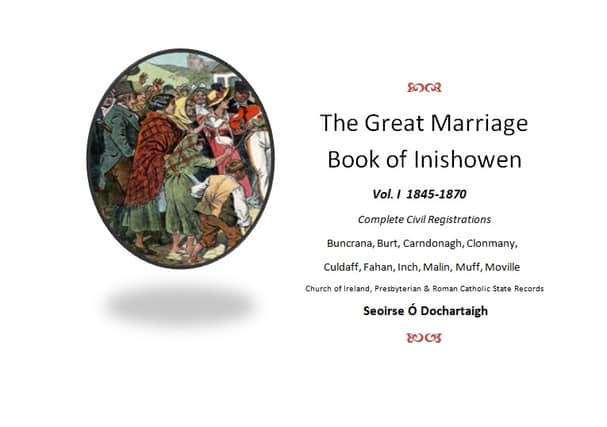

'Romantic love was the luxury of the landless' says Seoirse Ó Dochartaigh
Seoirse Ó Dochartaigh's latest publication 'The Great Marriage Book of Inishowen' is a thing of beauty and insight, belying the exhaustive research undertaken by its author.
And, the fascinating story behind 'The Great Marriage Book of Inishowen' is equally enthralling.
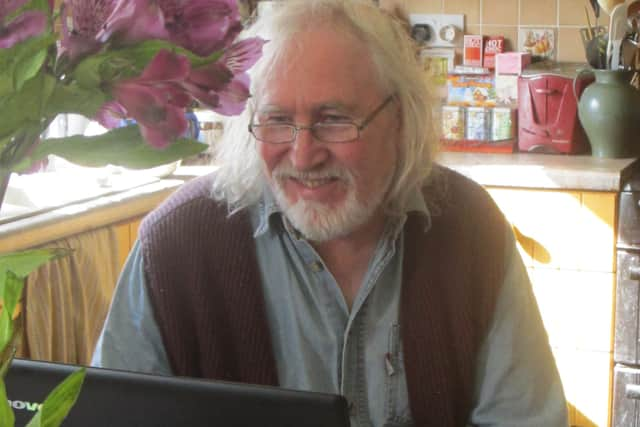
Seoirse the Scholar (Courtesy of Kathleen Daily)
Speaking to Donegal Live, Seoirse revealed he had honed his genealogical research skills while working for the Ó Dochartaigh Clann in Buncrana, under the auspices of Pat Doherty who was from the States and is sadly deceased.
Seoirse recalled: “I worked for Pat as an independent researcher. I was a teacher at Abbey Vocational School in Donegal Town, formerly, and I retired early to do some research work and painting. My folks are from Inishowen, that is why I am living here now. I came back home.
“Because I was working in the field and finding out family details for people, I was building up a database of my own. I began researching place-names. I could not figure out where half the places where because they were not even shown on maps.
“So, I started to combine several databases. On one was the place-names, which I turned into a book in the end, and the other was the marriages. I noticed a lot of gaps when the marriage information was being filled out.
“Luckily, I was also able to avail of the records held by The Church of Jesus Christ of Latter-day Saints (Mormons) in Derry. The Church had records, which it was given by the Irish State. The Irish State allowed the Church to photograph the records, back in the 1950s.
“You see, the The Church of Jesus Christ of Latter-day Saints has a belief that you can you can name and bless the dead. It is part of its religion, that naming the dead it to have their souls. That was the Church's mission. It went all over the world collecting such records.”
According to Seoirse, the Church of Jesus Christ of Latter-day Saints had approached the Irish Government and asked if it could photograph the civil registration records.
Civil registration records is the information which the Churches provided to the State. The State requires more information than the Church records.
Seoirse described Church records as “quite scant in some cases”. However, civil registration records are “fully detailed”.
He said: “The Irish Government allowed The Church of Jesus Christ of Latter-day Saints to keep recording and it got births as well and deaths.
“At some point, some religious figures objected to the practise and the Irish Government came under pressure and stopped it. However, The Church of Jesus Christ of Latter-day Saints had recorded recorded everything from 1845 right through to 1871. Those were the records which were made available to me, the ones I copied.
“Photocopiers which were very rare in the 1950s, even in the States but they were shipped over to Ireland by the Church, which then photocopied and filmed all of the registers that the Irish Government had given them.
“I was allowed access these, over a long period of time and when I got it all complete, I said, 'What am I going to do with all of this information?'
“It is really a valuable social history. What I had was people who were long forgotten.
“I have had brilliant brilliant feedback about 'The Great Marriage Book of Inishowen'. It is selling well, although, I would not be able to retire or anything like that.”
Turning his thoughts to his next project, Seoirse said he was contemplating Volume Two of 'The Great Marriage Book of Inishowen'.
He added: “The first volume of ' The Great Marriage Book of Inishowen' covered the years 1845 to 1870. I would like to continue from 1871 to 1901. 1901 is the year the census information appears.
“I thought it would be a good idea to get all of the marriage records up 1901 and then to complete the picture of Inishowen.
“What is generally understood is that members of the Church of Ireland and Presbyterians all spoke Irish up to a certain point in history.
“Outside Carndonagh, there is a Presbyterian Church, Hill Head and during the 1700s it advertised for a Minister who could speak and read and write in Irish, not Scots Gaelic but Irish. It would seem that the congregation could not speak English.
“They came to Inishowen from Scotland in 1600s and the spoke Gaelic, which is very close to Irish. And after a while, they became more familiar with the Irish language off Inishowen and kept it going for years and years and years.
“And, I think no-one has written down this history. Those marriages were full of people who were speaking Irish. On one record I found a very interesting thing.
“It was a Presbyterian marriage record and in the margin, there was a discussion about a certain place-name. It was written in English, between the Minister and some other minister but the way they were describing it, it was clear the discussion had taken place in Irish.
“This is the type of history we didn't get in school. Inishowen people were marrying wholesale into the Presbyterians and that is an important part of our culture.”
“If you could have been a fly on the wall listening to those weddings,” said Seoirse, “you would have heard a lot of Irish spoken. We were let down badly in terms of culture. When the National Schools were set up, we were told, 'No more Irish from now on.'”
'The Great Marriage Book of Inishowen' contains a brief history of 19th Century Irish weddings.
It was superbly printed by Gráinne and Colm Gillen of Foyle Press, Carndonagh.
Rightly proud of the striking tome, Seoirse said it also contained 215 pages worth of marriage details for the entire Inishowen peninsula, during the Great Famine and after.
He said: “I have also relayed how marriages were celebrated then: the horse-ride from the church to the home; the good luck charms; the drinking of mead; the scattering of coins; the dowry; the 'walking the land' of the future bridegroom; the Brehon Laws of the 7th and 8th Centuries; the changing of the bride's name; and the clothing.
“I would also like to acknowledge the tremendous help which I received from Keith Wright of the Foyle Family History Centre in Derry, who allowed me, over a period of many years, these registrations from film strips.”
'The Great Marriage Book of Inishowen' is available in the following outlets: Mac’s Books (Buncrana), SuperValu (Carndonagh), Gillen’s, (Moville), Centra (Muff); and Callaghan's Centra (Burt). For more information, contact: www.seoirse.com.