

‘The people around Luk did everything humanly possible to help him’, inquest hears

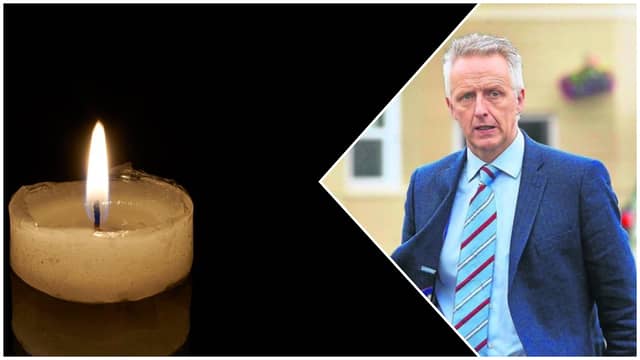

The inquest into the death of an experienced Belgian diver at a shipwreck site off the Donegal coast found that he died by drowning, with a likely secondary cause of immersion pulmonary oedema
An inquest into the death of Belgian diver Luk Heyvaert off the coast of Donegal heard that those around him did everything humanly possible to try and save him.
The inquest in Letterkenny Courthouse on Thursday, April 16 returned a finding of death by natural causes as a result of drowning. There was some discussion between coroner Dr Denis McCauley and expert witness Dave Gration as to whether to attribute a secondary cause of immersion pulmonary oedema. This is a condition which may affect divers and sea swimmers, whereby fluid from within the body accumulates in the lungs without the patient having inhaled water.
Mr Gration expressed reluctance about labelling the outcome when there was no way of knowing for sure that this was what happened. However, he acknowledged that on the balance of probability, it was a likely factor, and Dr McCauley included it in the inquest finding.
A qualified and experienced diver, Mr Heyvaert, 52, of Beochout, Belgium was on a diving holiday in Donegal as part of a group of nine fellow divers and two women who travelled with the party. Members of the diving party participated in the inquest via videolink, having previously written depositions which were read into evidence by Sergeant Mark Colgan.
In July 2024, they travelled together from Belgium in three vans and a jeep, bringing all their own equipment. The party stayed at Bradley’s B&B in Downings, having booked seven dives - one per day - with Mevagh Diving Centre.
On Friday evening, July 19, 2024, they arrived in Downings, checked through all their equipment and discussed the planned dives to various shipwrecks off the Donegal coast.
Their first dive was on Saturday, to the HMS Audacious. This went well, as did the next day’s dive to the wreck of the SS Empire Heritage.
It was on Monday, July 22, the third dive of the trip, that tragedy struck.
A deposition by Dean McCullough of Mevagh Diving Centre Ltd was read into the inquest.
He operates a charter vessel for divers. Mr McCullough said the group of Belgian divers had been out with him the previous year and he knew them to be competent divers.
The party departed Mevagh Boat Yard at around 7.30am.
“It took about three hours to get to the dive site, the wreck of the HMS Viknor,” he said.
Members of the Belgian diving party gave evidence that they and Mr Heyvaert had drunk a lot of water on the boat trip to help with decompression.
Mr McCullough’s deposition outlined that on arrival at the dive site, each diver checked their equipment and got ready for the dive. It was to be a three-hour dive. The wreck is at a depth of 83m, and allowing for decompression, the divers would spend around 30 minutes at the bottom.
He explained that each diver’s equipment includes a rebreather which guides the decompression stop times on the ascent.
The skipper’s first indication that something was wrong was when a yellow buoy came to the surface.
“That indicates that divers need gas,” he explained. “I dropped two cylinders. Another two or three buoys came up so we started putting in more bottles.”
He then noticed a diver at the three metre safety stop. He had a raised arm and appeared to be entangled.
“I knew we had an unconscious diver in the water,” said Mr McCullough. “I went down and untangled him. I got him to the surface and removed some of his equipment.”
Having got the diver onto the boat, the skipper began CPR and gave oxygen to try and get water off his lungs, but there were no signs of life.
Malin Head Coast Guard Station was contacted and a helicopter was subsequently dispatched. CPR continued under guidance from the emergency operators.
The helicopter arrived and took Mr Heyvaert on board.
The inquest heard from the divers that they were divided into groups of three. Two divers who were with Mr Heyvaert gave evidence in their depositions that all had been going well, and they enjoyed a nice, relaxed dive at the wreck. However, they had become concerned about Mr Heyvaert as they prepared to return to the surface, despite the information devices on their wrists not indicating any problems with gas composition in the rebreathing equipment.
They described Mr Heyvaert as appearing nervous and agitated, and that he took someone else’s light off the shotline before commencing his ascent.
He did not stop at the 10m mark, and was pressing his wrist computer in panic. He did not respond to the signalled question from his fellow divers asking if he was ok.
At the 27m mark, one of the divers went to Mr Heyvaert and offered back-up gas, which he refused.
“I saw fear in his eyes,” said the diver. “He looked panicked to me.”
Another group of three divers was a little higher up, approximately 24m from the surface. Having observed the interaction and given that they were more experienced, they descended and took over the efforts to get Mr Heyvaert to the surface, allowing his diving partners to safely continue their decompression.
Mr Heyvaert was described at this stage as ‘frantic’ and grey in pallor, and was refusing further attempts to give him back-up gas.
A second diver said: “At the 12m stop, Luk let go of his mouthpiece. I noticed a mouthpiece was shoved into his mouth.
“At some point he stopped breathing. I knew this because there were no bubbles.”
The divers used what they described as ‘lifting gas’ to get Mr Heyvaert to the surface, having attached him to the shotline which the divers used as a guide for descending and ascending.
“We had to do this, otherwise he would have sunk and been lost and we did not want that to happen,” said his diving partner.
Dr McCauley asked the witnesses if Mr Heyvaert had been coughing. He had not, they said.
When asked about his breathing, it was outlined that he had appeared initially to be making a conscious effort to get breath into his body.
A post mortem examination was carried out by pathologist Dr Gerard O’Dowd, and evidence was given to the inquest on his behalf. There were no signs of injuries, and toxicology investigations showed only painkillers which, it was later established, Mr Heyvaert was taking for back pain, and a decongestant which he took before diving.
The pathology report indicated that Mr Heyvaert had died from drowning but it was not clear from the post mortem examination if this was caused by water being inhaled, or by immersion pulmonary oedema.
Expert witness David Gration is a technical diving instructor, a diving safety officer, and an offshore medical technician.
He said that all the equipment had been working well. It had been suggested by Mr Heyvaert’s fellow divers that he may have been suffering from receiving too much CO2 through his equipment.
Mr Gration said that while there were elements of his behaviour that would indicate that to be a likelihood, the computer records from the equipment indicated that this was not the case.
“Everything that seems to be going on is physiological for Luk,” he said.
“I don’t think we are ever going to know what the problem was.
“We can safely say the rebreather was working
“We can safely say that the people around Luk did everything humanly possible to help him.”
Mr Heyvaert’s wife was present. She told the inquest that she was able to accept not being able to know exactly what had caused his death.
Dr McCauley said: “We have explored everything we can, and there comes a point that we have to say we don't know.”
The inquest heard that while coughing would usually be present with immersion pulmonary oedema, this was not the case in around 4% of cases. Furthermore, it was noted that drinking a lot of water in a short period before going into the sea can somewhat increase the risk for divers and swimmers.
“It is better to hydrate gradually over 24 or 48 hours,” advised Mr Gration.
The coroner returned a finding of death by natural causes, namely, drowning with a likely secondary cause of immersion pulmonary oedema.
He expressed his condolences to Mr Heyvaert’s wife and family, adding: “He seemed to love diving and did everything he could to keep it as safe as possible.”