

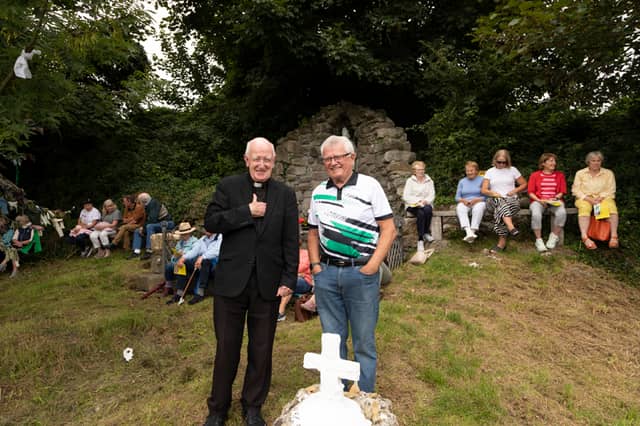

A pilgrimage to St Patrick’s Well was held in The Abbey, Ballyshannon.
Akin to his saintly namesake, Patrick, Paddy Donagher is a local saint of Ballyshannon history.
According to Tírechán, Bishop of Ardbraccan, in his 7th-century biography of St Patrick, the Collectanea, Patrick’s church-founding journey to spread the Christian faith in County Donegal first began between Bundoran and Ballyshannon on the ancient plain of Magh Ene.
Tírechán records that Patrick first“proceeded to Mag Aine (Ene) and founded a church there.” Patrick’s first Donegal church was known as Donach Mor of Magh Ene. This church was founded at an earlier pre-Christian Celtic site in Donaghmore, a quarterland of Higginstown, east of Rathmore and south of Carrickboy, near a Druid’s Altar (megalithic court tomb).
Tradition says that Patrick also blessed at least three holy wells in Magh Ene that were originally Celtic water-ritual sites: Tober Patrick at Ashbrook in Dunmuckrum, Tober Patrick by St Patrick’s Donagh Mor church in Higginstown and Tober Patrick by St Ninnidh’s Finner church in Bundoran. Up until the last century, pilgrimages were also made to these three holy wells dedicated to St Patrick.
Tírechán then records that after Patrick founded Donagh Mor, he travelled west where he cursed the River Duff on the Sligo-Leitrim border “because he asked and (the people) gave the holy man none of their fish; he blessed, however, the river Drowes, which now contains many large fish.”
Leaving the Bundrowes fishermen in Magheracar, Patrick travelled through the seaside village of Bundoran. As noted by the late Bundoran historian, another Patrick, Fr Paddy Gallagher, in his book Where Erne and Drowes meet the sea (1961): “After crossing the little Bradogue”, Patrick “stopped, as many a traveller since has stopped, on the crest of a hill on the Moy.” This crested hill was probably located at the great Celtic ring-fort of Rathmore, strategically overlooking Bundoran and Ballyshannon.
Fr Paddy said that “In the words of a frequent visitor to this district, the late Archbishop Healy, Patrick saw “spreading out before him that fair valley” of Ballyshannon: “Where the sunny waters at Assaroe / By Erna’s shore, and no one has ever seen it without admiring it.”
Tírechán records that Patrick “entered Mag Sereth across the river between Assaroe and the sea, and founded a church in Ráith Argi, and camped in Mag Sereth.” While Magh Sereth is the ancient name for the Gaelic plain around Ballyshannon in Kilbarron, the church in Ráth Airgi is likely the original early Christian church in Assaroe, prior to the founding of the Cistercian Assaroe Abbey in the 12th-century.
By Ráth Airgi, Patrick then founded Disert Patraic (Patrick’s Hermitage) and blessed Leac Patraic (Patrick’s Stone). Patrick’s hermitage appears to have been located around Catsby Cave, while Patrick’s Stone may correspond to the natural rock outcrop and raised stone structure at Cloghan, across the road from Danby House.
Like Magh Ene, tradition says that Patrick blessed two holy wells at two other pre-Christian Celtic sites: Toberpatrick (Patrick’s Well) in Abbey Island and Tobernaboghilla (The Well of the Crozier or Staff) at the pilgrimage site of St Patrick’s Well.
By possessing the visionary insight to found churches and bless holy wells at these pre-Christian Celtic sites, Patrick cultivated a faith-harmony between the old native Celtic spirituality, deeply rooted in the indigenous Irish landscape, and the new, growing Christian religion emerging from Europe.
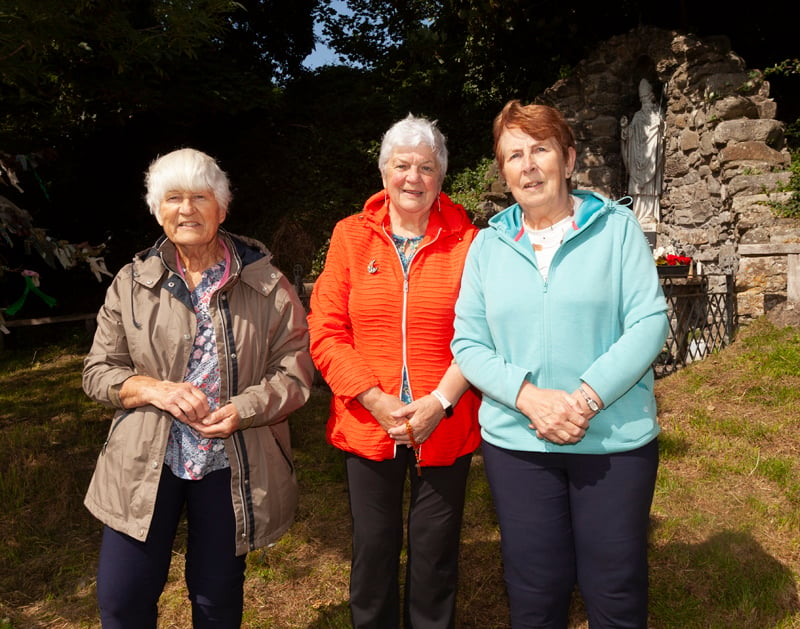
13. St Patrick's Well
Donegal Live
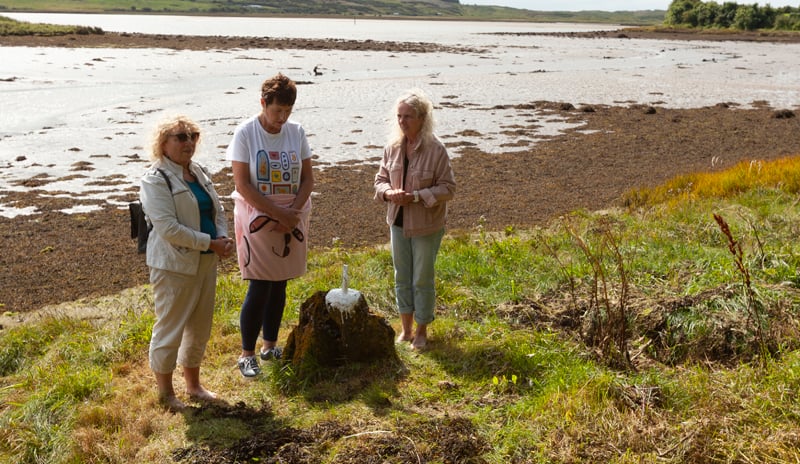
14. St Patrick's Well
Donegal Live