

Volunteers recall history on Slieve Liag

A wonderful community project underway
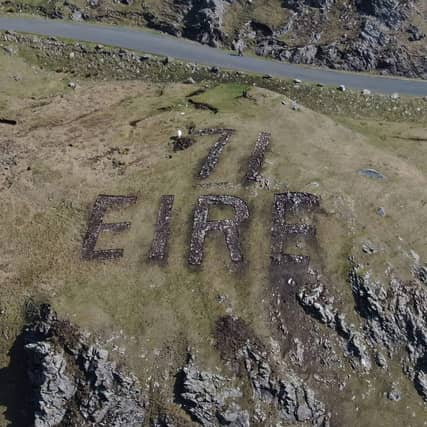
A group of nine industrious volunteers have decided to restore an Éire 71 marker on Carrigan Head near the iconic Slieve Liag.
The whitewashed Éire 71 marker is one of the many markers that were speckled along the Donegal coastline during the World War II period.
The signs worked as navigational aids for American pilots.
They also informed airborne pilots that they were flying over Ireland.
The Éire 71 sign near Slieve Liag, like many of the markers, was made of whitewashed stones.
In recent years, the stones had become overgrown by bush and growth and could no longer be seen from the sky.
A group of nine volunteers from Teelin and Carrick areas decided that they would restore the sign to its former state.
A week last Saturday, the group began to work on the project in south Donegal.
Local Independent councillor Niamh Kennedy said the project is one of community pride.
“I would be encouraging this,” she said.
“It gets the community out and working together. It is a project which shows great community pride.”
The local councillor said the local community group derived their inspiration from the work that was carried out on a similar such sign at St John’s Point in Dunkineely.
That project began back in 2016.
“There is another sign on the other side of Slieve Liag which says Eire '72,” Ms Kennedy said.
She said she thinks the group will also undertake to restore this sign to its former glory as well.
The ‘Eire’ signs were seen as a declaration of Irish independence, sovereignty and neutrality during the World War II period.
Beside each of the signs was a number.
The one at St John’s Point was 70, the next one along the coast at Carrigan Head is 71.
Each of the 83 lookout posts around the Irish coast had an identifying number that could be seen from the air by pilots.
The signs, and later the numbers, were added at the request of David Gray, the American Ambassador in Dublin.
Fourteen of these markers are located in Donegal.
Last Saturday, volunteers began their work by removing the sods from the huge rocks.
They used an old photograph as a guide as they undertook the restoration to the rocks which had been untouched for over seven decades.
It is hoped that the sign will become another tourist attraction in south Donegal.