

Five brake caliper warning signs you shouldn't ignore


If you notice one or more of these signs, it’s worth getting the caliper checked rather than waiting for the next scheduled service
If your car pulls to one side when you brake, or the pedal feels harder to push than it used to, a sticking brake caliper could be the reason. Catching it early is the difference between a quick fix and a much bigger bill.
A caliper’s job is simple: it clamps the brake pads against the disc every time you press the pedal, then lets go cleanly when you release it. When a caliper sticks, that release doesn’t happen properly.
The pad stays partly clamped against the disc even when you’re not braking at all, and that causes a chain of problems that get worse the longer they’re left, sometimes ending with the need to buy brake calipers rather than just clean and service the ones already on the car.
Below are the five signs that tend to show up first and what’s usually behind each one.
The car pulls to one side under braking
This is often the first thing drivers notice. If one caliper is sticking and the other is working normally, that side will brake harder than the other. The result is a car that veers left or right every time you touch the pedal, sometimes only slightly, sometimes enough to be alarming on a motorway.
It’s worth pulling over and checking sooner rather than later, since uneven braking affects how the car handles in an emergency stop.
A burning smell after driving, especially after motorway runs
A pad that's permanently dragging on the disc generates constant friction, not just when you brake. On longer drives, particularly motorway-speed ones, this builds up real heat. Many drivers first notice a sharp, acrid smell after pulling into a petrol station or parking up, sometimes with a faint haze coming from the wheel.
This is one of the more urgent signs, since sustained overheating can warp the disc or damage the caliper seals further, turning a simple fix into a more expensive one.
The pedal feels firmer or the car feels like it’s dragging
Some drivers describe it as the pedal needing more effort than usual. Others notice the car doesn’t coast the way it used to. Take your foot off the accelerator and the car slows down faster than expected, almost like a gentle, constant brake is being applied.
This is the dragging pad at work. It’s subtle at first, which is exactly why it tends to get missed for a few weeks before anyone looks closer.
Uneven wear on one wheel’s brake pad or disc
This one usually only gets spotted at a service, or if you look closely yourself. Pop the wheel off, or look through the spokes, and compare the pads side to side. A sticking caliper wears its pad down faster than the other side, and in worse cases the disc on that wheel picks up scoring or an uneven, discoloured surface from the constant heat.
If a mechanic mentions one side’s pads are noticeably thinner than the other, a sticking caliper is one of the first things worth ruling out.
A wheel that’s noticeably hotter than the others after a drive
After a normal drive, all four wheels should feel roughly similar to the touch (carefully, and only once you’re sure it’s safe to check). If one wheel hub or rim is distinctly hotter than the rest, that’s the dragging pad generating heat that has nowhere to go. It’s a simple check that takes seconds and can catch a sticking caliper before any of the other symptoms show up.
What’s actually causing the caliper to stick
Calipers stick for a handful of common reasons, and most come down to moisture, dirt or the wrong grease getting where it shouldn’t.
Floating calipers, the type fitted to most everyday cars, rely on guide pins sliding smoothly through rubber boots so the caliper can move freely against the disc. Over time, water and road grime work their way past worn or split boots and corrode the pins. Old brake fluid makes this worse, since it absorbs moisture from the air over the years and that moisture ends up inside the system, encouraging corrosion from the inside as well.
The wrong grease, or no grease at all, on the guide pins is another common cause. Ordinary grease can dry out, wash away or even damage the rubber boots, leaving the pin to bind in its sleeve rather than sliding freely.
Worn pads and discs play a part too. As friction material wears down, the piston has to extend further out of the caliper to keep contact with the disc, and a piston extended further than it should be is more prone to skewing and sticking in its housing.
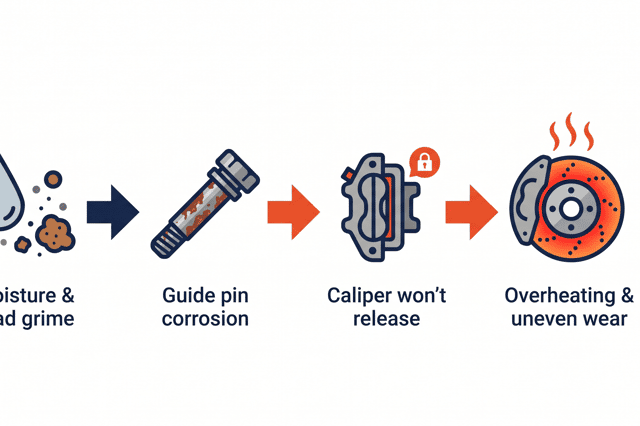
The chain reaction is straightforward once you see it laid out. Moisture and road grime work their way into the guide pin, the pin corrodes and stops sliding freely, the caliper can no longer release the pad cleanly, and the trapped friction builds up heat that wears the disc and pad unevenly.
It isn’t a rare fault either. Research carried out by recycling firm CarTakeBack, reported by the Irish Examiner, looked at NCT test centres around the country and found front suspension was the single biggest reason cars failed, accounting for almost 7% of all failures. Headlight beams came next at 6%, with brake lines or hoses close behind at 5%. Mechanical brake components and steering linkage also made the top five causes of NCT failure that year, which gives a sense of how often brake related issues, sticking calipers included, are quietly catching drivers out at test time rather than showing up as a dramatic breakdown on the road.
What to do if you spot these signs
If you notice one or more of these signs, it’s worth getting the caliper checked rather than waiting for the next scheduled service. A garage can usually tell fairly quickly whether a caliper is sticking by checking how freely the pads and pistons move once the wheel is off.
In many cases, a sticking caliper can be cleaned, regreased and put back into proper working order, especially if its caught early. Left too long though, the disc can become scored or warped from the heat, and the caliper itself may need replacing rather than repairing.
A few habits help avoid the problem altogether. Getting the brake fluid changed at the intervals your manufacturer recommends keeps moisture out of the system. Asking for the calipers to be checked and lubricated whenever the pads are replaced, roughly every couple of years for most drivers, catches early stage corrosion before it becomes a stuck pin. And a generally smooth driving style, avoiding constant hard braking, keeps the whole system running cooler and under less strain.
None of this requires specialist tools or knowledge to spot. A pull to one side, a burning smell, a firmer pedal, uneven pad wear or one hot wheel are all signs you can notice yourself, long before a warning light or an NCT failure forces the issue.
**Sponsored Content**