

An alternative view: Donegal can't scale Derry's walls - and now the climb steepens


Following a blistering run to the Ulster final, Derry were still outsiders against Donegal on Sunday and whilst their victory wasn’t a shock, it leaves Declan Bonner’s side in a precarious position looking into the All-Ireland qualifiers
So, one minute and 54 seconds into injury time at the end of 20 minutes of extra-time following 70 minutes of normal time, it had come down to this.
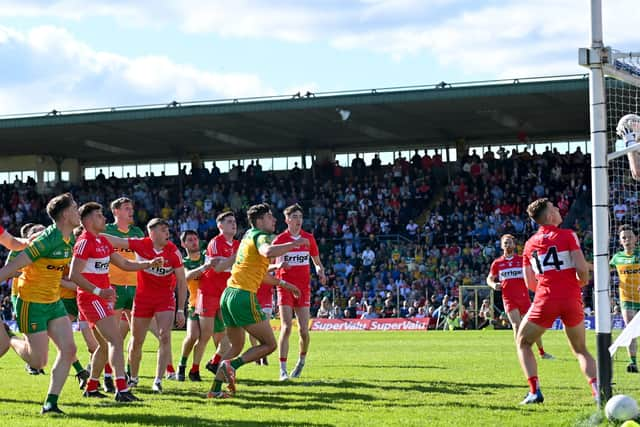
The award of a free-kick, having not seen it back, at the time seemed curious, with Ryan McHugh grappled a bit by Derry goalkeeper Odhran Lynch inside the square only for referee Sean Hurson to shake his head before Aaron Doherty was bumped in much lighter fashion outside by Conor Glass, to which Hurson nodded his head.
But cats, spilled milk and all that. It would’ve been an absolutely huge call and Donegal’s recent record from the spot isn’t great. Half of Derry was on the goalline.
While Pat Gallagher, the lead singer of Goats Don’t Shave, famously sang “If I could I'd build a wall around old Donegal,” in Derry, in a less said and more done type of fashion, they built a walled city.

For the Oak Leaf County, it’s a victory few can begrudge. They’re an energy and a synergy reminiscent of our own 10 or 11 years ago.
But how did it come down to this? Sixty-one minutes in, Donegal, through a move that involved McHugh, Michael Langan and Eoghan Ban Gallagher, had manufactured a fine Jason McGee score to edge into an advantage of 1-12 to 1-10 - the second time they’d forced a two-point lead, having come from five down at various stages in the first half.
For the next 12 and a half minutes - until the end of normal time - as Kieran Cunningham, a native of Glencolmcille and the chief sportswriter of the Irish Daily Star would later note on Twitter, Donegal didn’t have one shot at the posts.
This was an abnormal game in some ways; yet predictably normal in so many others. Gripping for some. Gruesome for others.
Anyone who is familiar with the goings-on of the Twitter world would’ve noticed that prior to Donegal’s quarter-final win over Armagh in April, Irish News journalist Cahair O’Kane had practically called it to perfection.
On Sunday afternoon, quarter of an hour before throw-in, he tweeted: “Think Donegal will probably dominate possession as usual but Derry will be confident in their defensive setup.
"Donegal will have been fed up listening to the hype about Derry and will come with a big start. Expect them to mirror Derry defensively. Tight and tactical, Derry by two.”
Derry 1-16 Donegal 1-14.
O’Kane had reached this opinion, not by looking into a crystal ball whilst domiciled in Bellaghy, but rather by studying Donegal’s form, which showed their accuracy from shooting in recent years hits the ceiling at 60 percent - it was 58 against Cavan, 53 in the meeting with Armagh, 41 when faced with Tyrone last year and only 39 in the 2019 loss to Mayo in Castlebar.
Derry, to lay a comparison, had 75 percent accuracy in their semi-final win over Monaghan. On Sunday, Derry were 61 percent accurate from their 28 shots, whilst Donegal only reached 47 percent from 30 shots.
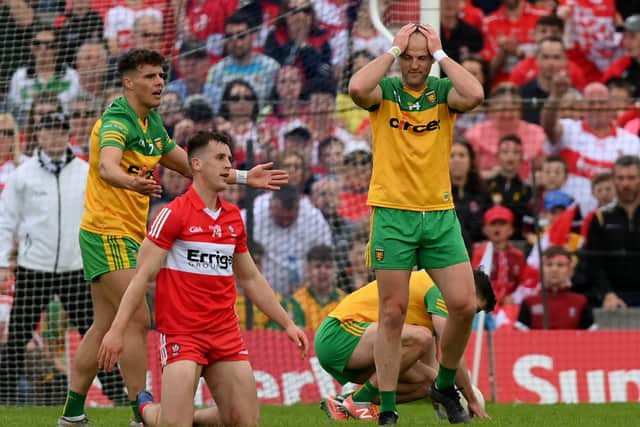
Losing games from winning positions has been a disappointingly familiar facet of Donegal teams in recent years.
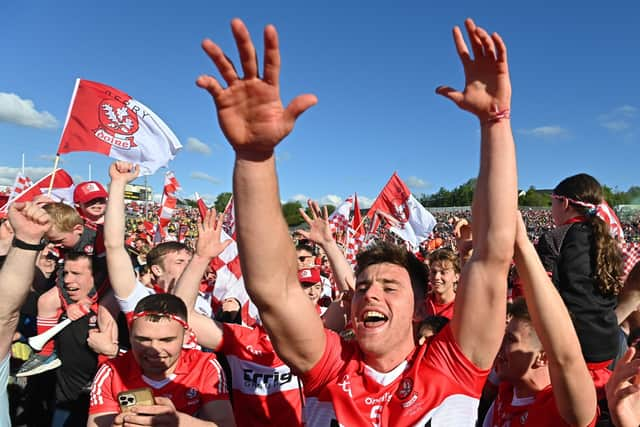
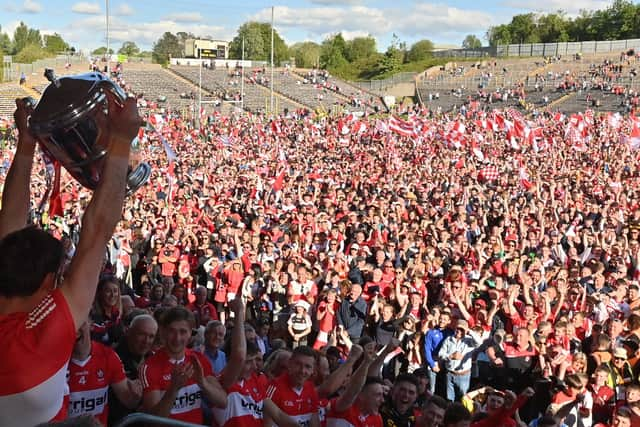
The scenes at the end of joyous celebration from Derry’s colourful followers made even the most hard-nosed of Donegal supporters feel some twinge of appreciation for what they had achieved.
That full-time whistle couldn’t have been more different to the Ulster final of 2020, when Donegal surrendered an Ulster final against Cavan in the month of November at an eerily-empty Athletic Grounds in the midst of a pandemic.
There had been a whisper in the week before Sunday’s final that Murphy, the Donegal captain, had picked up “a knock” at training. Declan Bonner, his manager, had given the journalistic fraternity more than a good slice of his time the previous Friday at the Fir Trees Hotel in Strabane for the Ulster GAA press launch.
Bonner was followed by Brendan McCole, the Donegal full-back, who spoke of the inspiration he received from Stephen Griffin taking Sam Maguire into Mountcharles on the whistlestop tour following the 2012 All-Ireland. Derry, on the other hand, opted not to participate in Strabane, where manager Rory Gallagher and midfielder Glass conducted television interviews only and a photoshoot in the garden.

By admission of some former Derry players, Rogers isn’t overly fond of a high ball coming in over the top and although an excellent footballer and an adventurous defender, he is a player who doesn’t overly perturb the umpires. He is, after all, a full-back.
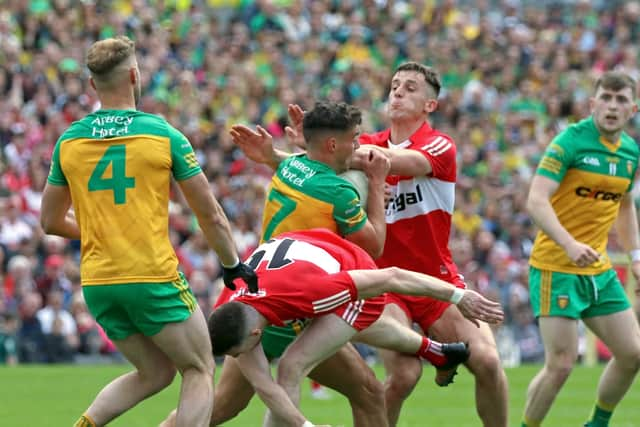
But from early on Sunday, Murphy was sitting deep, which enabled Rogers a much more advanced stage to base himself from to supplement the attack, which was plain for all to see.
Going against the grain of criticism since, Peter Campbell, who has worked in the Donegal Democrat now for 45 years to the position of sports editor, offered a quite balanced appraisal that has been since overlooked - in that Murphy’s ankle issue was best catered for in a role that didn’t involve a lot of twisting and turning, like full-forward, so he lined out in a place to avoid the heavy traffic, very withdrawn.
That point aside, Donegal were much too accommodating of Derry, who had to lay their cards on the table to produce their best to defeat both Tyrone and Monaghan. Donegal, the one thing O’Kane hadn't noted, hadn't come with their big start.
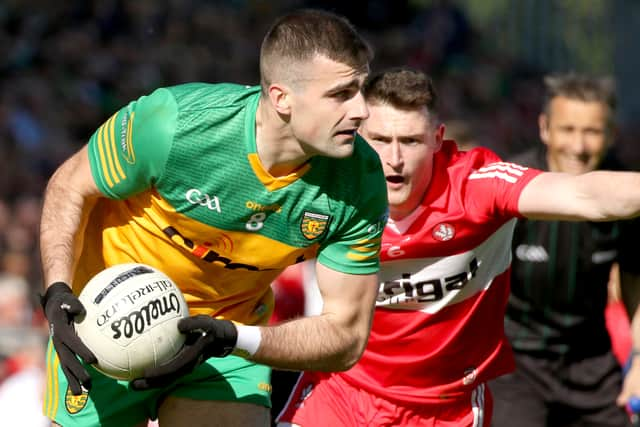
Derry’s trajectory since 2019, when they had somehow fallen to the depths of Division 4, has been incrementally positive, with the one real blotch on the copybook being their Division 2 clash with Galway in Owenbeg in March.
There, Pádraic Joyce’s team hounded goalkeeper Lynch’s kick-outs and ran out winners on a 4-11 to 0-12 scoreline, despite, like Derry it must be said, playing with only 13 for a spell in the second half when the damage was already done.
“Holy mother of God,” could be heard in the pressbox in an opening 10 minutes which sapped the atmosphere from St Tiernach’s Park.
Both teams had massive chunks of possession whilst playing the percentages. It was like basketball without the basket.
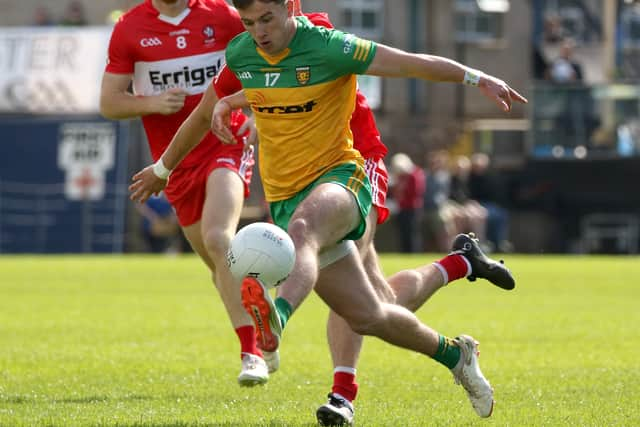
Derry pushed that lead out to 1-3 to 0-1 and at five down on a couple of occasions, Donegal were all at sea. Peadar Mogan - only for him - carried not only the fight to Gareth McKinless, but to Derry as a whole, with three top-class first half points. Whilst everyone seemed to be playing chess, Mogan was attacking like you would in a game of draughts.
With Mogan forcing McKinless onto the back foot, Rogers took up the role of Derry’s marauder to telling effect to, over the course of the game, kick three points from play and lay on two more.
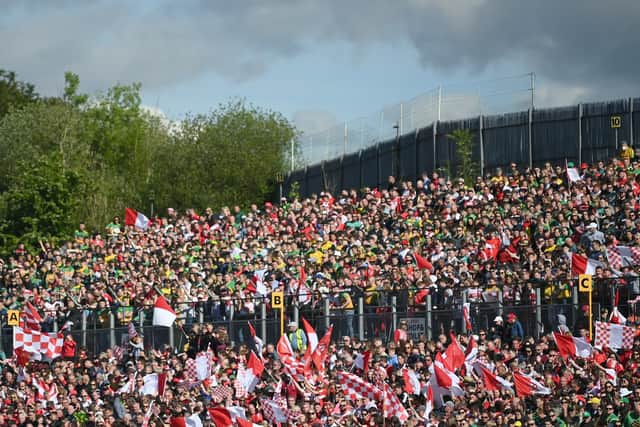
Beforehand, we had heard that Donegal had sold in the region of 15,000 tickets of the capacity of just under 29,000, although when the teams marched behind the Mayobridge band, Derry’s support - and accounting here for whatever Tyrone support were there in the same colours for the minor final - seemed to outnumber Donegal’s by, at the very least, three to one.
Donegal improved towards the end of the first 35 minutes and 1-6 to 0-6 wasn’t as bad an interval deficit as they’re might’ve been, with Lynch struggling under the occasional high ball, something that should’ve been tested again in part two.
With Mogan belatedly nullified, the mantle of freedom fell to Odhrán McFadden Ferry, whose goal 45 seconds in part two got Donegal going.

The midfield duo of McGonagle and McGee were putting up a commendable fight. The usual scoring reliables of Murphy, out the field, and Patrick McBrearty, who got practically nothing from Chrissy McKaigue from open play, were choked up. Donegal might’ve been better using the alternatives. Ciaran Thompson, for one, showed what he could do against a packed defence from distance, although that was in extra-time.
At one stage, McGonagle beat Glass to a 50-50 ball in the air and a roar went up. You couldn’t but remember this is how football should be. For a team in their 10th final in 12 years, was there a need for Donegal to absolutely mirror a Derry side who are still finding their feet at this level? Basically, trying to out-Rory Rory.
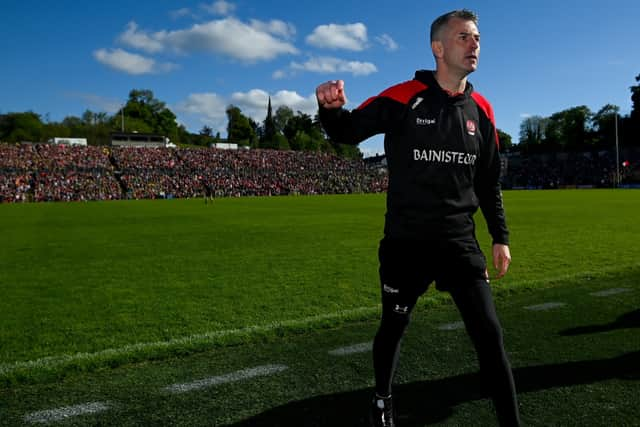
On Halloween night 2014, he was ratified as Donegal manager at the Villa Rose in Ballybofey, inheriting an ageing panel, although one who had done wonderful things for football in the county - two months beforehand to the day, they had beaten ‘the unbeatable’ Dublin in the last of McGuinness’s famous wins.
Gallagher was unfortunate to lose the 2015 Ulster final against Monaghan - he didn’t kick 11 second half wides in the 0-11 to 0-10 loss, although the year afterwards, he might still regret trying to sit on a four-point lead against Tyrone who rallied at the finish to take the Anglo-Celt into Aughnacloy.
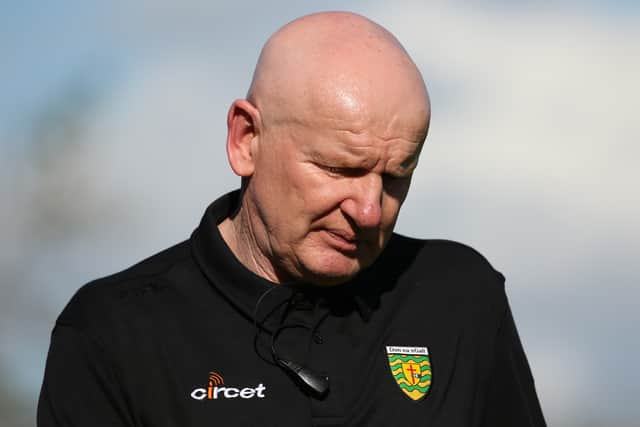
Bonner, of course, had a huge involvement in the development of those players too, with some coming from his Buncrana Cup winning side from a decade ago, through the ranks. Like with Gallagher in 2017, some of the criticism of Bonner now on a personal level is completely out of order.
Donegal will admit they now have questions to answer and if not through the media channels - which is understandable - then on the pitch and on the line. They’re still in this All-Ireland series, although it will need a significant improvement to stay in it.