

LGFA can’t let standards slip due to AFLW exodus - Aoife McDonnell

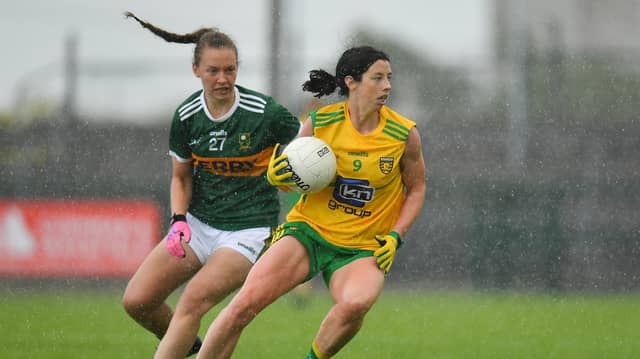

42 of the country’s top ladies Gaelic footballers are now full-time professionals in the AFLW but the ex Donegal star, a three-time Ulster SFC title winner, says too many meaningful yards have been made to simply let things slide back down the ladder
Aoife McDonnell says that with over 40 of the LGFA’s top talent now in Australia, there is a real concern that the standard of ladies football could seriously regress.
42 of the country’s top ladies Gaelic footballers are now full-time professionals in the AFLW but the ex Donegal star, a three-time Ulster SFC title winner, says too many meaningful yards have been made to simply let things slide back down the ladder.
McDonnell made her own senior intercounty bow back in 2003 and she says the LGFA eventually elevated itself to dizzy heights inside what she called “two spectacular decades of unimaginable progress”.
The Glenties native, who has lived in Australia herself for many years, currently works as the Performance Lifestyle Advisor with The Australian Ballet in Melbourne and the Sydney Opera House.
She also holds an MBA in Sports Management and has a Masters in Sport and Exercise Psychology.
So she understands the lure and indeed the lifestyle that Oz offers and doesn’t blame so many of the country’s best players, including fellow Donegal women Niamh McLaughlin, Tanya Kennedy and Amy Boyle Carr, for heading Down Under to play professional sport.
Her concern is that the ground the LGFA has so impressively made up in the last decade might be lost if the game, as a spectacle, suffers a real dip.
What exactly the LGFA and indeed GAA, as that integration progresses, can do to stop the players drain is difficult to say. And McDonnell says there is no simple solution.
She explains: “Both things can be true at the same time, insofar as this presents a wonderful opportunity for Irish girls to play professional sport.
But you also have to acknowledge that it’s leaving a real gap. Ladies Gaelic football, where it’s come from to what it is now, it’s unrecognisable. “Believe me, I was there for that entire sort of evolution. I’m so proud to have seen the work and the progress the LGFA has made.
“On one hand, we have to accept that this is very hard to stop, prevent even. And as I said, it’s such a wonderful opportunity that shouldn’t be the case anyway. Because it’s a fight the LGFA probably can’t win.
“So I think it’s a case of looking to go back to the drawing board. It feels like a transition period, where many experienced players and leaders on teams have left.
“But new talent is emerging. And it’s a case of developing that talent and new leaders within the teams.
“You couldn’t take almost 50 of the best players out of a league in any sport and expect it to bounce back immediately.
“It’s an opportunity for the LGFA and county set-ups to think outside the box and create strong performance systems internally that could have them contending for All-Irelands in the next few years. It’s a blank canvas, which in its own way is also exciting.
“The GAA is also powerless to stop this same trend, albeit on a much narrower scale. So I think the LGFA have to approach this with a different mindset”.
Players chief Tom Parsons recently described the drain of talent as a ‘huge blow to Gaelic Games‘.
He said that making sure players aren’t ‘out of pocket’ while playing here, and providing them with a decent government grant and minimum welfare standards, should improve the retention rate.
“How would the men’s game look if up to 40 of the best players in the country were no longer involved? said McDonnell, who was also a 2010 All-Ireland Intermediate winning captain with Donegal.
“So much has been said and written about Mayo’s Kobe McDonald alone. Losing even one talented player can create a huge disadvantage, never mind the three to four top LGFA sides are seeing depart.
“That sort of cluster has the potential to be the backbone of an All-Ireland contending team.
“These players are also your leaders - the ones raising standards and expectations at training, setting the tone.
“That leaves a void, not just in terms of quality but also on many different levels behind the scenes”.
Players had previously been able to juggle both codes but in 2025, the AFLW switched its start date to August, putting it on a direct collision course with the championship season back home.
That had obvious ramifications for Irish players who then had to make a straight choice.
And unsurprisingly, they have chosen, in their droves, to play professional football in Australia.
“What’s very clear from being based in Australia and working within high-performance environments is that the decision for players isn’t just about professionalism in terms of pay.
“It's about the entire system around them. In the AFLW, athletes are supported across performance, wellbeing, career development and lifestyle in a truly integrated way.
“That creates an environment where players can not only perform, but sustain performance.
“If the LGFA is to continue the brilliant momentum it has built, the next step may not just be about financial support, but about evolving the overall player experience, building structures that support athletes as both people and athletes.
“That includes how we prepare them, how we support them off the pitch, and how we create environments where they feel they can develop long-term.
“It’s like that baby/bathwater analogy, we have to remember just how hard the LGFA has worked.
“Today, we get identical coverage, reports, previews and photo coverage. That all came from the LGFA getting to a serious level of professionalism where the product was simply brilliant to watch.
“Maybe we need to look at this as an opportunity to sort of reset and again sort of defy the odds that looked stacked against us.
“There is a real opportunity here. The foundation is already strong, what’s needed now is alignment around what a modern, high-performance female athlete environment looks like, and how we can build that within the Irish system in a way that fits our culture.”
She added: “What’s also important in this conversation is the role of the Gaelic Players Association.
“They have already made significant strides in advocating for equal player welfare and support, and that work is becoming increasingly important in the current landscape.
“I personally have been supported by the GPA through their career development program and will forever be grateful for that support.
As the demands on players continue to evolve, there is an opportunity to further strengthen how athletes are supported not just financially, but across performance, wellbeing and career development.
“This is where we see the real difference in professional environments like the AFLW, where support structures are integrated and proactive rather than reactive.
“There is a natural alignment here between player representation bodies and the future of high-performance development in Gaelic games, particularly in ensuring that athletes feel valued, supported and able to sustain long-term careers within the system.
“I think the issue is not about stopping our players from leaving to take up amazing opportunities in Australia, but more about what we can do to entice them to stay and support them in realising the benefits of playing at home.
“Across various sports that I’ve played and loved, Gaelic football has always been number one. Playing and viewing-wise, it’s a superior product. That’s a real start.
The only thing I wanted to do when I was a child was to play for Donegal. I got so much out of that journey.
“It’s the best thing I’ve done in my life. Even now, looking back, I appreciate the connections I’ve made, the great friends, the great rivalries.
“It shaped me as a person and gave me so many opportunities post-career.
“We’re probably at the peak right now in terms of departures. The AFLW can’t continue to completely flood its own league with imports.
“It will be developing its own academy and graduate structures as it looks to eventually grow talent from within.
“So let’s not just roll with the punches for the sake of it until then. Let’s kick on in the LGFA and be in an even better spot down the line. As I said, we’ve made too much progress to sit idle now”.