

The lesser-known story of a Celtic legend from Donegal - Patsy Gallagher

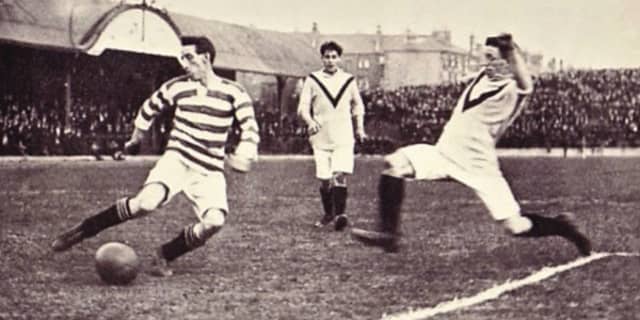

Ramelton folk might tell you otherwise, but one of the greatest players ever to wear the Celtic hoops was born in Milford. In fact, he even played for Rangers
With Celtic returning to the top of the Scottish Premiership this week, the scenes from the East End of Glasgow showed that of the club at their best.
Celtic, founded in 1888 and European Cup winners in 1967, have a bonded link with Ireland and Donegal, with thousands of supporters making the trip across the Irish Sea every season.

Patrick 'Patsy' Gallagher, above, came into this world on March 16, 1891, in the workhouse in Milford; the son of illiterate parents Margaret and William, who was a post car driver, which was not a position within the postal service but a name given to those who drove the more affluent folk around Donegal and the surrounding areas.
The confusion over their son’s place of birth comes from the fact Ramelton, the family’s hometown, was what appeared on the newborn’s birth certificate.
They weren’t the only Gallagher family living in Ramelton in the late 1800’s that would be written about for years to come.
Some 18 years beforehand, in 1873, at Crammond House in Ramelton’s Market Cross, David Gallagher – no relation – was born. He was the third son of James Henry Gallagher – a 69-year-old shopkeeper who was in the drapery business – and his 29-year-old wife Maria Hardy Gallagher.

Dave Gallaher, above, the captain of the All Blacks ‘Originals’ was also from Ramelton although not related to the family of Patsy Gallagher

Times were tough and for Margaret and William Gallagher, who lived in a house just off the Cross on Ramlelton’s Main Street, and their destination would not be as far. With emigration still rife in Donegal, which was very poor, they decided to relocate to Scotland. There was no shortage of work in the late 19th century in shipbuilding.
No record of when the move took place exists, although it’s estimated to be around the turn of the century when Margaret and William and their four sons Johnnie, Willie, Jimmy and Patrick and three girls called Madge, Mary and Maggie swapped the banks of the Swilly for the Clyde.
From those humble beginnings, Patrick Gallacher – another adopted version of the family surname Gallagher, which occurred after they arrived in Clydebank – is still talked about around Parkhead way and much further afield.
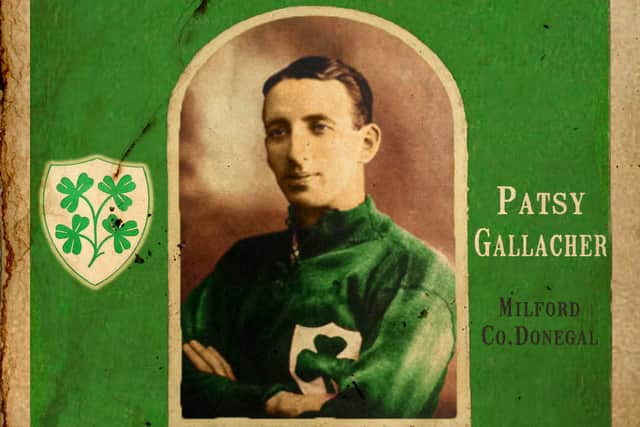
“Being illiterate, Mr and Mrs Gallagher didn’t notice the difference.”
As a boy, Patrick, or ‘Patsy’ by now, played locally, possessed a box of tricks in regards a skill-set, but was deemed too small at five foot and seven inches (although historical variations say he was anything from 5ft 5in to 5ft 9in) and too light at not even nine stone weight to make it as a professional.
He played with Cyldebank Juniors and despite his size was signed by Celtic manager Willie Maley having scored two and three respectively in trial matches against Dumfies and a British Army XI.
“You can’t put that boy on the park boss,” said Celtic’s former striker Jimmy Quinn. “If you do it will be manslaughter!”
Despite his stature, Gallacher – at Celtic’s second time of asking as he was serving an apprenticeship to work in the shipping industry – made his first-team debut for the Hoops in November 1911.
“I was asked to sign on and stop work right away,” he said of the first refusal. “I had just completed about three of a five-year apprenticeship as a shipwright, so there was nothing doing.”
That same season, Gallacher – by then qualified – won his first Celtic honour, the Scottish Cup.
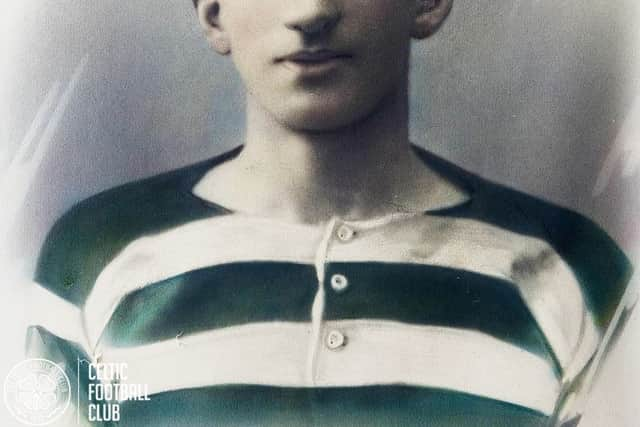
“Maley allowed him to adopt a take-it-or-leave-it attitude to training,” it says. “ ... so Patsy would usually leave it.”
Maley’s theory was that footballers trained to lose weight. And since Gallacher – capped by Ireland and Northern Ireland – possessed little of that, he was left to his own devices.
Gallacher, though, sometimes had to be intuitive. Once, in the early 1920’s, Maley took the team to a spa-type hotel in Dunbar for relaxation purposes and having set a curfew the Celtic manager decided to stay in the lobby to ensure no sneak-outs.
According to Celticwiki: “Gallacher, however, decided he would quite fancy a nippy sweetie or two, and so persuaded a hotel chambermaid to lend him her uniform.
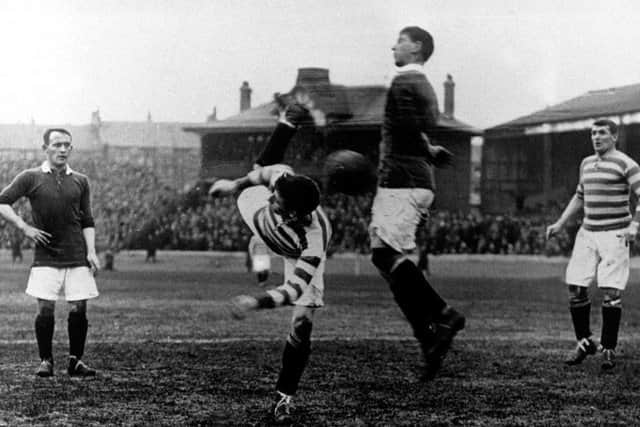
Between 1911 and 1926, when dressed in the more conventional Celtic kit, Gallacher would score 187 goals in 432 league games – 200 in 491 in all – winning six league titles, four Scottish Cups, four Glasgow cups and 11 Glasgow charity cups.
Only six players – Jimmy McGrory, Bobby Lennox, Henrik Larsson, Jimmy Quinn, Steve Chalmers and Sandy McMahon – have scored more goals for Celtic to this day.
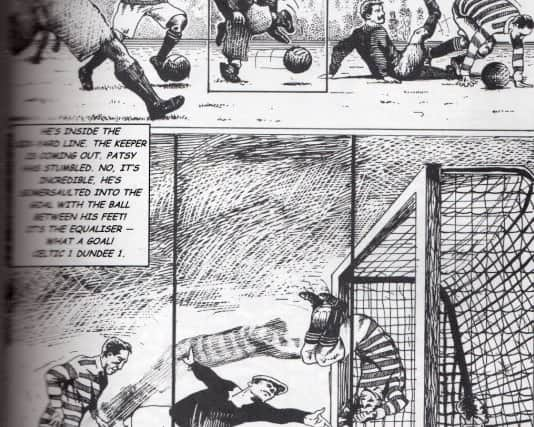
If there’s one moment that stands out more than any other though, it’s the 1925 Scottish Cup final, where Celtic beat Dundee 2-1 in what has since become known as the ‘Patsy Gallacher final.’ The 75,317 inside Hampden Park that April afternoon witnessed something – in an era with no television footage – that is still talked about today.
“Getting the ball just inside the Dundee half, he rolled past challenge after challenge, sometimes appearing in danger of toppling over as he swerved and swayed dangerously close to the ground,” recalls Celtic FC – The Official History 1888 to 1995.
“No Dundee boot or body could stop him completely as he veered, sure foot as a young deer, towards their goalmouth.
“Finally a heavy, desperate tackle grounded him inside the six-yard box. Patsy hit the ground and for an instant his brave effort seemed to be at an end. But Patsy had not yet parted company with the ball, which remained between his feet.
Sadly though, just 14 months later, without even knowing it, Gallacher was retired by the Celtic board.
“The day of July 27, 1926 was dark one in the club’s history and one which highlights the attitude of the then board towards great players who had outlived their use,” wrote the official Celtic website in 2015.
“After 15 years of courageous service and an unfathomable number of kicks and assaults during matches, Patsy was ‘retired’ by the club without his knowledge. The little playmaker had missed most of the previous season with a knee injury and it is widely believed that the board acted in order to save on wages.”
Gallacher would pay on for Falkirk for six years having lost his wife in 1929 as she was giving birth to their sixth child.
Two of his sons played football professionally, Willie for Celtic and Tommy for Dundee, while his grandson Kevin scored for Dundee United in the 1988 Scottish Cup final against Celtic and won the 1994/95 Premier League with Blackburn Rovers.
Patsy Gallacher, as he had at Celtic, continued to work in the shipyards – once missing a match after being hurt when a box of tools dropped on his foot – and ran the International Bar in Clydebank.
After his death, aged 62, from cancer at Lennox Avenue, Scotstoun, Glasgow in 1953, the family discovered “hundreds'' of credit notes that Gallacher had purposely hid in the bar as not to annoy his customers into replaying their bills in leaner times in Glasgow. He is buried in Arkleston Cemetery, outside Paisley.
“Gallacher was the original will o’ the wisp,” wrote The Sunday Herald in 2000. “There is no grainy newsreel to hint at his greatness. There are few, too, who saw the great man in action and live to tell the tale. Gallacher remains as elusive to the present day fanatic as he was to the toiling defenders who sought to contain him in the early 20th century.”

In 2007, eight members of the Lisbon Lions – the Celtic team that won the European Cup in 1967 – were present when a memorial plaque, pictured above, was unveiled at the childhood home of Gallacher in Ramelton, by Celtic Chairman Brian Quinn and Patsy’s son Bernard Gallagher.
The legend of Patsy Gallacher lives on.