

The Alternative View: Donegal at cruising altitude and set for championship takeoff

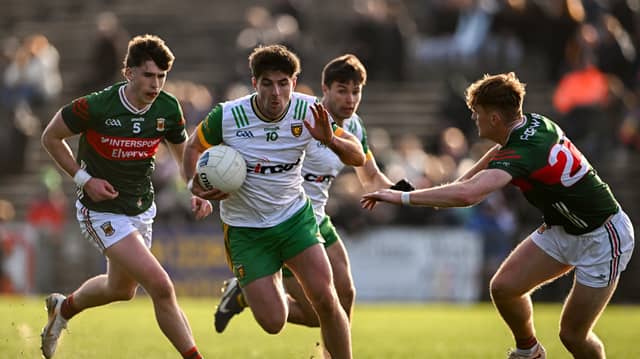

In the Alternative View this week Conor Breslin looks at Donegal's league clash with Mayo, their league criticism, and why Jim McGuinness’s real test is only beginning
There comes a point in every National League campaign when the whole thing starts to feel like a long-haul flight.
You’re halfway through, you’ve watched the safety demonstration, you’ve had your tiny bag of peanuts, and now you’re just staring out the window waiting for the real journey to begin. That’s probably where Donegal were pulling out of MacHale Park on Sunday evening.
The league is over, the Championship looms, and Jim McGuinness has spent the last few weeks pushing the refresh button on a team that, before he came back to the sideline in 2023, looked like a group that had been handed an Etch A Sketch and asked to draw the Mona Lisa.
Before the sun began to rise on Sunday the likeliest Division 1 final pairing was Dublin and Galway. In the end, two teams who both spent a brief time in the relegation zone – Mayo and Kerry – made it to the final.
Just another reason why the GAA is the worst association on earth for promoting itself. Time for the GAA to put the ‘Help Wanted’ PR signs out. Seriously! It’s needed.
For Donegal, the last chapter of this particular 2025 league book came against Mayo in Castlebar, a game that was always going to be something of a juggling act.
Donegal had one eye on a league final and the other firmly on the championship opener against Derry. The result? A selection that blended experience with fresh legs, giving valuable game time to those who needed it while keeping key players in reserve. A nice PR answer!
It’s been over three years since I last saw Mayo live when they played Donegal in the opening round of the 2022 league in Sligo which saw the teams leave Markievicz Park 0-11 each, with Donegal also missing a penalty that afternoon.
I tried to find how much has differed in those three years between the Donegal team of then and the team now; I wasn’t far looking. One column from that January afternoon cited Donegal as being easy on the eye and easy on themselves. A team that lacked sufficient ruthlessness – super at an aimless game of ‘keep ball’ but ineffective when trying to punish teams going towards the opposition’s goal.
How times have changed!
Donegal started strong last Sunday, their subs used, were even more effective. They had 11 different scorers and for periods looked to be the side that would storm out of Castlebar with the win.
But Mayo being Mayo, were never going to offer a polite send-off to the league campaign. The game had an edge, a championship undercurrent, the sort of match that exists on the border between warm-up and full-blooded engagement.
Donegal though nearly snuck a result. A saved penalty from a Dáire Ó Baoill kick — one of those moments that lingers in the gut — proved costly, while Hugh McFadden smashed the tip of the crossbar just before the end.
A handful of missed chances added to the frustration. The kind of game that could have swung their way but, in the end, didn’t.
Yet McGuinness wasn’t for wallowing. There was a plan, a method to the team selection, and an understanding that the bigger picture had to be kept in mind.
In his Sunday World column last week, Kerry legend Pat Spillane didn’t hold back in his criticism of Donegal’s approach to the National League. He described last week’s situation between Donegal and Tyrone as “farcical”, pointing out that despite being joint table-toppers in Division 1, Donegal effectively abandoned their league campaign to focus on the upcoming Ulster Championship clash with Derry.
Spillane was particularly critical of McGuinness’s decision to make 11 changes to the team that had beaten Derry, fielding, what he viewed as a much-weakened side against Tyrone — a game they unsurprisingly lost. While he acknowledged that McGuinness has every right to prioritise competitions as he sees fit, Spillane argued that entering a competition should mean competing to win it, not simply taking part.
He also raised concerns about the integrity of the league, given that Donegal’s last two opponents, Tyrone and Mayo, faced a significantly understrength team, while other counties had to take on Donegal at full strength earlier in the campaign. For Spillane, this was not just unfair to those teams, but also to supporters who paid good money expecting to see Donegal’s best players in action.
One of his most striking comparisons was to horse racing — suggesting that if McGuinness were a trainer, he’d be called before the stewards for using the racecourse as a training ground rather than a genuine competition.
It’s this old adage again. I think it’s time people stop making the mistake between managers and teams disrespecting the league competition and the GAA themselves spitting on their own tournament by shoehorning it in so close to the championship.
With regards to Spillane’s remarks about the supporters being sold a dummy by paying good money to follow their team, only for the star men to be left back home, there can be a point in that, but if any Donegal supporter believed that their side were going to release a full-blown championship side two weeks out from the championship . . . to quote Roy Keane’s famous line; ‘you’re living in cuckoo land’.
According to the manager, Donegal went to win the game, make no mistake about that. The talk of dodging a league final was wide of the mark, but it was never the be-all and end-all. The focus was always on shaping a team that would be at its sharpest come championship time.
The integrity of the league, you say? Come on. The league has been a mixed bag of shadow-boxing and squad rotation for years. Teams have been using it to fine-tune their summer plans forever, and nobody was calling for stewards' inquiries when that happened. So why is it suddenly a crime when Donegal plays the game the same way?
If McGuinness gets it wrong and Donegal flop in the summer, the critics will have every right to gloat. But if Donegal go deep in the championship, this whole argument will look like what it really is — a lot of noise about nothing.
Over the course of the league, McGuinness has used 36 players, a testament to both his willingness to experiment and the sheer necessity of doing so. It’s no longer a team in transition, blending the old guard with a new wave of talent.
The likes of Ciarán Moore and Finnbarr Roarty have been trusted with key roles, while established figures such as Michael Murphy, Ryan McHugh, and Michael Langan have had to manage their game time carefully not to get injured or get back to full strength.
In that 36 stronghold, 26 players have played over 100 minutes of league football, 16 have played over 200 minutes in the league, while Shane O’Donnell, Brendan McCole, and Moore top the podium with over 400 minutes played, with the St Eunan’s man the only one to feature in all seven league matches.
The pen and paper are now out for Donegal supporters to cobble together their starting XV for the Derry game. One league start in seven matches is already enough to show that Murphy will possibly be in the starting line-up, more than likely togging alongside Oisin Gallen and Patrick McBrearty.
Langan’s return against Mayo has shown that he is the midfield supremo and if fit, will be central to McGuinness’s starting plans more than likely alongside the rejuvenated McFadden, which pushes Moore back to his natural spot in the backline.
Against Mayo, there were flashes of the Donegal that McGuinness wants them to be. Stephen McMenamin’s discipline in defence, Shane O’Donnell’s relentless work rate, the controlled aggression that they brought to the middle third — it was all there in patches.
When Donegal get it right, they look like a side capable of matching anyone. When they don’t, the gaps appear, and top sides know how to exploit them.
That, more than anything, is what this league campaign has been about. Not silverware. Not statements of intent. But evolution.
If there is a blueprint for success, it is, as ever, hidden somewhere in McGuinness’s notebook. The familiar hallmarks of his first reign are creeping back in – the defensive discipline and the ability to keep a game in a stranglehold. In Castlebar, Donegal were at their suffocating best in phases, closing off space, forcing errors, and dictating the terms of engagement.
The new rules haven’t helped either. If inter-county football was already an unforgiving place, the tweaks to kick-outs and the increased speed of play have made it even more challenging.
Donegal, like everyone else, has had to adapt. The quick restarts, the squeeze on possession, the need to be constantly switched on — it’s all part of the modern game. And McGuinness, ever the pragmatist, has been tinkering to find the right balance.
At times in the league, Donegal has looked like a team on the cusp of something. Against Kerry, they were fluid, dynamic, and hard to pin down. Against Dublin, they were tenacious, relentless, unyielding. Against Mayo, they were somewhere in between. Not quite the finished article, but not far off either.
That’s why the next two weeks are crucial. The league has served its purpose. It has been a testing ground, a lab experiment, a necessary evil. Now the real business starts.
Derry will arrive into Ballybofey with an attempt to overthrow the Ulster champions, something that happened to them last season. Paddy Tally’s men come to MacCumhaill Park looking to overthrow a side that has spent the last two years turning itself into one of the most consistent and polished outfits in the country.
But Derry will not be spooked by Donegal either. They will not be unsettled by Ballybofey. They will not roll over just because McGuinness is patrolling the sideline.
They will still be a test that Donegal must pass if they are serious about progressing beyond Ulster and into the latter stages of the All-Ireland series.
The wider question is how areas of Donegal’s league form translates to championship, and how much do we read into that? For all their progress, there are still concerns. Can they maintain their intensity for 70 minutes under this new culture of fast-moving football? Have they fully adjusted to the increased speed of the modern game? Are they clinical enough in attack?
These are the issues McGuinness, and his team have been working to resolve.
Donegal’s ability to close out tight games will be key. Championship football is unforgiving in that regard. Small margins decide everything.
And that, in the end, is what makes this so fascinating. The two Ulster sides have had their trial run. Now comes the actual performance. We are about to find out whether the league was a launchpad or a carefully measured step along the way. We are about to find out if Donegal are where they want to be.
Most of all, we are about to find out if Jim McGuinness’s second season of his second term is ready to deliver or if, for now, we are still stuck somewhere at cruising altitude, waiting for the real journey to begin.
Mayo scorers: Jack Carney 1-3; Stephen Coen 0-2; Frank Irwin 0-3; Ryan O’Donaghue 0-6,1f; 2tp; Jordan Flynn 0-1; Paul Towey 0-1; Matthew Ruane 0-2,1tp.
Donegal scorers: Eoin McHugh 1-0; Daire Ó Baoill 0-2,1tp; Gavin Mulreany (0-1,1’45), Ciaran Thomspon 0-2; Niall O’Donnell 0-1; Luke McGlynn 0-1; Michael Langan 0-2; Conor O’Donnell 0-2; Finnbarr Roarty 0-1; Aaron Doherty 0-2; Shane O’Donnell 0-2.
Mayo: Colm Reape; Conal Dawson, Donnacha McHugh, Enda Hession; Sam Callinan, David McBrien, Fenton Kelly; Stephen Coen, Matthew Ruane; Jack Carney, Darren McHale, Jordan Flynn; Aiden O’Shea, Frank Irwin, Ryan O’Donoghue. Subs: Paul Towey for A O’Shea (53); Eoghan McLaughlin for F Kelly (61), Fergal Boland for Irwin (65), David O’Connor for Flynn (69).
Donegal: Gavin Mulreany; Finnbarr Roarty, Stephen McMenamin, Brendan McCole; Ryan McHugh, Caolan McGonagle, Caolan McColgan; Hugh McFadden, Ciaran Moore; Daire Ó Baoill, Ciaran Thompson, Shane O’Donnell; Niall O’Donnell, Conor O’Donnell, Luke McGlynn. Subs: Mark Curran, Michael Langan, Aaron Doherty and Eoin McHugh for McGlynn, McColgan, N O’Donnell and McGonagle (all ht); Caolan Ward for McCole (61)
Referee: Joe McQuillan (Cavan).