

The one and only Mickey McLoone - the flying comet
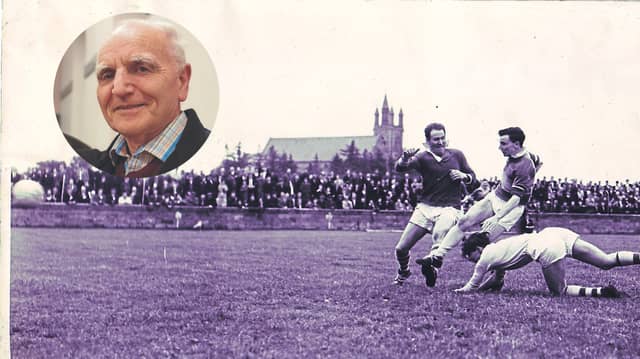

In his weekly Donegal Post column, Gerry McLaughlin recollects his memories of watching Michael McLoone play
It is 1968 and this small GAA mad Rockfield Primary schoolboy is in Gaelic Park in Bundoran watching St Joseph’s beating Dunmore MacHale’s in an All-Ireland club final.
Almost 54 years on, I can still see Sean Óg Kane, Rossa McCosker, Paul McLoone and Tom Daly shouting and singing that signature tune as the men in white made some autumn magic.
Dunmore had Pat and John Donnellan, John and Tommy Keenan and the flying Seamus Leydon as well as Johnny Kelly a Customs man who was working on the Cloghore checkpoint and we gave him hell coming up to that match.
The Donnellans, Keenans and Seamus Leydon had three senior All-Ireland medals and that made Joseph’s victory even more special.
We all know the big names of the men who lined out - McEniff, McShea, Brady, O’Carroll, Granaghan and a very young Carney. But my idol was the one and only Mickey McLoone from the Abbey in Ballyshannon. And I can still hear the great Micheal O’hEithir’s voice go up an octave every time our very own pocket-rocket got the ball.
Of course it helped that his Glenties native father and our late father Willie McLaughlin were good buddys in the ESB in Ballyshannon.
And even though Mickey to me was a superstar, he looked and was so ordinary - but had and has an extraordinary acute mind. In his powerful prime, he was Ballyshannon and Donegal’s own version of Bobby Charlton.
Rattling the net was the thing that gave him the greatest pleasure in six scintillating years from 1964 to 1970. Mickey was like a flying comet hurtling across the Gaelic landscape and he had dynamite in his boots. Mickey was small and stocky and had exceptional pace, but more importantly, always had the courage to run at a defence and was never afraid to go into the dark places where traditional corner-backs showed all the dark arts.
And there was not the same protection that modern forwards are afforded, so there was always something gladiatorial about him. The crowds loved his all-action direct style of football in an era when defenders were not as mobile as the modern era.
But he was always a leader with supreme confidence in his own ability as opposed to arrogance, totally dedicated and always very well organised. He had the feet of a dancer, the hands of a hurler and his low centre of gravity meant that he was extremely hard to knock off the ball.
In one season 1965/66 he scored an incredible 9-20 in his 21st year. But a cruel injury caused a spectacular crash in and around 1970 as both of his knees gave up.
He played for his county from 1964 to the late 1960s, played for Ulster in 1966 and scored two telling clinching goals against the great Dunmore Gaels side in two fabulous All-Ireland club finals in 1968.
He won two Ulster Minor League medals with Donegal in the early 1960s and three Ulster U-21 titles in 1963, 64 and 66.
1966 was the same year he captained his county to their first ever televised provincial final against Down in Casement Park, when he had just turned 21.
It was “one we should have won”, Mickey ruefully admitted years later. Down got a late goal and scrambled home but McLoone’s knees were starting to show the wear and tear and he did not do himself justice on that historic day.
“It was the day after England beat Germany in the World Cup”, he recalled. From his debut as a 19-year-old against Fermanagh in the Ulster SFC in Irvinestown in1964, Mickey was the beating heart of the Donegal attack.
And he played and starred on a team that many regard as the most talented to ever represent the county. Frankie McFeely, Sean Ferriter, Seamus Hoare, PJ Flood and Sean O’Donnell were all colleagues of Mickey’s on Ulster teams.
But they also had the likes of John Hannigan, Fionn Gallagher, Des Houlihan, Neilly Gallagher, Declan O’Carroll and Seamie Granaghan to boost their efforts.
Mickey was also the heartbeat of a truly fabulous St Joseph’s team of all talents from Ballyshannon and Bundoran and he won three county championships with the Saints in 1965, 66, and 68 as well as that famous first ever All-Ireland club title when he was only 23.
“We wore all white and were the Saints and thought we were really cool,” he said. “Many people say it was two towns but the basis of the team was all of us who had gone to De La Salle College Ballyshannon in the late 1950s and early 1960s. And we did not want to split up”

Mickey's first major success was in captaining the Bakery Cup winning team in Ballyshannon in 1959 when he was 14, and then going on the famous parade around the town that inevitably ended up at Paddy O’Neill’s with a load of ice cream.
That was the start of a spectacular career that was tragically cut short when both his knees literally gave up. The warning signs had been there since the mid 1960s but he was forced to take a heart-breaking decision in 1970 to give up the game he loved so much.
Lesser men might have wilted and sought solace by drinking deep from the cup of regret. But McLoone dealt with extreme adversity with character, courage and class.
“Gaelic football was what defined me,” he said. “That’s who I was so I had to go and re-define myself and build another me. My major regret dates back to those injuries that were pretty devastating at the time. I don’t know what would have happened if I had not re-directed my career. It would have been a very depressing time, because Gaelic football was my whole identity, that was me.
“And then when you do something different it helps you mentally and you get huge satisfaction out of it.”
But sport has certainly taught Mickey McLoone some very valuable lessons.
“I have learned more from sport than I could imagine and I would commend it to anyone,” he said. “Learning to lose because life has so many disappointments and learning that the popular acclaim is very transient and just to your next game is another huge lesson.
“If you want great success, you must make great sacrifices, looking after yourself, being measured in the social side of life is hugely important. I learned those from sport, and they stood me in good stead”.
It certainly did, and for this writer, there will always be one and only Mickey McLoone