

When Donegal stopped ‘the unstoppable juggernaut’


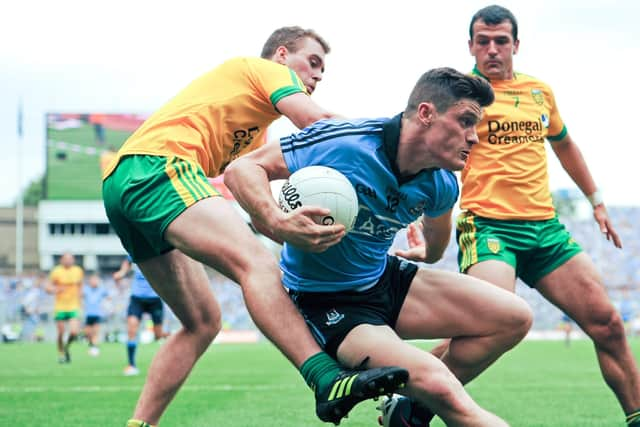
Donegal, despite being All-Ireland champions just two years beforehand, were rank outsiders ahead of the 2014 All-Ireland semi-final against Dublin. It was to prove Jim McGuinness’s final masterstroke as Donegal manager, as Alan Foley recalls ahead of Declan Bonner's side's trip to Croke Park on Sunday
The Tuesday night after Donegal scraped through the 2014 All-Ireland quarter-final, Jim McGuinness crammed his players into a makeshift portacabin at Donegal’s yet-to-be-built Centre of Excellence, as it was known as then, in Convoy.
“I know how to beat Dublin,” he began, speaking of their daunting semi-final against the back-to-back All-Ireland chasers, who were already been dubbed in certain quarters as the 'unstoppable juggernaut' or, more simply, 'the unbeatables'.
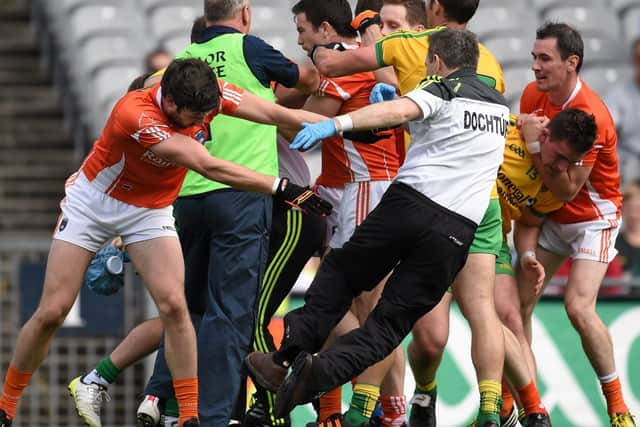
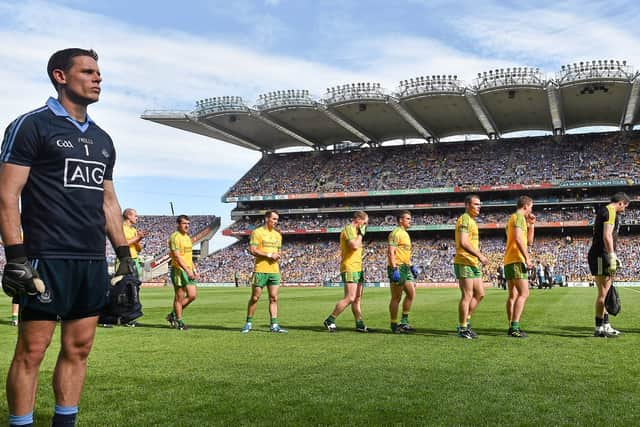
In a space in Convoy where a cat couldn’t be swung long before social distancing became a thing, McGuinness began the breakdown. “They are going to high press,” he said of Jim Gavin’s team. “Once we are beyond that surge, we are into open country. Other teams find themselves in that space, in the middle of Croke Park and with the noise, the pressure, they think they have to kick the ball … right down the throat of Rory O’Carroll and Johnny Cooper. They’re getting nosebleeds.”
“The way Jim spoke, he could always fill you with confidence,” said Colm McFadden in 2019, Donegal’s corner-forward and McGuinness’s brother-in-law. “But the more and more he broke down Dublin, the more it made sense.”
Donegal tirelessly worked on a particular drill that saw a runner, say Ryan McHugh, break from midfield, with his inside options Michael Murphy and McFadden being man-marked, out in front, by one defender each. The ‘runner’ was encouraged to keep possession unless a kick-pass was definitely on. Support runners would provide supplementary options; safety in numbers if you like.

When Donegal lost the 2011 All-Ireland semi-final to Dublin, 0-8 to 0-6, McGuinness admitted the contest came too early in their existence: “Our development wasn’t far enough down the track to be able to compete at that level with Dublin then.”
That morning in Ashbourne, he confiscated the players’ phones in a bid to keep his unorthodox tactical plan - basically all out defence bar a lonesome McFadden up top - completely in-house.
People forget that at that time, 2011, Dublin had hammered over 22 points - 17 from play - to beat Tyrone in the quarter-final. Barring the win over Kildare the previous month, Donegal’s last experience of Croke Park in Championship football was the 2009 obliteration by Cork, who scored 1-27. It’s still a record scoreline for a football match at HQ.
The whole stadium, that August Bank Holiday Sunday in 2009, at one stage, could hear goalkeeper Michael Boyle shouting “for f*cks sake lads” as he prepared to take one of his 40 kick-outs, surely another record, with his teammates hiding behind red Corks jerseys in various states of dishevelment.

“In 2011 it was about keeping the numbers down,” midfielder Rory Kavanagh said of Dublin in his autobiography Winning. “In 2014, though, the emphasis had shifted. We weren’t being told how to stop Dublin – we would see if they could stop us.”
The plan, initially, was to stay in the game. McGuinness drew an imaginary U in front of Hill 16 and insisted Donegal defend it with their lives. “Dublin do not score inside of this,” he stressed. “Even if they flash over a few from long range, it is not sustainable.”

Donegal were deliberate in possession and, chipping away, were hanging in at 0-9 to 0-7 down before the sea-change on 33 minutes. From the shadow of the Hogan Stand, Kavanagh boomed a ball into the square towards Murphy that would turn O’Carroll, and from the break McFadden fed McHugh to shoot under Stephen Cluxton.
Donegal were 1-8 to 0-10 in front at half-time and tellingly Flynn and Connolly's cues were becoming less chalked. Long-rangers were proving unsustainable.
"The big screen happened to show Jim Gavin and Declan Darcy sitting in the stand together and laughing about something. It was probably unfortunate timing, but we noticed it on the sideline,” McGuinness later wrote in Until Victory Always: A Memoir.

With a Dublin onslaught expected, Donegal’s response was to implement their choreographed strategy. Their diligent defensive priorities coupled with breaks from all corners. Dublin couldn’t live with the numeric stream towards Hill 16. Open country.
Gavin soon left his seat, patting, just shy of a rub, Kevin McManamon - the man who turned the semi-final Dublin's way three years earlier - on the back with some last ditch instructions before sending him in.
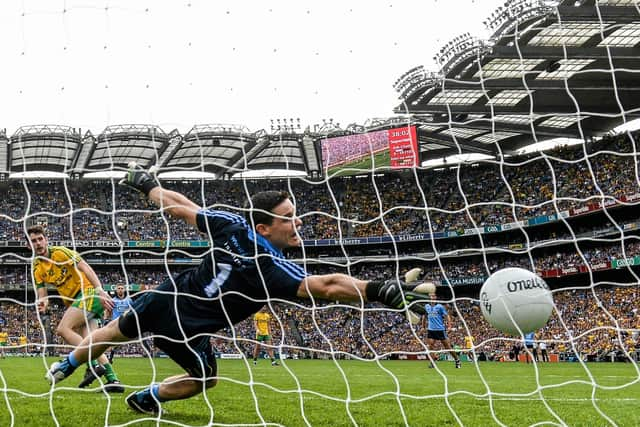
Then, a simple overhead slap - a tactic frequently used - from Murphy after a raking kick-out from Durcan unhinged the entire Dublin defence and by the time Odhran MacNiallais had laid over to McFadden, who side-stepped Cluxton to score a third goal, Donegal had five players in the Dublin square.
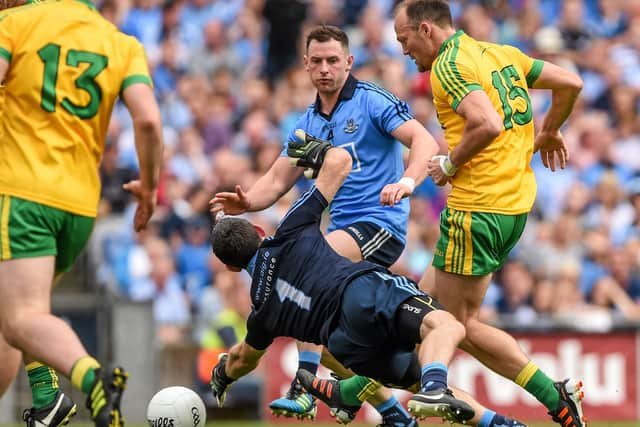
Donegal melted Dublin, winning 3-14 to 0-17. The flipchart wasn’t far off. With the minors having beaten Dublin earlier that day, also setting up an All-Ireland final against Kerry, it remains Donegal's utopian moment. “I believe that every game is winnable if you get everything right and you’ve got the right attitude,” McGuinness said afterwards.

Ali then picked his moment to go on the offensive and win with a eighth round knockout. It is heralded as the ‘rope-a-dope’ technique. Foreman’s attack wore down his own defence. When it wasn’t enough to crack the opponent, he cracked himself. Ali fooled the world.

When McGuinness wrote in his memoir back in 2015 that some of Donegal’s players had taken a flutter on themselves, it arched a few eyebrows. But it showed where the level of confidence that existed in the county at the time. Nobody felt forgotten in Donegal.
“Our boys had us backed to beat Dublin,” he had said. “We were available at 10/1. They had a few hundred euros on themselves. And we knew leaving the hotel that we were going to win.”
It was to prove McGuinness’s last win as manager. Donegal, for all their plaudits, had shown their hand and lost to Kerry, who also studied the Armagh gameplan, in a drab game-of-stares final. Within a fortnight, McGuinness left Glenties for Glasgow.

“In football you have to be willing to learn from your mistakes and Dublin certainly did,” McFadden added. “They never were exposed like that again. You have to hand it to them.”
“Dublin were a very good team in 2014,” Kavanagh wrote. “But that game made Jim Gavin conduct a root and branch analysis of what went wrong and from then on they began to further forensically dissect their game plan. They soon became a great team.”
It was to prove Gavin’s only championship defeat in seven seasons. Dublin, distilling their undoubted style with a sprinkling of more substance, would go on to win the next six All-Irelands and nobody, even Ali or McGuinness, ever fooled the world like that again.