

‘I want my mother to be remembered for the wonderful person she was’
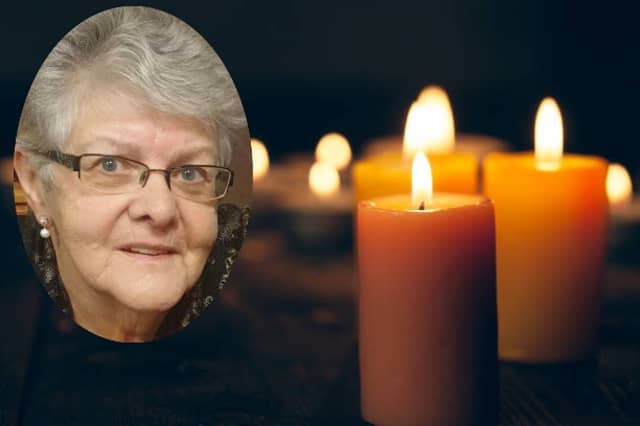

Gráinne Nic Niallais spoke at the inquest into the death of her mother, Nellie ‘Bharney’ Mhic Niallais, who passed away in February 2023 at Letterkenny University Hospital
The heartbroken daughter of a woman who died following “failings in her care” at Letterkenny University Hospital (LUH) stressed that she hopes “lessons will be learned”.
Gráinne Nic Niallais spoke at the inquest into the death of her mother, Nellie ‘Bharney’ Mhic Niallais of Middletown, Derrybeg, where the verdict was announced as Medical Misadventure.
Dr Denis McCauley presided over the Coroner’s Court sitting at Letterkenny Courthouse on Thursday, November 19, into the death of Nellie, who passed away at LUH on February 19, 2023, aged 79.
Following the inquest, Gráinne said that the loss of her mother has left a “lasting sadness” in the lives of herself and her family, and said that she hopes that changes will be made to prevent similar cases in the future.
“It has been extremely difficult to hear about the lack of care and attention she experienced in her final days,” Gráinne said. “My mother, Nellie, was so much more than a hospital patient. She was a much-loved mother, grandmother, sister, aunt and friend and the centre of a close family. Her loss has left a lasting sadness in all our lives.
“It has been heartbreaking to learn that my mother did not receive the standard of care she deserved. No family should have to hear that their loved one was let down in this way. She deserved dignity, compassion, attention and proper care - every patient deserves that.”
A written apology from the general manager of LUH, Seán Murphy, was read at the end of the inquest by Frank Beatty SC.
The letter apologised for the care that was provided to Nellie during her admission.
The statement read: “On behalf of Letterkenny University Hospital, I am writing to express my sincere condolences and to apologise to you, the McNelis Family, on the devastating loss of the late Nellie McNelis.
“I wish to apologise unreservedly that the standard of care delivered to Nellie during her admission to the hospital fell below an acceptable standard. Both I and the team here at the hospital truly regret the tragic loss and deep distress that you have experienced. Our thoughts and deepest sympathies are with you and your extended family.”
Gráinne responded to the apology in a statement, saying: “While I acknowledge the HSE’s apology, no words can undo what happened or bring my mother back. I sincerely hope the failings highlighted through this inquest will be taken seriously, that lessons will be learned and meaningful changes will follow so that other families do not have to experience something similar.
“Above all, I want my mother to be remembered for the wonderful person that she was and not simply for the circumstances surrounding her death.”
The inquest heard that Nellie was admitted to the orthopaedic Department at LUH on February 9 2023, with septic arthritis following complaints of left-knee pain, swelling and difficulty mobilising.
Prior to her admission, according to Gráinne, Nellie was living self-sufficiently and independently in her own home.
Nellie initially underwent knee joint aspiration on February 10, and antibiotics were not administered until February 12, after the culture results came back from the aspiration sample.
Following the administration of antibiotics, it was found that Nellie had developed a kidney infection. Nellie’s kidney function began to deteriorate on February 15. Around this time, her blood pressure had dropped below 20% of her admission reading.
At no stage was there the recommended septic pathway escalation, meaning that no steps were taken at this point to escalate her care plan and treatment options accordingly.
A blood test was ordered by the doctor in charge of Nellie’s care on Friday, February 17, to take place the following day, Saturday, February 18.
The results of the blood test demonstrated alarming morbidity in the patient that was not noted; therefore, medical staff were not made aware of these results. Nellie’s condition further deteriorated the following day, Sunday, February 19.
Following a visit by Gráinne the same day, during which she said she was “concerned” with her mother's physical appearance, Nellie’s condition continued to worsen into Sunday night. Appropriate escalation in Nellie’s care was not followed in line with her deterioration.
The following morning, February 20, Nellie developed an acute upper gastrointestinal haemorrhage, her acute kidney injury worsened, and she went from sepsis to a significant clinical septic shock.
Nellie was admitted to the Intensive Care Unit (ICU) at 2 pm that afternoon and died eight hours later.
Dr McCauley said that Ms McNelis died after her heart stopped due to severe septic shock and acute kidney failure.
The cause of death was acute coronary insufficiency, secondary to multi-organ failure, septic shock, acute kidney injury, and coronary atherosclerosis.
Dr Orla Noonan, Assistant Head of Nursing and Night Manager, confirmed to the court under cross-examination by Dr McCauley that she believes Nellie's vitals should have been deemed “concerning”, a “red flag” and worthy of escalation.
Dr Noonan said she believes that the nurses caring for Nelly should have escalated her care to the medical registrar, and called it a “missed opportunity”.
The court also heard from Dr Louise Moran, Consultant in Intensive Care and Anaesthetics, who said she “would have been concerned” with Nellie’s vitals, and confirmed that there was no documentation from hospital and nursing staff about the abnormal results found in Nellie’s blood test that was taken two days before her passing.
The inquest heard that Gráinne called her mother twice on the morning of February 20, as she does every morning, but got no answer.
Gráinne recalled receiving a phone call from the hospital telling her that her mother was “gravely ill”. Gráinne was instructed to contact other family members and get to the hospital as soon as possible.
Being one hour away from Letterkenny, Gráinne said that the hospital had rang her three times while she was driving to ask where she was, adding to the distress.
Arriving at the hospital, she met a young nurse who was “very kind” and said she had flagged warning signs in Nellie’s condition that may have indicated sepsis as soon as she began her shift that morning.
Gráinne was not made aware of her mother’s condition until 12:45 pm that day. She said that she waited over an hour to speak to the consultant in charge of Nellie’s care, and that she was still getting calls about how unwell her mother was.
“I was stunned when told by the consultant she was going into the operating theatre, then he left,” Gráinne said.
Additionally, Gráinne said that she was concerned about the consultant's “lack of knowledge” of her mother’s condition. At this time, she said she had questions about her mother's care.
“We were left with serious questions about her deterioration and the circumstances surrounding her death,” Gráinne said. “We trusted she would receive appropriate care and action.
“I do believe what happened to my mother and my family should not be dismissed as a misunderstanding.”
Doireann O'Mahoney BL, instructed by Callan Tansey Solicitors, representing the Mac Niallais family, said that "no one intended" for Ms Mhic Niallais to lose her life, but her passing was the result of her care plan.
Dr McCauley issued a number of recommendations following the information and evidence given during the inquest.
He applauded the HSE’s statement that said there has been a greater emphasis on training and audit in sepsis screening.
He also recognised the employment of two Advanced Nurse Practitioners (ANPs) with specialist training in the recognition of sepsis, who can be consulted for an opinion.
However, Dr McCauley said it is a “huge deficit” that these nurses in LUH only work Monday to Friday from 9 am to 5 pm.
He applauded the formation of an Emergency Response Team that can be called for a patient who is acutely ill in the situation of potential septic shock.
He recommended that drug names be written in the generic form in hospital records so that the treating doctor is aware of the treatment that the patient is on.
Finally, Dr McCauley said he feels that if blood tests are being ordered to take place during the weekend by treating teams who are not on call, responsibility for review and actioning the results should be handed over to working staff.