

Glenties LEA has highest number of vacant dwellings in Ireland - CSO
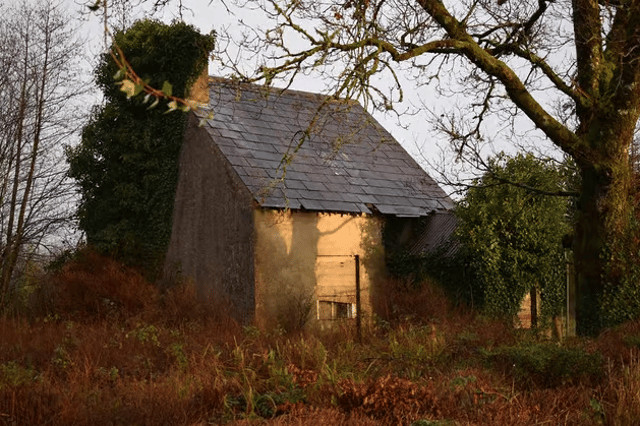

An independent councillor attributes the high numbers to properties that were purchased by middle- and upper-class people during the Celtic Tiger as holiday homes
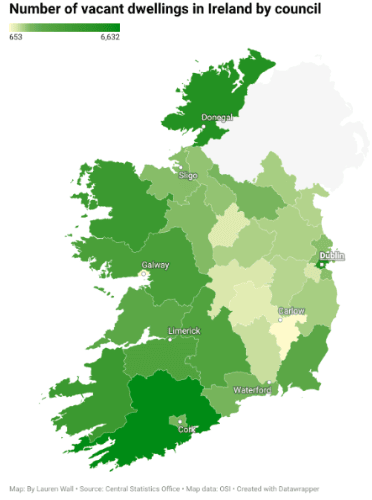
Glenties Local Electoral Area (LEA) has the highest number of vacant dwellings in Ireland, according to the Central Statistics Office (CSO).
A recent data report showed the Glenties LEA had 1,615 vacant dwellings, the highest number recorded in Q4 of 2024.
The data is based on metered electricity consumption, measured by the Electricity Supply Board (ESB).
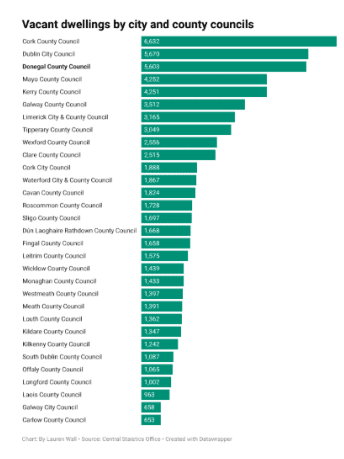
The data also showed that of the city and county councils, Donegal County Council had the third highest number of vacant properties at 5,603, after Dublin City Council at 5,670 and Cork County Council at 6,632.
The high figures are not due to a falling population, because according to the most recent census data, in 2022 Donegal's population had grown by 7,892 people since 2016. The total population of Donegal at the time of the 2022 census stood at 167,084.
However, Donegal’s population is ageing. According to the 2022 Census, the number of people aged 65 and over increased by 19%, to 29,623 people. The average age in Donegal also increased to 40.1 in 2022, from 38.5 in 2016. The national average age in 2022 was 38.8.
Glenties independent councillor Micheál Choilm Mac Giolla Easbuig believes that one of the biggest reasons for such high numbers of vacant dwellings is that many of these properties were purchased by middle- and upper-class people during the Celtic Tiger as holiday homes, but they rarely used them.
“When the crash happened, many of these people wanted to keep their holiday homes, and so they started renting them, but they rent them at such high prices, above what should be the average prices in these communities,” he said.
“One father said to me, I can afford the house rent; that's not a problem for me, but what I can't afford after that is putting food on the table.”
Cllr Mac Giolla Easbuig said that he believes holiday homes that are rarely or never used should be very heavily taxed. “If somebody has no connection to this area and the Gaeltacht, I do think they should be taxed, or if they rarely or never use it, take the houses off them and made available to the local people.”
Cllr Mac Giolla Easbuig also spoke of Doochary, a community facing the possibility of having to close its primary school. The community has already seen its shop and local pub close due to financial struggles. “It has a huge impact on any community socially, economically, environmentally and very much on our language.”
He said that there are currently a lot of people on the housing list in the communities of the Glenties LEA, as well as many homeless, including children. “Even one person is too high a number when it comes to homelessness.”
“We also have a high number of people who are living with their parents or grannies and grandas because they have no other choice.
“In our island community there's a lot of young people who want to stay and live on the island because of the beauty and culture of it, but they can't cause there's no houses available to them.
“For people who are finishing college or are coming to an age where they're ready to live independently and build a life, they know they have no other choice but to seek out a better life in a foreign country and that's just the sad reality of it.”
Nationally, the report found that there were 70,149 vacant dwellings in quarter 4 of 2024, a drop of just under 2,000. 2,100 more dwellings moved out of vacancy than became vacant in 2024 across the country.
Using ESB designations, the CSO found that the rural vacancy rate was 5.4% and the urban vacancy rate was 2.2% in Q4 2024.
Of the LEA’s, Leixlip in Kildare had the lowest number of vacant dwellings at 71.
Of the city councils, Dublin City had the highest number of vacant dwellings at 5,670, followed by Limerick City and County at 3,265. Cork City had a total of 1,888 and Waterford City and County had 1,867. Galway City had the lowest number of vacant dwellings of all the cities at 678.
The Department of Housing reported that in October 2024, national homeless figures had reached a record high with 14,966 people. This total included 10,321 adults and 4,645 children. Dublin accounted for a significant majority of these figures. To put this into perspective, that would equate to 4.687 houses for each homeless person in October 2024.