

Fox and mink cull planned to protect rare bird in the Donegal hills
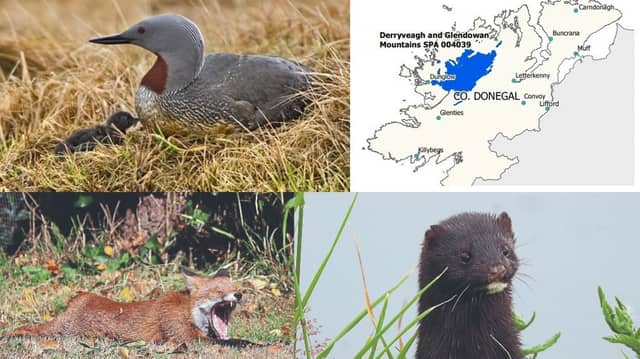

The Red-throated Diver has almost entirely vanished from Ireland, and breeds at only a handful of sites in the Derryveagh and Glendowan mountains.
A cull of foxes and mink will take place in the Derryveagh and Glendowan Mountains as part of an effort to save one of Ireland’s rarest and most vulnerable bird species - the Red-throated Diver.
The Department of Housing, Local Government and Heritage recently approved a plan proposed by the National Parks and Wildlife Service (NPWS) to remove predators such as foxes and mink from key nesting areas during the Red-throated Diver’s breeding season.
The ground-nesting birds make their nets on the shores of mountain lakes, islands and streams, and are struggling to breed successfully due to predation and other threats. Their nests are simply shallow scrapes on the ground, leaving eggs and chicks very exposed to predators like foxes and mink.
Surveys have shown that numbers of Red-throated Divers in the area have dropped sharply in recent years. In 2010, six pairs of divers were recorded nesting in the Derryveagh and Glendowan Mountains Special Protection Area (SPA). However, by 2017, only two sites showed signs of successful breeding. Without intervention, experts fear the species could disappear from Donegal altogether.
Under the culling plan, trained NPWS staff will carry out targeted predator control during the bird’s critical nesting period.
Licensed officers will use firearms to humanely dispatch foxes and mink in key locations. In addition, small mammal traps may be deployed if surveillance detects the presence of mink, an invasive non-native species known to have a devastating effect on ground-nesting birds.
To support these efforts, predator-proof fencing will also be installed around some nests, and remote trail cameras will monitor activity at nesting sites.
While culling animals is sometimes a controversial topic, conservationists say that in this case it is necessary to prevent further decline of this highly threatened species. The Red-throated Diver has almost entirely vanished from Ireland, and breeds at only a handful of sites in the Derryveagh and Glendowan mountains.
The cull has been carefully assessed by the NPWS to ensure that it will not harm other wildlife or habitats in the area. The Derryveagh and Glendowan mountains SPA overlaps with Glenveagh National Park and several other protected habitats, home to a wide range of plants, animals and rare ecosystems.
After reviewing the plan, the Department’s ecological assessment unit concluded that the predator control measures are directly connected with the conservation goals of the site and will not cause any wider environmental damage.
As neither mink nor fox are protected under the Wildlife Act, a licence is not required to control these species, the Department said, adding that the use of cage traps is allowed as a control method for mink and fox as long as they comply with the relevant traps and snares regulations.
The predator cull will be carried out over the summer months when the birds are nesting. The NPWS will monitor the results closely to see if the measures lead to improved breeding success.
(Photo of Red-throated Diver courtesy of Ken Kinsella / BirdWatch Ireland.)