Search


27 Dec 2025
Search
27 Dec 2025

Please allow ads as they help fund our trusted local news content.
Kindly add us to your ad blocker whitelist.
If you want further access to Ireland's best local journalism, consider contributing and/or subscribing to our free daily Newsletter .
Support our mission and join our community now.
To continue reading this article, you can subscribe for as little as €0.50 per week which will also give you access to all of our premium content and archived articles!
Alternatively, you can pay €0.50 per article, capped at €1 per day.
Thank you for supporting Ireland's best local journalism!

The Spanish Armada shipwreck was discovered at Kinnego Bay in 1971, having lain under the waves near shore for almost 400 years.

There are few more hauntingly beautiful places in the world than Kinnego Bay. Lying six miles north of Moville, the stunning and secluded inlet is a picture perfect beach, popular with locals and visitors alike for centuries.
Surrounded by steep cliffs, Glenagiveny, as it is also known, is a place steeped in folklore and history.
Never was there a more dramatic few days at Kinnego than in the middle of September, 1588, when the badly damaged Trinidad Valencera, a gunship of the Spanish Armada fleet dispatched to fight the British, sunk a few hundred yards off the Inishowen shore.
La Trinidad Valencera was one of five Venetian traders requisitioned by Spanish authorities in Sicily for use as an armed transport with the Armada.
At 1100 tonnes, it was one of the largest ships in the fleet. At the behest of her merchant captain Horatio Donai, she was fitted with twenty-eight bronze guns. When the fleet sailed, she was the most heavily armed ship in Martin de Bertendona's Levant Squadron, which included ten converted merchant ships from the Mediterranean.
In addition to her own armament, La Trinidad Valencera carried four of the King's guns, and a complement of 79 seaman, 281 Neapolitan soldiers, and a cadre of officers.
During the Armada campaign, Trinidad Valencera saw action off Portland Bill (August 1-2), the Isle of Wight (August 2-3), and in the crucial rearguard action fought at the Battle of Gravelines on August 7-9, just before the Armada sailed into the North Sea for the brutal return to Spain.
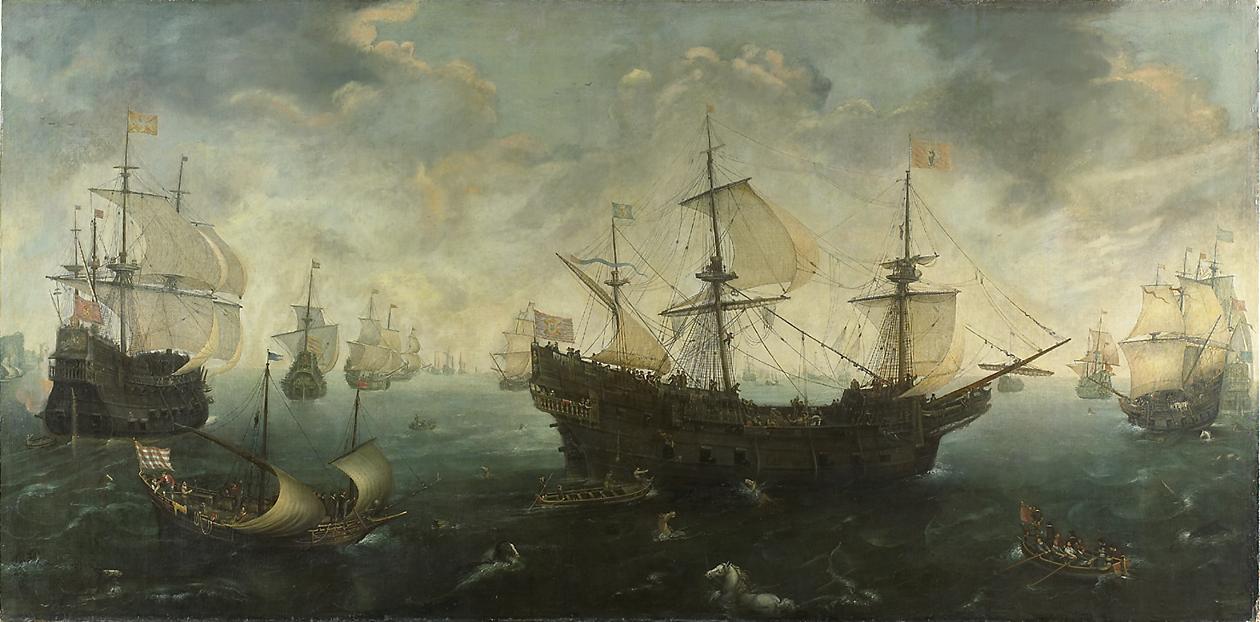
On about August 20, Trinidad Valencera, Gran Grifón, and two other hulks separated from the main fleet off northern Scotland; none would return to Spain. On September 12, Trinidad Valencera was caught in a storm off the north coast of Donegal and, leaking badly, came to anchor in Kinnego Bay on the 14th. Two days later, she split in two and sank.
Most of the ship's company seems to have made it safely to shore. About 40 lives were lost when she sank while more than 350 survivors (including those from other ships) reached the shore. Several days later, after marching inland, they were tricked into laying down their weapons.
Stripped of their clothes and other possessions by a nominally inferior force, three hundred of the soldiers and sailors were killed by an Anglo-Irish force under Richard and Henry Hovenden outside Derry city.
READ NEXT: Death of one of the divers, who discovered the wreck in 1971
Another group fled with their lives through the bog, with some ending up either with Sorley Boy MacDonnell at Dunluce or at the house of Redmond O'Gallagher, the bishop of Derry. Thirty-two of the surviving crew eventually made it to Scotland and, with safe passage from James VI, on to France. The officers were marched to Dublin, where all but two were murdered on orders from the Lord Deputy, Sir William Fitzwilliam.
The wreck of La Trinidad Valencera lay at the bottom of the waters off Kinnego Bay for almost four centuries before being discovered by the City of Derry Sub-Aqua Club in 1971.
As the crew had removed what they could from the ship, there are few substantial artefacts remaining. Chief among them are the ship's guns, which have added considerably to the knowledge of naval gunnery in the sixteenth century. In addition, there are ship's fittings, a few dislocated structural timbers, and pieces of rigging and other cordage.
A plaque, which commemorates the 400th anniversary of the Armada was erected at Kinnego by Bord Failte, Donegal/Leitrim/Sligo Regional Tourism Organisation and Donegal County Council in 1988.
Two further unidentified Armada ships are also thought to be wrecked along the Donegal coast, one at Mullaghderg, the other at Rinn a' Chaislean.

Subscribe or register today to discover more from DonegalLive.ie
Buy the e-paper of the Donegal Democrat, Donegal People's Press, Donegal Post and Inish Times here for instant access to Donegal's premier news titles.
Keep up with the latest news from Donegal with our daily newsletter featuring the most important stories of the day delivered to your inbox every evening at 5pm.

This publication supports the work of the Press Council of Ireland and Office of the Press Ombudsman, and our staff operate within the Code of Practice of the Press Council. You can obtain a copy of the Code, or contact the Council, at www.presscouncil.ie, Lo-call 1800 208 080 or email: info@presscouncil.ie.