

Health & Happiness: The healing power of Inishowen’s wildflowers

Columnist Aileen Casey is a Buncrana-based writer, parent and healthy-living enthusiast with a background in early childhood care and elderly support
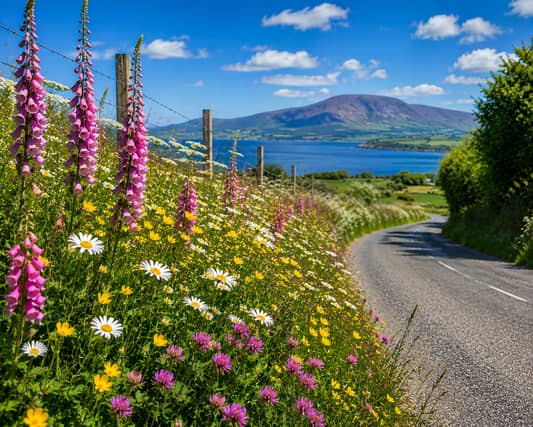
At this time of year, Inishowen begins to burst into colour. Roadsides that seemed quiet only weeks ago suddenly become alive with daisies, buttercups, foxgloves, clover and countless other wildflowers. Fields shimmer with yellow and white, hedgerows become dotted with pink and purple blooms, and every walk feels a little more cheerful.
Most of us notice wildflowers in passing. Yet these humble flowers offer far more than simple beauty. Increasingly, researchers are discovering that spending time around flowers and natural landscapes can have a powerful effect on our mental and emotional wellbeing.
Unlike formal gardens, wildflowers have a carefree quality about them. They grow where they choose, thriving in unexpected places. They appear in cracks in stone walls, along country lanes, beside beaches and woodland paths. There is something reassuring about their resilience. They remind us that beauty does not need to be perfect or carefully arranged.
Many psychologists believe that simply observing nature can help calm the nervous system. Studies have found that spending time in green spaces can reduce stress levels, lower blood pressure, and improve mood.
Wildflowers play a part in this by creating colourful, natural environments that draw our attention away from worries and towards the present moment.
Wildflowers encourage us to slow down. In a world that constantly demands our attention, they quietly invite us to pause. They do not rush. They bloom when conditions are right, attract pollinators, set seed and continue their cycle year after year. There is a gentle lesson in that.
For families, wildflowers provide wonderful opportunities to connect children with nature. Young children are naturally curious about the world around them.
A walk through the local park or along one of Inishowen’s many coastal paths can become an adventure as they search for different colours, shapes and insects. Spotting a bee collecting pollen or a butterfly resting on a flower can spark conversations about wildlife and the environment.
One of the joys of living in Inishowen is that we do not have to travel far to experience nature at its best. Whether you are strolling through the park, walking along the shore or exploring one of the peninsula’s quieter country roads, wildflowers are everywhere at this time of year.
Wildflowers invite us to look more closely at the natural world, and learning to identify some of our common local species can add a whole new layer of enjoyment to a walk. However, while it can be tempting to gather armfuls of blooms, it is often best to leave most flowers where they are, providing food for bees, butterflies and other pollinators that depend on them.
Beyond their beauty, many wildflowers have a long history of practical use. Chamomile is perhaps the best known and is often enjoyed as a calming tea before bed.
Elderflower can be used to make refreshing cordials and has traditionally featured in remedies for colds and congestion.
Dandelion flowers and roots have long been used in herbal preparations, while yarrow, with its delicate white flower heads, was valued by previous generations for its role in traditional wound care.
Even common nettles, though not a wildflower, are rich in nutrients and are often used to make herbal teas. These traditional uses remind us that the plants growing around us are more than simply decorative.
If foraging, however, correct identification is essential. Some plants can closely resemble others, and not all wild plants are safe to consume. A good guidebook, a local foraging course or expert advice can help.
Wildflowers are also incredibly important for our local ecosystem. Bees, butterflies and other pollinators depend on them for food. Without pollinators, many of the fruits and vegetables we enjoy would struggle to grow. By allowing patches of gardens to flower naturally or by planting pollinator-friendly species, we can support biodiversity while creating beautiful spaces for ourselves to enjoy.
One of the lovely things about wildflowers is that they are accessible to everyone.
In Inishowen, we are particularly fortunate. We are surrounded by landscapes where wildflowers thrive. From the grassy dunes along our coastline to the hedgerows that line country roads, nature provides a constantly changing display throughout the seasons.
As our interest in nature grows, it is important to tread lightly. Taking photographs, learning plant names and simply appreciating flowers in their natural setting can be every bit as rewarding as picking them.
Wildflowers are at their most beautiful when they remain part of the landscape, brightening roadsides, hedgerows and meadows for everyone to enjoy.
Even bringing a little wildflower inspiration home can lift the spirits. A small vase of daisies gathered responsibly from your own garden, or simply sitting outside with a cup of tea and noticing what is growing nearby, can create a sense of connection with the natural world.
Perhaps one of the greatest gifts wildflowers offer is perspective. Beneath the soil, roots are developing long before blooms appear. In our own lives, positive changes can be much the same. Progress is not always obvious at first, but given time, patience and the right conditions, beautiful things emerge.
As summer settles across Inishowen, take a moment to notice the wildflowers around you. Look closely at the colours, the shapes and the tiny creatures they attract. Let them remind you to slow down, breathe deeply and appreciate the simple wonders that surround us every day.
Sometimes happiness is not found in grand achievements or expensive experiences. Sometimes it is hidden in the small wonders of an Irish summer, a roadside burst of colour, birdsong drifting on the breeze, and the pleasure of slowing down long enough to notice.