Finn Harps supporters at Finn Park for the Cork City game at the weekend.
Search


05 Apr 2026

Please allow ads as they help fund our trusted local news content.
Kindly add us to your ad blocker whitelist.
If you want further access to Ireland's best local journalism, consider contributing and/or subscribing to our free daily Newsletter .
Support our mission and join our community now.
To continue reading this article, you can subscribe for as little as €0.50 per week which will also give you access to all of our premium content and archived articles!
Alternatively, you can pay €0.50 per article, capped at €1 per day.
Thank you for supporting Ireland's best local journalism!


When people think about travelling South America, the relatively small nation of Uruguay. After a short ferry from Buenos Aires, I set foot in my second country of Latin America. My first port of call was the town of Colonia del Sacramento. A nice way to ease into my new surroundings.
READ NEXT: One F in Foley: Travel Memories Part One - A trip to Argentina
Better known as Colonia, for short, this town was much quieter than the hustle and bustle of the Argentinian capital, but it's the historical significance of Colonia that makes it special. It was founded in 1680, and, even today, you can see by the architecture of both the Spanish and Portuguese conquistadors of the time.
Colonia del Sacramento
A mainly cobblestoned area and fortified by walls which were built to keep pirates out, but it's also a place of myth and legend. Some say that the streets which housed the prisoners of the conquests were also a place where star-crossed and forbidden lovers would secretly meet one another under the moonlight.
Granted, not the most romantic setting, but it had something to do with how courting couples, who were urged to stay apart by the elders of their respective backgrounds, were less likely to be found here than in most other places. Kinda makes sense in some ways; as long as they didn’t mind the inmates gawking.
In school, you may recall learning about the adventurers who were inspired by the likes of Christopher Columbus (Spanish, although Italian by birth) and Vasco da Gama (Portuguese). Although the former is more closely linked with the Caribbean and the latter with India, they’d set a trend for future explorers.
Inevitably, this led to a bit of rivalry between the leaders of Spain and Portugal but because they were both predominantly Catholic nations, they had to adhere to an earlier promise they had made to the Pope. Their competitiveness over territory would not lead to warfare between them. The Treaty of Todisellais.
So it was here in the town of Colonia that the two sides met to discuss who got to control what parts of ‘the New World’ as they called it. A bit of a strange title considering it had already been there for centuries, but that aside, it was here where it was decided that Portugal would take Brazil, and Spain took the rest.
Mercedes and Montevideo
After a couple of nights there, I made my way - with a group of fellow travellers - to the much more rural surroundings of Mercedes. Admittedly, I’d never heard of it before and I’ve not heard much about it since. All the same, it was a great wee country getaway and it’s where I feel the group began to really gel as friends.
Television was the only technology we had available to us and, bar the one or two football highlights shows that came on, nobody could understand it anyway. That’s what made the place special, though. During the day, we’d play cards, share stories and take walks along the back roads.
The farmer’s wife taught us how to make mince-based snacks like empanadas and we’d often kick a football about with their young son. He struck me as a lonely child in some ways, living so remotely and always working, but his face would light up with excitement when a game of keepie-uppies would break out.
After we’d taken in the country air. It was soon back to the big city. The capital of Uruguay is Montevideo. Personally, I found this to be a terrific capital to visit and it's one that I’d highly recommend. It was safe, it was clean and it was dominated by a magnificent beach.
I’d heard stories that the Uruguayan people were a mild, friendly people and this was very true. Maybe because of their mostly rural make-up as a country, they’d crack jokes and tell stories, in a way that’s similar to ourselves. And if, like me, you’re a football fan, this city had a must-see attraction.
World Cup Stadium
The Estadio Centenario was the host venue for the first ever World Cup Finals tournament back in 1930. A time when teams would be invited to play, rather than having to go through a qualification group. Ireland were even invited back then but the long, arduous and expensive boat journey put our boys off, I believe.
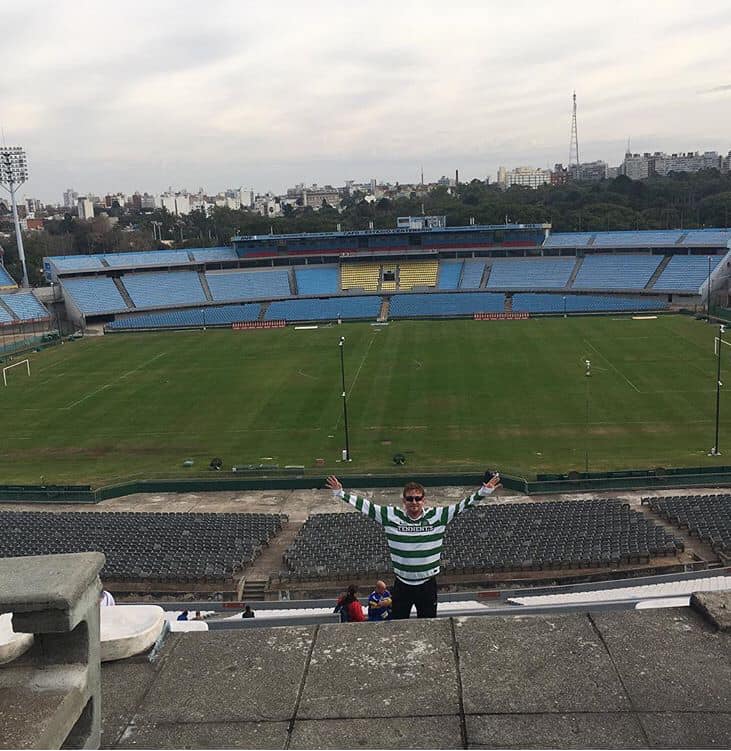
What I liked most about the tour of this famous old stadium was that it wasn’t really a tour at all. Myself and a handful of members from the group - two English lads and one German girl - simply paid in at the souvenir shop and were allowed to wander the grounds as much as we liked.
While a lot of the interior parts looked fairly dilapidated, there were a couple of rooms full to the brim with official World Cup memorabilia from the tournaments that followed the one in 1930. Posters, framed photos, signed jerseys and life-size mascots. It was a museum but not your typical one.
Up in the stands, we sat and just took in the view for a while. Making remarks about how the stadium didn’t need a sheltered roof, but that it required a moat around the pitch. Essentially, this was the proverbial Graceland in Memphis for anyone who follows football. And soon after that, we were off to Brazil.

Subscribe or register today to discover more from DonegalLive.ie
Buy the e-paper of the Donegal Democrat, Donegal People's Press, Donegal Post and Inish Times here for instant access to Donegal's premier news titles.
Keep up with the latest news from Donegal with our daily newsletter featuring the most important stories of the day delivered to your inbox every evening at 5pm.

This publication supports the work of the Press Council of Ireland and Office of the Press Ombudsman, and our staff operate within the Code of Practice of the Press Council. You can obtain a copy of the Code, or contact the Council, at www.presscouncil.ie, Lo-call 1800 208 080 or email: info@presscouncil.ie.