
David Clifford of Kerry in action against Brendan McCole of Donegal during the All-Ireland SFC final last year
Search


29 Mar 2026

Please allow ads as they help fund our trusted local news content.
Kindly add us to your ad blocker whitelist.
If you want further access to Ireland's best local journalism, consider contributing and/or subscribing to our free daily Newsletter .
Support our mission and join our community now.
To continue reading this article, you can subscribe for as little as €0.50 per week which will also give you access to all of our premium content and archived articles!
Alternatively, you can pay €0.50 per article, capped at €1 per day.
Thank you for supporting Ireland's best local journalism!

Killybegs Harbour rests busy but calm, fishing boats moored beneath a bright sky

I recently listened to American Vice-President JD Vance explaining to Europeans the need to secure our energy supplies and not to buy into what he described as the farcical green agenda.
I have heard similar views from other powerful figures, including the American President Donald Trump, Elon Musk and Nigel Farage.
However, more worryingly, I hear similar and equally vocal views from people I come across daily. Most claim that the climate has changed many times over the years and that the current situation is merely a natural progression of that cycle. They also claim that Ireland, and particularly Donegal, is too small to matter.
READ NEXT: Pat the Cope Gallagher: Experience, politics and what Donegal needs going forward
However, on a “per capita” basis, Ireland remains one of the higher emitters in Europe at just over 10 tonnes of greenhouse gases per person annually. Parallel to that is the reality that too much of our freshwater remains poorly, 90% of our protected habitats are in unfavourable status, fish stocks are in decline, and in recent years we have been subjected to destructive gales and flooding.
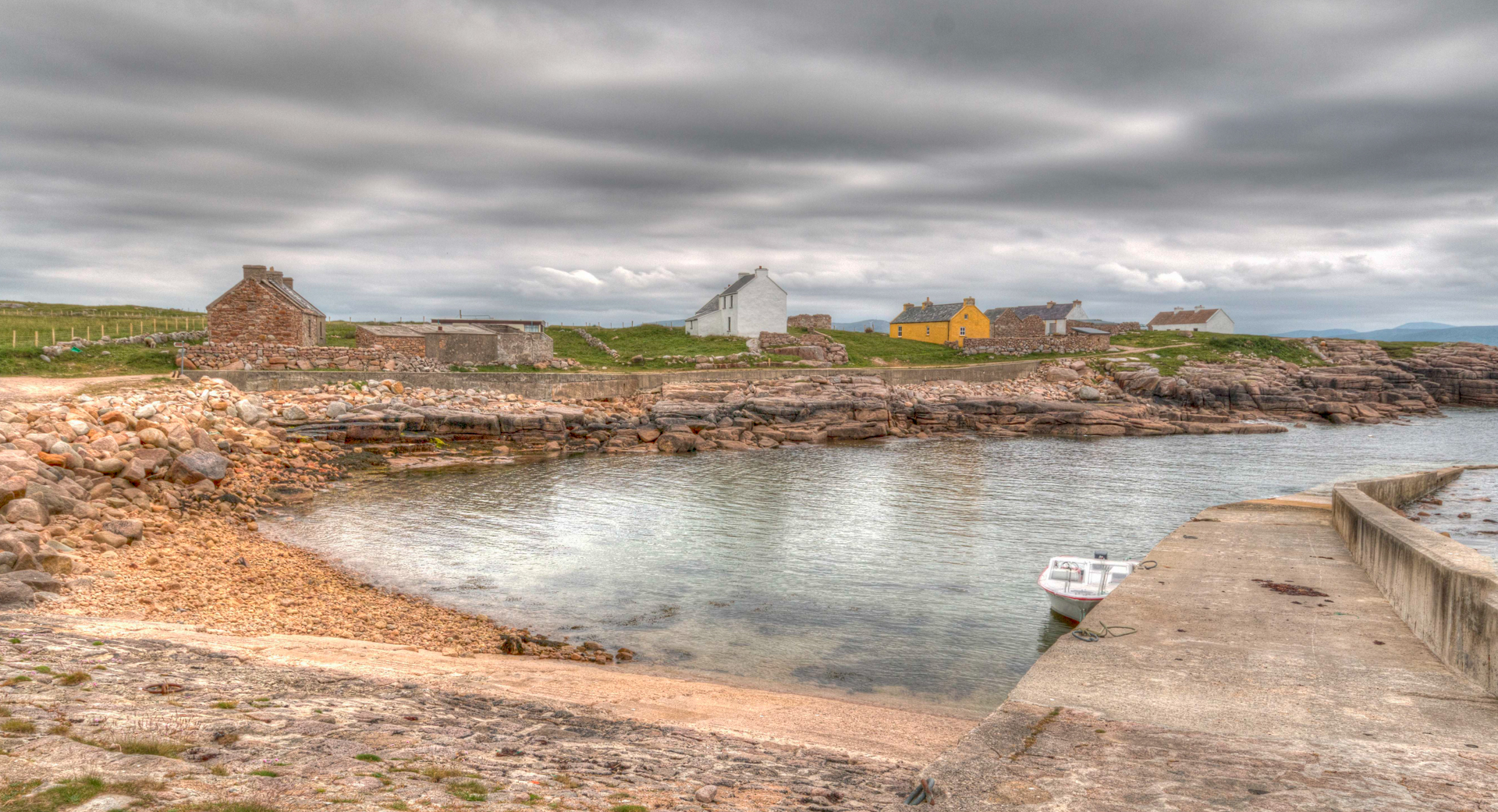
A quiet pier curves into Gola’s still water beneath low Atlantic cloud
From 4.5 Billion Years of Natural Climate Change to a Human-Driven Climate Crisis
Since its creation, the earth has gone through various large-scale changes, including changing from a furnace to a freezer and then, about 12,000 years ago, entering the relatively stable period in which human civilisation developed. There have been a number of major climatic shifts.
However, the big difference between those changes and the current situation is that previous major changes generally occurred over thousands to millions of years and were natural developments in the evolution of planet Earth. In comparison, the current period, from about 1800 onward, is extremely short. More importantly, most of the damage caused by humans to the planet has taken place during what is often called the “Great Acceleration”, from about 1950 onwards, when our consumption of natural resources, including fossil fuels, together with population and economic growth, accelerated at an alarming pace.
Yes, the climate has always changed. A candle left on a table burns down slowly over hours - that is natural. But when someone throws petrol on it, the house burns down in minutes. That is precisely what humanity has done to the Earth's climate since industrialisation. The speed and cause are what make today's crisis fundamentally different from anything that came before.
The Science Is Clear, This Crisis Is Human-Made
Environmental scientists study ice cores, tree rings, sediments and other records in order to understand how climate changed in the past and why it changed. On that basis they are convinced that the current regrettable situation is directly linked to greenhouse gas emissions, especially carbon dioxide. Pre-industrial atmospheric CO2 stood at about 280 ppm. By 1958, when direct measurements began, it had already risen to about 315 ppm, and today it stands at well over 420 ppm. At the same time, the planet's average surface temperature has risen by a little over 1°C since the late nineteenth century, with most of that warming occurring since about 1950.
There is no serious doubt among climate scientists that climate change is a real and present danger and is likely to worsen. Sadly, the problem is exacerbated by those who deny that fact, and some of those deniers hold very powerful positions. The climate has indeed changed before, but that is not an argument against modern climate change. The real question is what is causing the change now, and the scientific answer is clear. Human activity is, and that is called anthropogenic climate change.
Climate Change Is Already Hitting Rural Ireland, Particularly County Donegal
The west coast of Ireland, and particularly Co. Donegal, was battered by Storm Éowyn in January 2025. Many parts of the country have also experienced prolonged heavy rainfall and local flooding. These are the kinds of events that focus minds in rural Ireland, because climate change is not simply an abstract global theory. It is increasingly bound up with the lived reality of damaged infrastructure, stressed farmland, coastal exposure and uncertainty.
-1774293284150.jpg)
Blue Atlantic light opens across Glenlough Bay, Port, where Donegal’s cliffs meet distance
Other areas directly affected include the loss of wildlife, soil degradation, marine damage through ocean warming and acidification, and overall biodiversity loss. None of these problems exists in isolation. They overlap and reinforce one another. That is why climate change cannot be dismissed as some distant ideological concern. It is already affecting the natural systems on which rural life depends.
From Malthus to Limits to Growth, The Warnings Were There All Along
Back in 1798, the British economist Thomas Malthus expressed concern about the planet's ability to provide food for an ever increasing population. Fortunately, his worst fears did not manifest in the crude form he expected. The Green Revolution took hold and food production expanded dramatically, driven by synthetic fertilisers, mechanisation and irrigation. It solved one problem while contributing to others. We are now beginning to understand that some of those innovations also damaged soils, water and wider ecosystems.
About 170 years later, in 1968, Paul Ehrlich expressed concerns similar to those of Malthus. Population, he argued, could grow faster than food and resources, pushing society beyond the earth's carrying capacity, causing famine, scarcity, ecological damage and social stress. Many of his short-term predictions were wrong. However, his wider warning about pressure on a finite planet now looks far less easy to dismiss.
Around 1972, scholars associated with MIT produced the book Limits to Growth, expressing similar concerns about endless economic growth on a finite planet. What has plainly happened is that the planet has been severely damaged, and matters will continue to worsen unless serious corrective measures are taken. Nowhere is this tension felt more sharply than in coastal and fishing communities such as Killybegs, where environmental limits, sustainability and livelihoods increasingly collide.
Donegal’s Climate Challenge and the Search for Practical Solutions
Denis Faulkner of Greentrack Environmental has stated that Donegal County Council is involved in extensive ecological restoration and conservation work. The Council is currently progressing its Draft County Donegal Biodiversity Action Plan 2026 to 2030, and a full-time Biodiversity Officer is now in place. These are positive developments and they matter.
To this day, however, the county remains heavily dependent on fossil fuels. One recent analysis described Donegal as a “diesel county”. In a recent interview, Pat the Cope Gallagher pointed to the major efforts underway to expand renewable energy, in line with the State's target of generating 80% of electricity from renewable sources by 2030. That target is ambitious, but necessary.
Regenerative farming is also a positive and necessary step in the right direction. It involves a gradual move away from over-reliance on fertilisers and pesticides and towards stronger soil biology, better winter soil cover, more diverse planting, improved nutrient cycling and more resilient farming systems. Andrew McShea at Tully House Farm in Ballyshannon is one current champion of this approach.
Pat the Cope also recently explained the significant efforts being made in the move towards domestic home retrofitting, with SEAI grants available for insulation, PV panels and heat pumps. Energy efficiency is one of the quickest ways to reduce emissions while also lowering household costs.
While governments at local, national and EU levels can design and enact legislation, a great deal of power also rests at the individual level. Professor Tim Benton of Leeds University has argued that if we are serious about food security and sustainability, then diets will also have to change, including some reduction in high-impact foods. That does not mean the elimination of dairy or meat, but it very likely does mean a reduction. In the end, that will have to be an individual-led bottom-up change as much as a top-down one.
The plain truth is this. The farce is not climate change. The farce is the persistent refusal by some to accept what is now plainly visible, scientifically measurable and increasingly damaging. Climate change denial is not realism. It is evasion.
Eamonn Coyle is a Chartered Engineer and a Chartered Environmentalist

Subscribe or register today to discover more from DonegalLive.ie
Buy the e-paper of the Donegal Democrat, Donegal People's Press, Donegal Post and Inish Times here for instant access to Donegal's premier news titles.
Keep up with the latest news from Donegal with our daily newsletter featuring the most important stories of the day delivered to your inbox every evening at 5pm.

This publication supports the work of the Press Council of Ireland and Office of the Press Ombudsman, and our staff operate within the Code of Practice of the Press Council. You can obtain a copy of the Code, or contact the Council, at www.presscouncil.ie, Lo-call 1800 208 080 or email: info@presscouncil.ie.