

Proud day as Tullydonnell Hoard goes on display
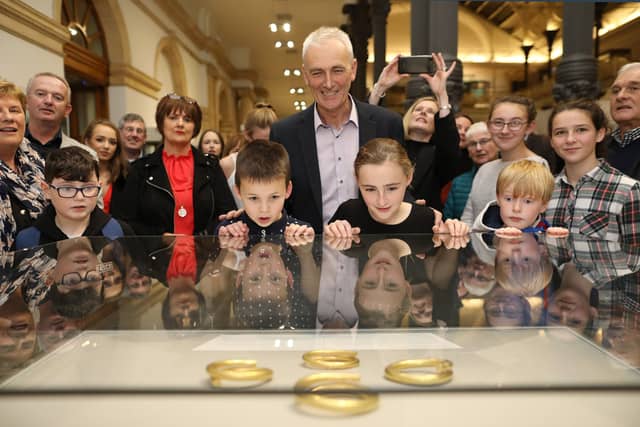

Four Bronze Age gold rings were found in a field in Donegal
Four Bronze Age gold rings unearthed in a Donegal field earlier this year have gone on display at the National Museum of Ireland.
The Tullydonnell Hoard is among the heaviest hoards of gold on record to be discovered in Ireland.
The four gold rings, weighing just over 4KG in total, will complement the Museum’s permanent gold exhibition, Ór – Ireland’s Gold, which showcases one of the largest and most significant collections of Bronze Age gold internationally.
The gold, which was discovered in a field in Tullydonnell Lower in East Donegal, will go on temporary loan to the Donegal County Museum next year.
The gold has undergone investigations by experts at the National Museum of Ireland over the last number of months. The Museum’s Keeper of Irish Antiquities Maeve Sikora revealed that the gold was discovered in excellent condition: “Our conservation staff have conducted extensive analysis of the gold and the results indicate that this hoard dates to the late Bronze Age, between approximately 1200BC and 800BC. The objects were discovered in perfect condition.”
Ms Sikora explained that while the gold overlapping rings are circular in shape, it is not possible to accurately determine their use: “They’ve been described as ‘arm bands’ because of their size, but it is thought more likely that gold was shaped in this fashion as a means to store wealth,” she said.
Judith McCarthy Curator of the Donegal County Museum said the unearthing of the Tullydonnell Hoard was a unique and significant find not only for Donegal but for Ireland; “We were delighted to be able to assist both the finders and the National Museum of Ireland with this discovery. Donegal has a very rich and varied history stretching back thousands of years and the Tullydonnell Hoard forms an important part of this multi-faceted story,” she said.
Chair of the Board of the National Museum of Ireland, Catherine Heaney, said: “From discovery to the exhibition, the expertise in the National Museum of Ireland ensures that important artefacts from our past - like the Tullydonnell Hoard - are conserved and protected for the enjoyment and education of generations to come.”
Minister Joe McHugh paid tribute to the finders of the hoard, and to Donegal County Museum, who collaborated with the National Museum of Ireland on the discovery: “I don’t think I’m alone in admitting that I never knew Donegal was considered to be a particularly active area during the Bronze Age. This discovery is so exciting for Donegal because it gives us a rare and important insight into the history of our country, and it’s equally important for Ireland in that it adds to our already extensive collection of artefacts from this fascinating era.
“On behalf of the Government, I want to thank the finders for their assistance in preserving this collection for the people of Ireland. I’m delighted that the gold will go on display in Donegal next year and I’d encourage as many people as possible to visit it when it’s on loan to Donegal County Museum,” he said.