

Martin McNally open minded on further rule tweaks

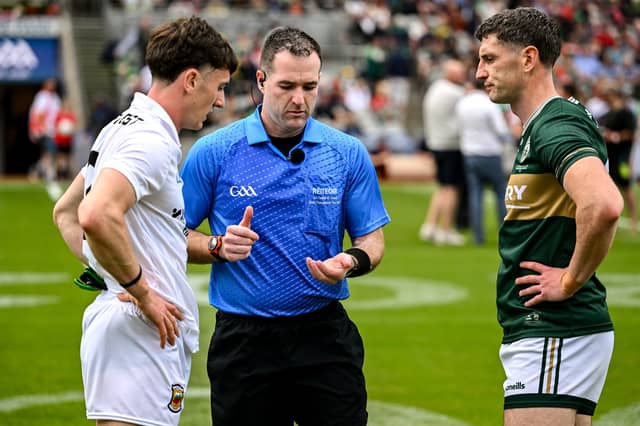

Martin McNally says there is nothing wrong with exploring further rule changes to Gaelic football but says there has to come a stage when the product is let settle.
The 2026 All-Ireland final referee was one of the guest speakers at Donegal GAA’s quarter-of-a-million fundraising draw on Sunday night in Ballybofey.
And the Monaghan native admits that the original Football Review Committee’s (FRC) raft of changes was certainly a shock to the system for the game’s officials.
It’s since come to light in recent days that a new set of rule adjustments are ready to be trialed in 2027.
A ban on fisted points, restrictions on handpassing and the introduction of a four-point goal are among a series of potential new rules set to be tested in this season's third-level Ryan Cup.
The Gaelic football Expert Advisory Group (EAG), chaired by former Roscommon and Mayo manager Kevin McStay, has put forward nine proposed amendments for trial in the competition.
The group was established following a recommendation from the Football Review Committee's final report in 2025 and was tasked with keeping the evolving game under review following the wide-ranging changes introduced towards the end of 2024.
Among the most significant proposals is a restriction on fisted scores, with points only permitted from a fist pass when the ball is already in flight.
Teams would also be limited to three consecutive handpasses, while a goal would carry four points under the proposed trial rules.
Changes are also being considered to kickouts, with the ball required to travel at least 13 metres rather than crossing the existing 40-metre arc.
Another proposed measure would prevent teams from bringing the ball back across their own halfway line once they have moved into the opposition half.
The EAG has also recommended increasing the number of substitutes from five to six.
Other proposals include a 50-metre advancement where a mark is impeded, extending the 40-metre arc to the end-line and bringing all 50-metre advanced frees forward to the 13-metre line rather than the current 20-metre line.
The Ryan Cup trials will provide the EAG with an opportunity to assess the impact of the proposed changes before any decisions are taken on their wider use within Gaelic football.
McNally was central to that original trialling of the FRC changes and officiated high-profile ‘sandbox’ games at Croke Park as well as numerous other behind-closed-door affairs inside the province.
There has been criticism this week regarding the prospect of further tinkering, but McNally is keeping an open mind. However, he did warn that we’re never going to have a perfect spectacle.
“My take on it is the same as it was the last time. Have a look, see if there are elements of it that are for us? We don’t have to go with it.
“I was heavily involved in the sandbox games prior to the previous rules coming in. And I think the Dublin and Armagh game I was part of, in Inniskeen, really opened my mind to where the game was possibly going to go at that stage.
“I did go on record at the time as saying that this will change the face of Gaelic football for the next 50 years.
“And that is the case. We have a product now that everybody likes and enjoys. If there are little tweaks to be made, let’s have a look at them.
“The talk is that they will be looked at in the third-level competitions. We can keep what we like, drop what we don’t like.
“The other part of it is, where do we also stop or draw the line? Are we looking for the perfect game or too much perfection?”
Pressed on whether Gaelic football might need to explore or look at the option of a second official on the field of play, similar to Australian Rules Football, McNally says that simply wouldn’t work.
“I don’t see that working in Gaelic football. The rules in Australian Rules, and even rugby, they are very distinct.
“A lot of what we have in Gaelic football is down to the referee’s interpretation. And you could have two contrasting styles involved in that type of scenario in each half of the pitch.
“I don’t think we’re at the stage where we need to look at that. I think we, as referees, need to raise the bar in terms of the way we approach games.
“I think we are well on the journey to doing that in terms of fitness, video analysis and all the other bits and pieces.
“There really is no off-season for referees now - like players, you’re straight back into club action. It then goes into Ulster club, third level leagues, second level leagues and, before you know it, you’re back into McKenna Cup.
“The wheel just keeps turning.
“But when you go down the road of two referees on the pitch at the same time, you’re going to have a clash of styles”.