

Breaking down barriers to fish migration on Donegal’s rivers
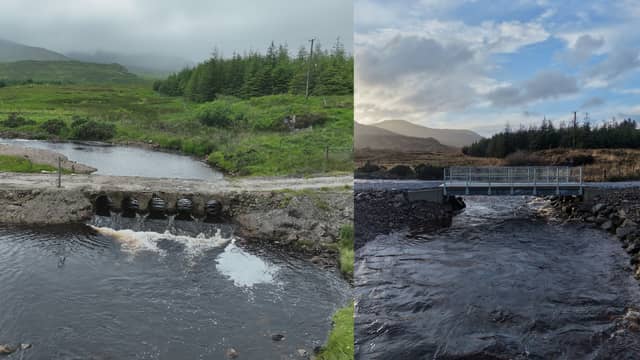

Nine new studies planned across the county as part of efforts to restore river habitats and improve fish migration routes
The removal of barriers to fish migration at nine locations on Donegal rivers is set to be progressed by Inland Fisheries Ireland (IFI) and the Loughs Agency.
The Department of Housing has awarded €14.88 million to support 91 fish barrier mitigation projects across the State, with nine of those located in Donegal.
The programme aims to improve fish passage, restore aquatic habitats and reconnect rivers and streams that have been disrupted by man-made structures.
Many fish species in Irish rivers, including salmon, sea trout and eel, travel long distances to breed, while others such as pike, brown trout and bream move within freshwater systems to feed and spawn. Experts say these movements are essential for survival and reproduction.
However, structures such as weirs, dams, culverts and bridge crossings can block these natural journeys, making it harder for fish to reach breeding and feeding grounds and reducing fish populations over time. Weirs can also alter the natural flow of rivers, slowing fast-moving water and changing riverbed conditions, water quality and habitats used by fish and aquatic insects. These changes can also affect plant life and disrupt the wider river ecosystem.
Read more: Glen River restoration gets €40,000
Each of the nine Donegal projects is new, with funding being provided to either IFI or the Loughs Agency to carry out feasibility studies and identify the best solutions to removing the barriers. These projects are all currently at ‘phase 1’ of an eight-stage delivery process.
The Donegal locations to be examined are Boyston’s Carry Weir near Raphoe; Stranagoppoge Fish Pass and the Effernagh River Culvert near Fintown; Tullyhoner Weir between Fintown and Newmills and the Newmills Weir near Letterkenny; Crow River Bridge near Glencolmcille; Bungosteen River Weir at Killybegs; Ballintra Weir; and Cloontagh Bridge near Clonmany.
Nationally, 257 barrier mitigation projects have been identified, with 27 completed since 2024.
Four completed projects are in Donegal, including three near Dungloe - among them Lough Craghy Weir - as well as the Reelin River Culvert between Ballybofey and Glenties.
Projects have been prioritised based on ecological benefit, feasibility and their potential to restore access to valuable fish habitats, particularly for protected species such as Atlantic salmon and European eel.
Minister of State for Nature, Heritage and Biodiversity, Christopher O’Sullivan, said free-flowing rivers are vital for wildlife and freshwater ecosystems. “These projects are making a significant contribution towards Ireland’s goals under both the Water Framework Directive and the Nature Restoration Law, alongside a wide range of measures to improve water quality and freshwater biodiversity more broadly,” he said.
Minister of State for Fisheries and the Marine, Timmy Dooley, said the programme would help restore healthier and more resilient river systems. “By improving connectivity across our river systems, this programme will help restore healthier, more resilient rivers and contribute to the recovery of our fish stocks.
“It also highlights the importance of coordinated action in managing our natural resources, protecting our aquatic ecosystems and delivering long-term environmental benefits. This is a practical step forward in meeting our climate and biodiversity commitments.”
IFI’s head of the national barrier mitigation programme, Hazel King, said the funding marked a key transition into the delivery phase. “It reflects a strong commitment to reconnecting our waterways and enabling fish to move freely once again,” she said.
The programme forms part of Ireland’s wider biodiversity commitments under the EU Biodiversity Strategy 2030, which aims to restore 25,000km of free-flowing rivers across Europe. Ireland’s national target is 300km.
A third funding call is planned for this autumn, providing further opportunities for eligible projects to secure support.