

Five-metre-long whale with ‘makeshift buoys’ attached found stranded in Donegal
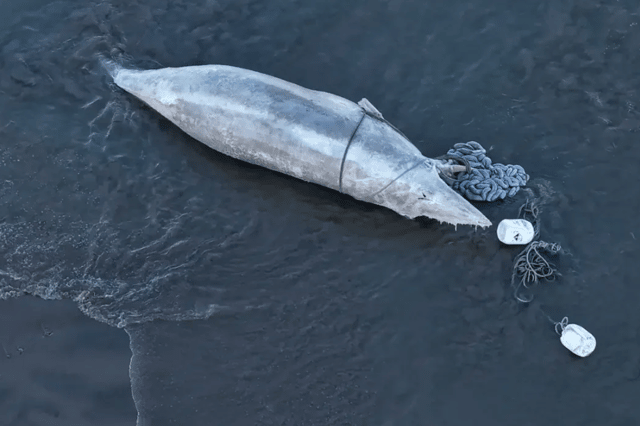

A minke whale was spotted entangled in ropes and stranded on a Donegal beach
A five-metre-long minke whale entangled in ropes has washed up on a Donegal beach.
On Monday morning, local man Darren Roche found the whale while out for his morning walk on Ballyheirnan beach.
The Irish Whale and Dolphin Group was contacted regarding the discovery.
One of the group’s volunteers, David McGloin, went to the beach to get photos, confirm the stranding, and get more information.
The whale, which was roughly five metres in length, had its upper body and head entangled in ropes, with two “makeshift and unmarked buoys” attached to it.
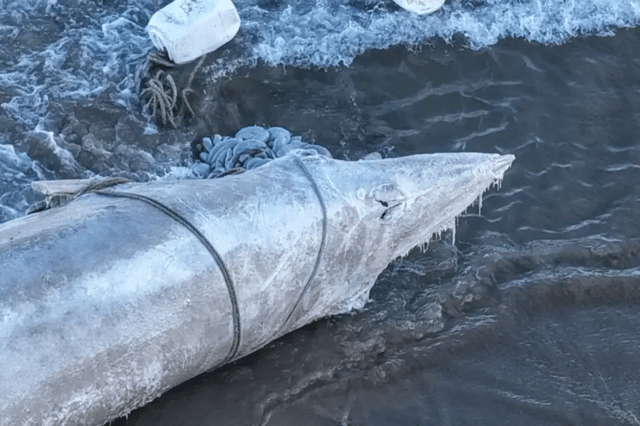
The Irish Whale and Dolphin Group suspects that the whale likely got stuck in the lines of a pot, which is a submerged, baited trap used to catch crustaceans such as crabs, lobsters, or molluscs.
This is called creel fishing.
Because the number of minke whales washing up entangled in Ireland is quite high, the group, along with the Atlantic Technological University and the Marine Institute, decided to assess the potential threat that creel fisheries could pose in Ireland.
That paper and master's thesis of IMBRSea student Julie Fichete was published in 2025.
It found that the entanglement risk for minke whales was “substantial” in Ireland, with the south and southwest of the country posing the biggest risk.
“However, with the recent shift in large whale sightings towards the north, northwest of Ireland and the high pot fishing efforts off the north coast of Donegal, this risk may shift further north,” the Irish Whale and Dolphin Group website states.
This paper provided the first estimation of entanglement risk of pot fisheries for large whales in Ireland, but the group believes further research is necessary.
“The majority of the creel fisheries in Ireland are small-scale, with ships under 12 meters in length and without AIS. Estimating the true creel fishing effort is further complicated due to the high number of unreported recreational pots and abandoned gear,” it says.
The vast majority of the entanglements happen in the floating groundlines, which are the ropes used to attach the pots/creels.
Buoyant rope causes them to form large arches in the water, meaning that when a whale dives to feed, the rope can become attached in or around its mouth, pectoral fin or fluke.
Larger whales may be able to surface and drag the lines and pots, but the smaller minke whales typically cannot and will drown.
If you spot a stranded whale or dolphin, contact the Irish Whale and Dolphin Group.