Denis O’Donovan of Ballyryan, Donohill, Co Tipperary
Search


12 Mar 2026

Please allow ads as they help fund our trusted local news content.
Kindly add us to your ad blocker whitelist.
If you want further access to Ireland's best local journalism, consider contributing and/or subscribing to our free daily Newsletter .
Support our mission and join our community now.
To continue reading this article, you can subscribe for as little as €0.50 per week which will also give you access to all of our premium content and archived articles!
Alternatively, you can pay €0.50 per article, capped at €1 per day.
Thank you for supporting Ireland's best local journalism!

A man from Convoy was among those to perish when the Titanic sank off Newfoundland in 1912.

Next April marks 114 years since of the most infamous shipwreck of all time, the sinking of the mighty Titantic.
On a freezing cold, calm morning on April 15, 1912 more than 1,500 men, women and children lost their lives when the Belfast-built passenger liner struck an iceberg off Newfoundland, some one thousand miles short of its New York destination.
Among those on board was a newly married young man from Convoy on his way to start a new life in Manhattan.
The son of William and Catherine (nee Gordon), 27 year-old Neal McNamee was born in Ruskey, Convoy, on August 29, 1884. After emigrating from Donegal in the early part of the twentieth century, Neal secured work for Lipton’s Tea in England, where he married Eileen O’Leary, before being offered a high-profile position in New York.
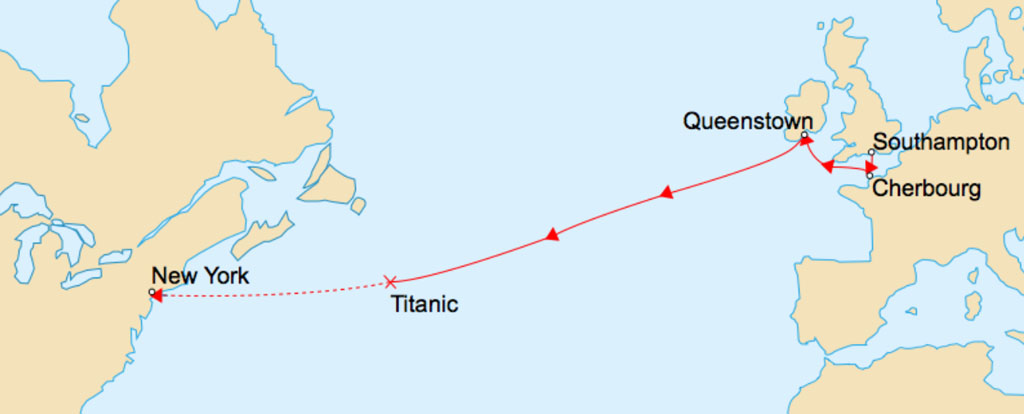
The newlyweds, looking forward to a new life across the Atlantic, boarded the Titantic at Southampton as third class passengers on April 10: ticket number 376566, price 16 and two shillings.
Five days later the pair, not priority class passengers, were among the 1,517 who succumbed to the icy ocean waters. First class passengers gained life saving preference over those in steerage below decks, resulting in the newly weds dying together, when the liner struck an iceberg just days from their American dream.
Eileen’s body was recovered wearing her brown velvet coat, white sailor blouse, blue skirt with black braid, black stockings and shoes with her wedding ring and purse containing her sailing ticket and just one shilling and eleven-pence. She was buried at sea two days later.
Neal's body was never recovered.
Large iceberg spotted
On the night of Sunday April 14, 1912 the temperature had dropped to freezing and the Atlantic Ocean was flat calm. Taking heed of iceberg warnings delivered in the days before, English Captain Edward Smith had charted a new more southerly course for the Titanic.
Earlier that Sunday afternoon two crucial iceberg alerts were not passed onto the crew in the ship’s bridge since radio operators were instructed to deliver only messages to and from passengers. This policy, more than any other, led to the chain of events, which would result in the loss of the ship and the vast majority of those aboard.
At 11:40pm, while sailing about 400 miles south of the Grand Banks of Newfoundland, lookouts Frederick Fleet and Reginald Lee spotted a large iceberg directly ahead of the ship. Sounding the ship's bell three times, Fleet telephoned Sixth Officer James Moody on the bridge exclaiming, ‘Iceberg, right ahead!’.
First Officer Murdoch, hearing Moody repeat the message, gave the helmsman, Robert Hichens, the order ‘hard-a-starboard’. The order came too late.
The ship made its fatal collision at an estimated 37 seconds after Fleet sighted the iceberg.
The iceberg scraped the ship's starboard side. The entire impact had lasted approximately 10 seconds. Captain Smith, alerted by the jolt, arrived on the bridge and ordered a full stop. About 130 minutes after the collision, an inspection by the senior officers arrived at a tragic conclusion - the Titanic would sink.
Lifeboats launched
The lifeboats were ordered to be readied and a distress call was sent out. It was estimated the ship would go down within an hour to an hour and a half, and said that the pumps would only keep the Titanic afloat for a few extra minutes.
At 00:05, Captain Smith ordered all the lifeboats uncovered; five minutes later, at 00:10, he ordered them to be swung out; then, at 00:25, he ordered them to be loaded with women and children and then lowered away. At 00:50, 4th Officer Joseph Boxhall fired the first white distress rocket.
Wireless operators Jack Phillips and Harold Bride began sending the international distress signal ‘CQD’, which was received by several ships, including Mount Temple, Frankfurt, Virginian and Titanic's sister ship, Olympic. Despite assurances that they were on their way, none of the vessels were close enough to reach the liner before she sank.
The closest ship to respond was Cunard Line's Carpathia, 58 miles away, which would arrive in an estimated four hours—too late to rescue all of Titanic's passengers.
The first lifeboat launched was Lifeboat 7 on the starboard side with 28 people on board out of a capacity of 65. It was lowered at around 12:45am. Lifeboat 6 and Lifeboat 5 were launched ten minutes later. Lifeboat 1 was the fifth lifeboat to be launched with 12 people. Lifeboat 11 was overloaded with 70 people. Collapsible D was the last lifeboat to be launched.
Titanic showed no outward signs of being in imminent danger and passengers were reluctant to leave the apparent safety of the ship to board small lifeboats. Moreover, large numbers of Third Class passengers were unable to reach the lifeboat deck through unfamiliar parts of the ship and past barriers, although some stewards successfully led groups from Third Class to the lifeboats.
As a result, most of the boats were launched partially empty With ‘women and children first’ the imperative for loading lifeboats. Second Officer Lightoller, who was loading boats on the port side, allowed men to board only if oarsmen were needed, even if there was room. First Officer Murdoch, who was loading boats on the starboard side, let men on board only if women were absent. As the ship's list increased people started to become nervous, and some lifeboats began leaving fully loaded. By 2:05am, the entire bow was under water, and all the lifeboats, except for two, had been launched.
Final minutes
Around 2:10am, the stern rose out of the water, exposing the propellers, and by 2:17am the waterline had reached the boat deck. The last two lifeboats floated off the deck, collapsible B upside down, collapsible A half-filled with water after the supports for its canvas sides were broken in the fall from the roof of the officers' quarters. Shortly afterwards, the forward funnel collapsed, crushing part of the bridge and people in the water. On deck, people were scrambling towards the stern or jumping overboard in hopes of reaching a lifeboat. The ship's stern slowly rose into the air, and everything unsecured crashed towards the water. While the stern rose, the electrical system finally gave way causing the lights to go out. Shortly afterward, the stress on the hull caused Titanic to break apart between the last two funnels, and the bow section went completely under. The stern section righted itself slightly and then rose vertically. After a few moments, at 2:20am, it also sank.
Only two of the 18 launched lifeboats rescued people after the ship sank. Lifeboat 4 was close by and picked up five people, two of whom later died. Close to an hour later, lifeboat 14 went back and rescued four people, one of whom died afterward. Other people managed to climb onto the lifeboats that floated off the deck. There were some arguments in some of the other lifeboats about going back, but many survivors were afraid of being swamped by people trying to climb into the lifeboat or being pulled down by the suction from the sinking Titanic.
After steaming at 17.5 knots for just under four hours, RMS Carpathia arrived in the area and at 4:10am began rescuing survivors. By 8:30am she picked up the last lifeboat with survivors and left the area at 08:50 bound for New York.

Subscribe or register today to discover more from DonegalLive.ie
Buy the e-paper of the Donegal Democrat, Donegal People's Press, Donegal Post and Inish Times here for instant access to Donegal's premier news titles.
Keep up with the latest news from Donegal with our daily newsletter featuring the most important stories of the day delivered to your inbox every evening at 5pm.

This publication supports the work of the Press Council of Ireland and Office of the Press Ombudsman, and our staff operate within the Code of Practice of the Press Council. You can obtain a copy of the Code, or contact the Council, at www.presscouncil.ie, Lo-call 1800 208 080 or email: info@presscouncil.ie.