

Barrtalk: Bullseye a real throwback to a different era


Moville journalist Caoimhinn Barr writes a weekly column which has been running in the Inishowen Independent newspaper since 2010
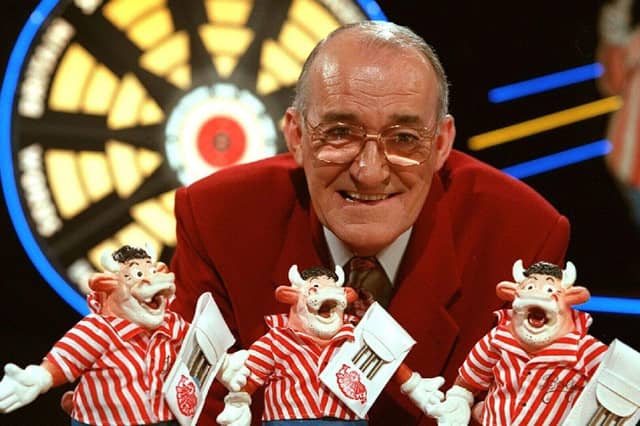
There are certain television programmes that you can put on today and instantly find yourself transported back to another time. For me, one of those is Bullseye [readers of a certain age will know].
I recently discovered that classic episodes of the great darts-themed game show are being shown on the Challenge channel on Sky Q, and, in a moment of weakness, I put it on series link.
That was a mistake. The episodes are coming at me at such a relentless pace that I have already amassed somewhere in the region of 100 of them.
At this rate, I’ll need to buy a second Sky box just to store all the episodes.
And I’ve been watching them from the very beginning – the first series from 1981. It really is like opening a television time capsule.
Some of the humour is wonderfully daft, although some of it is also very close to the bone – and there are jokes which, by today’s standards, would have you squirming.
There is a definite whiff of the casual attitudes of the era, including jokes that would now be regarded as borderline xenophobic. You have to put them in the context of the time, of course, but some of them certainly haven’t aged as well as the contestants’ hairstyles.
The premise was beautifully simple. Contestants threw darts, answered questions and, during the prize segments, tried to land a dart in the red.
Miss the red and hit the black and, as Jim Bowen famously put it: “Keep out of the black and in the red, nothing in this game for two in a bed.”
Jim was brilliant at the little throwaway jokes after a missed dart. A player would miss and suddenly they had won a half-eaten banana, or the hole in a Polo mint.
On one occasion, after a contestant planted a dart firmly in the black, Jim announced that it was a miss and they had won “a fortnight’s holiday in Vietnam”.
The contestant promptly followed it with another dart in the black.
“That’s another miss,” Jim quipped, “you’ve won a semi-detached bungalow in Iran.”
And here’s the funny thing. Looking back now, those imaginary prizes – a holiday in Hanoi or a house in Tehran – sound infinitely more appealing than some of the actual prizes on offer.
A SodaStream. A carriage clock. A portable cassette player. A tool bench that looked as if it had been purchased from a pound shop. No thanks.
And then there was the cruellest sentence in television history: “Let’s have a look at what you could have won!”
You could watch contestants gamble everything on the final dart, only to miss out on a caravan or a speedboat and then be shown what they had just failed to win.
The prizes were so modest in those early days that contestants could finish an entire television appearance with £20 or less – and plenty left with absolutely nothing. Yet somehow, it was all part of the charm.
Bowen, who hosted the original programme from its launch in 1981 until 1995, had that wonderfully reassuring television presence. He was warm, funny and, like much of Bullseye, very much a man of his time.
At its peak, Bullseye was watched by audiences of up to 20 million people. And incredibly, after disappearing from our screens, it actually made a comeback in 2025, with Andrew Flintoff at the helm.
I still can’t quite believe it. But watching those old 1981 episodes, I understand why it worked.
There’s a charm about an old show like Bullseye, like a warm blanket, that reminds us of Sunday afternoons in our youth, when things didn’t go wrong. Ya can’t beat a bit of Bully.
Obama’s £1,500 selfie – hope certainly comes at a price!
The US Democrats like to portray themselves as the party of working people and the middle classes. So how’s this for a bit of working-class solidarity?
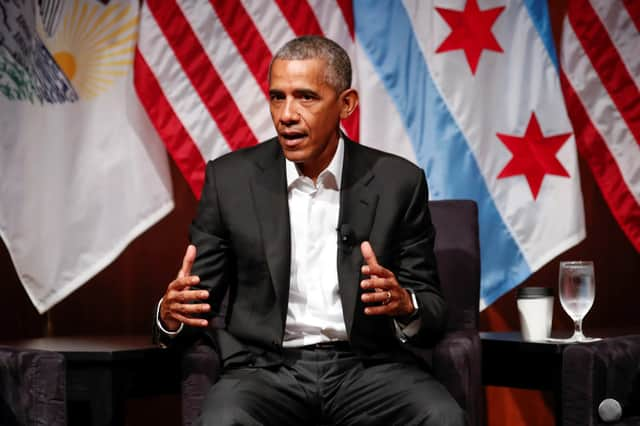
Barack Obama – Democrat, former US president and multi-millionaire – is coming to Belfast in October and, if you fancy getting a photograph with him, you’ll need to fork out more than £1,500. Yes, £1,500. Sterling.
That’s not for dinner with him, a lengthy conversation about the state of the world or even a signed declaration of independence. It’s for a photograph.
The standard tickets for Obama’s Belfast appearance start at around £30, but those wanting the full VIP treatment get priority entry, a copy of his book A Promised Land, a seat in the first 10 rows – and the privilege of standing beside him for the camera.
Now, I’m sure Barack Obama is a fascinating man to meet, and he certainly has plenty of stories to tell. But the man is reportedly worth around $52 million (£39 million).
How much money do these people actually want?
Obama has also developed quite a reputation for lucrative speaking engagements since leaving the White House, including hundreds of thousands of pounds for individual appearances.
And fair enough, if people are prepared to pay it, perhaps that’s capitalism doing what capitalism does.
But there is something rather jarring about charging £1,500 for a selfie in Belfast, particularly at a time when people are struggling to meet rising costs of living worldwide.
And I hate AI – absolutely hate the stuff – but even I have to admit there is one advantage to it here. For a fraction of £1,500, you could probably AI a photograph of yourself standing beside Obama and save yourself a small fortune. It might even look more convincing than some of the promises politicians make.
Obama’s political brand was built around “hope” and change. It seems the hope now comes with a hefty price tag.
And worst of all, does this mean we’ll have to suffer Trump in a few years’ time doing the same? Imagine how much he’d charge for a photo. And given that everything is always about him, would he even let you in the frame?