

Health & Happiness: Culture Night, Edge of the Atlantic, Heart and Sound of the Arts

Columnist Aileen Casey is a Buncrana-based writer, parent and healthy-living enthusiast with a background in early childhood care and elderly support
Here in Inishowen, culture has never needed much encouragement to make itself heard. It is carried in music and storytelling, in language and landscape, in old traditions and newer ideas, and in the strong sense of identity that comes from living on a peninsula shaped by both land and sea.
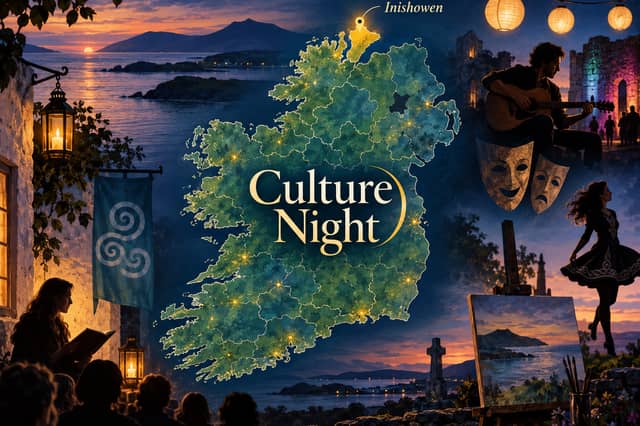
On Friday, September 18, that character will become even more visible when Culture Night returns across Ireland and Buncrana takes its place in the national celebration.
From 6pm, Buncrana’s Main Street and surrounding areas will come alive under the theme “Edge of the Atlantic, Heart and Sound of the Arts.”
Rather than centring the evening on one venue or one performance, the town itself becomes part of the experience, with businesses, cultural spaces and community locations opening up to music, storytelling, art, photography, writing, workshops and live performance.
The appeal is in the movement. People can wander, follow the sound of music, step into a place they might normally pass by and discover something unexpected. It gives the evening the feel of a cultural trail rather than a formal programme that has to be followed from beginning to end.
That suits Buncrana and the wider Inishowen peninsula particularly well. Culture here is not confined to galleries or theatres. It can be found in local music sessions, traditional crafts, stories handed down between generations, photography, dance, writing and community gatherings.
It is also present in the landscape, in the Irish language and place names, and in the traditions shaped by life on the edge of the Atlantic.
Culture Night itself began on a much smaller scale in Dublin in 2006. An initiative of Temple Bar Cultural Trust and Dublin City Council, the first event saw 40 venues in Temple Bar open free and late into the evening.
It expanded across Dublin the following year, and in 2008 Cork, Galway, Limerick and Waterford joined the initiative. Belfast followed in 2009 and Derry in 2010, helping Culture Night grow into the all-island celebration it is today.
What began in one part of the capital now reaches cities, towns, villages, islands and rural communities. Yet the idea remains straightforward: make culture easier to access, remove some of the barriers that can surround the arts and encourage people to try something they might not otherwise seek out.
That accessibility is especially relevant in a rural peninsula such as Inishowen, where getting to and from evening events can sometimes be as important as what is happening when you arrive.
This year, Buncrana’s participation is being supported not only through the significant public funding behind Culture Night nationally, but also through additional support for Culture Night Late and the wider Night-Time Economy initiative.
That investment is helping to extend cultural activity later into the evening and make the night more practical for people travelling from outside the town.
A particularly useful part of that is The One @ One, the late-night bus pilot introduced for Buncrana. The service leaves Buncrana at 1am and travels through Clonmany, Ballyliffin, Carndonagh, Drumaville, Culdaff, Gleneely, Moville and Greencastle, covering a wide sweep of the peninsula and giving people from across Inishowen another way of getting home after a night out.
The service has also operated over selected bank holiday weekends during the year and is scheduled for the October Bank Holiday weekend, as well as Culture Night itself. That matters. Public transport is often one of the first difficulties people think about when attending an evening event in a rural area, particularly on Sundays or bank holidays.
A later service makes participation more realistic for people who do not drive, do not want to take a car, are working late, or simply want a safer way home.
It also strengthens the idea behind Culture Night: that culture should not feel available only to people living within walking distance of a venue. Accessibility is about more than whether a door is open or whether an event is free. It is also about whether people can actually get there and get home.
For Buncrana, there is a wider benefit. Culture Night brings people into the town centre, encourages them to explore local businesses and venues, and allows artists, musicians and performers to meet audiences who may never otherwise encounter their work.
It shows how much creativity already exists locally without trying to imitate what is happening in a larger city.
That may be one of Culture Night’s greatest strengths. Dublin has its national institutions and large venues, Cork and Galway have their own distinctive cultural scenes, and Belfast and Derry bring another layer to the all-island story.
Inishowen adds something different again: a culture shaped by geography, community, music, language, memory and the sea.
The title “Edge of the Atlantic, Heart and Sound of the Arts” captures that neatly. It places Buncrana within a much bigger national celebration while still allowing the town and peninsula to sound like themselves.
There is a wellbeing element too. Creativity can offer connection, enjoyment and a break from routine. Singing, dancing, writing, painting, making something with our hands or simply standing in an audience and sharing an experience can change the atmosphere of an evening.
Culture Night gives people permission to be curious without needing to know much about the art form beforehand. And that is perhaps why the event has lasted and grown for two decades. It does not ask people to become experts. It simply asks them to come out and take part.
On September 18, that might mean following music down Main Street, stepping into a local business that has been transformed for the evening, hearing a story, seeing an exhibition or discovering a performer for the first time.
For one night, Buncrana becomes part of a cultural trail stretching across Ireland. But what people hear, see and experience here will remain unmistakably Inishowen-rooted at the edge of the Atlantic, with its own heart and its own sound.