Finn Harps supporters at Finn Park for the Cork City game at the weekend.
Search


05 Apr 2026

Please allow ads as they help fund our trusted local news content.
Kindly add us to your ad blocker whitelist.
If you want further access to Ireland's best local journalism, consider contributing and/or subscribing to our free daily Newsletter .
Support our mission and join our community now.
To continue reading this article, you can subscribe for as little as €0.50 per week which will also give you access to all of our premium content and archived articles!
Alternatively, you can pay €0.50 per article, capped at €1 per day.
Thank you for supporting Ireland's best local journalism!

Hill grazing sheep, illustrating extensive grazing systems where soil structure and vegetation evolved together under low stocking pressure

Growing up in Gaoth Dobhair in the early 1970s, we planted and harvested our own crops.
Using a shovel and spade, and working closely with my now deceased neighbours John Mhici Sheamais and Mici Beag Sheamais and my grandad Harry Mor Ruairi, we prepared the soil.
At the beginning of spring, and working in a community-based “meitheal” spirit, we manually rotated the soil, a process known at the time as "Ag Rómhar". After that, and again using a shovel, we prepared ridges to receive potato crops. Where oats, known locally as “coirce”, were to be planted, we would manually rake the soil using a “ráca”.
READ NEXT: We are living through a Global Warning – and Donegal is not immune
Two to three weeks after planting, we would draw seaweed from the cladach shoreline and livestock manure from the local stockpile. As our plant growing operations were extracting nutrients from the soil, it was being replenished using natural fertilisers. We were involved in organic farming, and we didn't even know it. In its natural, unaltered, naturally supported state, the soil could fend off most harmful pesticides.
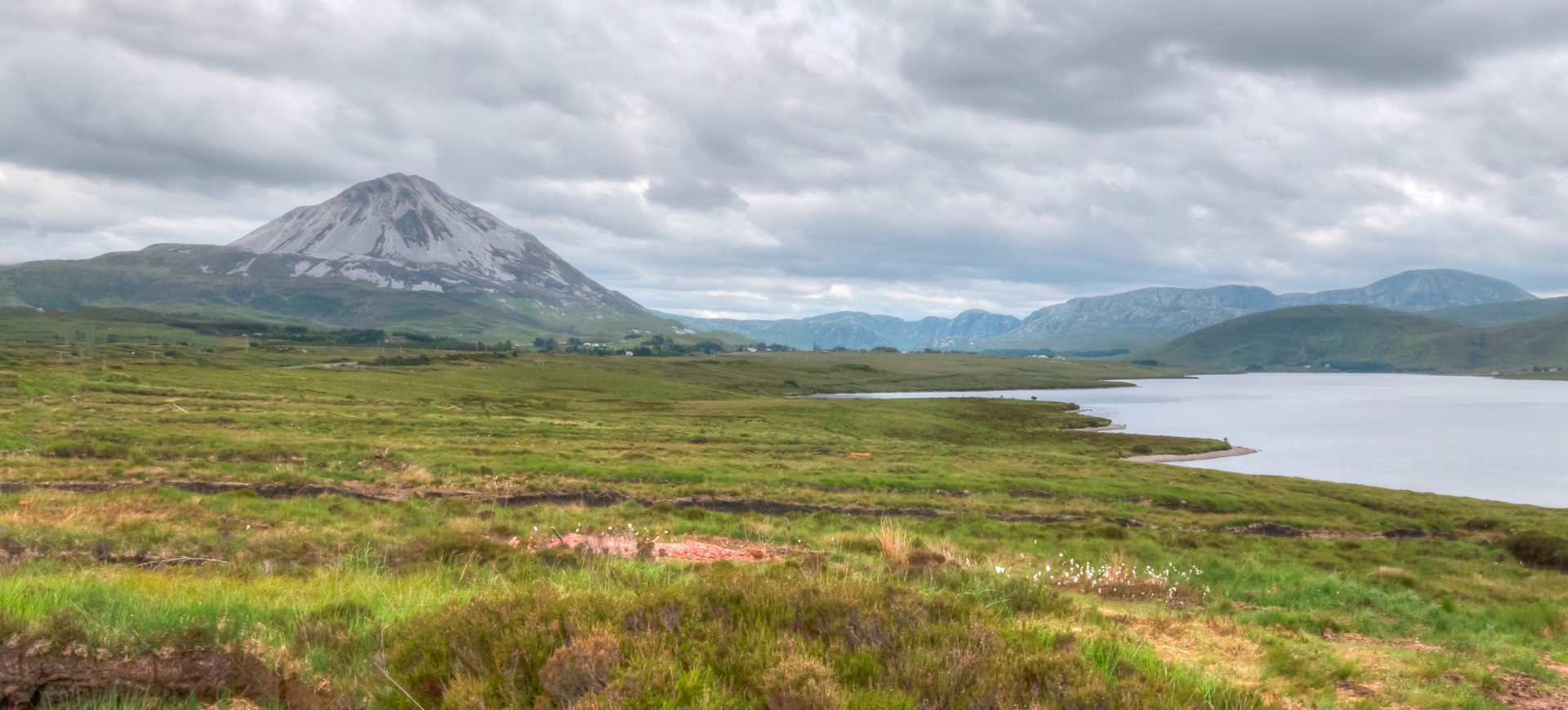
Errigal Mountain and surrounding blanket bog, a landscape shaped by slow soil formation, high rainfall and long-term ecological balance
Once the harvesting was completed in August, the soil would then be prepared for winter using a methodology called “Ag Huntal”. That entailed preparing ridges, or “iomairí”, along the length of the field. This provided for both frost protection and the free draining of the soil during the winter months.
The whole process was natural, healthy, non-destructive, environmentally enriching and sustainable.
Today's agricultural practices are very different. The processes have gone largely mechanical and chemical driven.
The Slow Formation and Accelerating Loss of Topsoil
Topsoil was created through a natural weathering process of wetting, drying, freezing and thawing. It takes around 500 years to create 25mm of natural topsoil. Regrettably and worryingly, worldwide the soil is being eroded at a much faster rate than it is being produced.
In the 1930s there were approximately five acres of arable land available per person globally, today this has fallen to well under one acre per person and continues to decline due to population growth and land degradation and pollution.
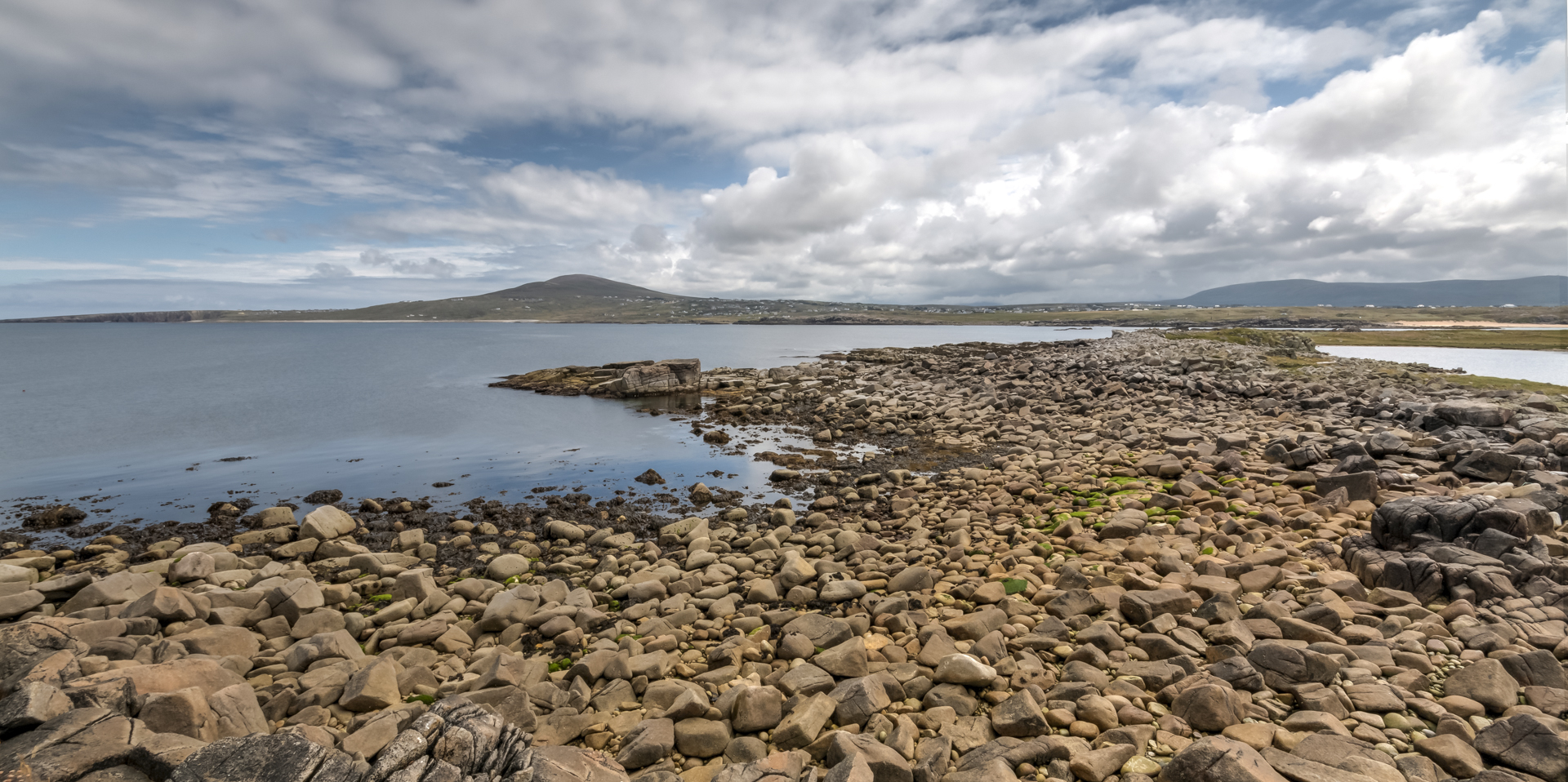
Rocky Atlantic shoreline at Inis Oirthear, where seaweed harvesting historically returned marine nutrients back to exhausted inland soils
A widely-cited 2014 UN warning suggested around sixty harvests may remain, though some scientists dispute this figure.
In large parts of America and India, soil has already turned to dust and continues declining. Whilst the mild and damp nature of Donegal's climate helps slow the decline, it will not prevent its demise.
In its natural state, topsoil consists of minerals including sand, silt and clay, air, water, organic matter, and living organisms including bacteria, fungi, protozoa, nematodes and earthworms. Back in the 1970s, I also used to fish with my friend Seamus Chundy. Before heading off to the lake or river we would dig a few holes in the local field to gather earthworms. They were plentiful and proved as excellent bait.
The natural ingredients in soil act cohesively and in unison to protect its health. By planting crops, we extracted nutrients from the soil. However, we most certainly replenished it through the addition of seaweed and natural manure. The manure was mixed with straw from the previous year's corn harvest.
Today's Unsustainable Practices
For soil to maintain its natural healthy state, earthworms and other living organisms must be allowed to move freely throughout the soil.
This was certainly possible in the 1970s as all work was manual and the soil was uncompacted. Today's heavy machinery compacts the soil to such levels that living organisms are unable to function within it. Earthworms, for example, acted as excellent cultivators and aerators of the soil. The interaction between the microorganisms also fought off harmful pesticides.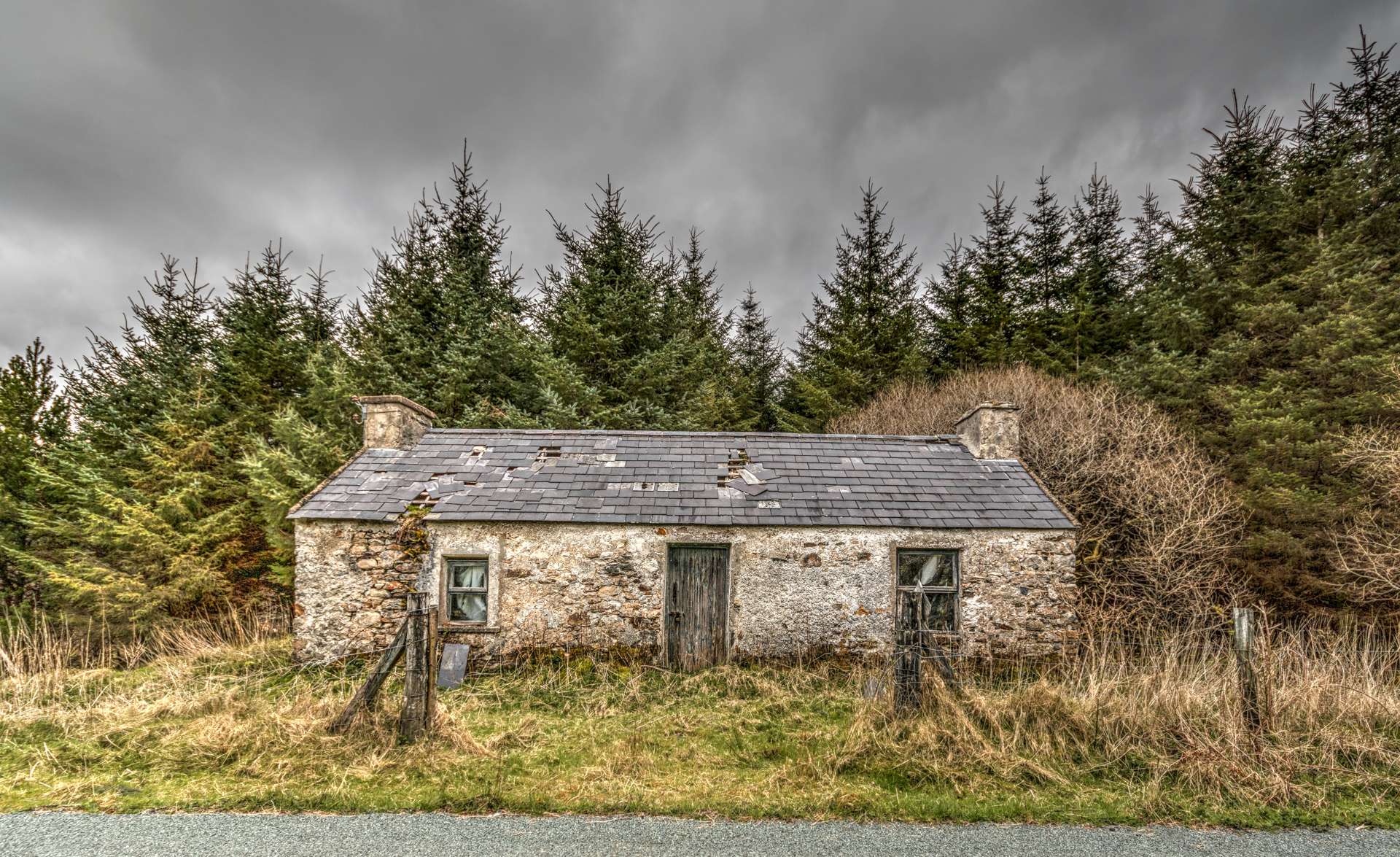
Traditional stone cottage in rural Doochary, built from local materials, reflecting a low impact relationship between land, shelter and subsistence farming
Now that the natural behaviours and interactions of the soil's living microorganisms have been stifled, it is necessary to compensate via the addition of chemical fertilisers and pesticidal treatment. The heavy soil compacting also prohibits the ingress of air and water. Instead, natural rainfall runs off into local streams, bringing with it the residues of chemical fertilisers and pesticides.
Back in the 1970s the soil acted in full unison with crop growing exercises. It was replenished as it was taken from. Crop rotation was also common practice, and it wasn't uncommon to put a field out to graze for three years after about four years of crop growing.
Today the soil, in a lot of areas, acts like a hospital IV drip. Just as food bypasses the stomach and is fed directly into a patient's bloodstream, chemical fertiliser generally bypasses the living soil and feeds the plant roots directly. Both patient and plant survive — but neither thrives or excel.
Climate change is also having a very serious negative impact on soil health, and this isn't going to improve any day soon either.
The Road Ahead
Similar to the use of fossil fuels, current practices aren't sustainable. Greta Thunberg always asks people not to listen to her, but to listen to the scientists. Back in 2014, UN environmental scientists predicted that we may only have around sixty more harvests left before the world's arable land turns into dust.
It isn't possible to go back to the way that we sustainably farmed in the 1970s, but we most certainly must take some positive action. The current population of eight billion is predicted to increase to over ten billion, making even more demands on the land. For a start, the soil that is already in danger needs to be put out to graze for at least four years. Against severe financial strain and other pressures, our farmers can continue with the well-thought-out regenerative schemes that they started some time ago. Further awareness around the problem of soil degradation and the benefits of circular economy principles will also help.
As individuals, we must also seriously embrace reuse and recycling. Current statistics also reveal that Irish households waste around 12% of their weekly shopping basket.
What my grandfather and neighbours knew with a spade, the world is now paying scientists to rediscover. Let us all learn together.
Eamonn Coyle is from Gaoth Dobhair and is a Chartered Engineer and Chartered Environmentalist

Subscribe or register today to discover more from DonegalLive.ie
Buy the e-paper of the Donegal Democrat, Donegal People's Press, Donegal Post and Inish Times here for instant access to Donegal's premier news titles.
Keep up with the latest news from Donegal with our daily newsletter featuring the most important stories of the day delivered to your inbox every evening at 5pm.

This publication supports the work of the Press Council of Ireland and Office of the Press Ombudsman, and our staff operate within the Code of Practice of the Press Council. You can obtain a copy of the Code, or contact the Council, at www.presscouncil.ie, Lo-call 1800 208 080 or email: info@presscouncil.ie.