Search


03 Apr 2026
Search
03 Apr 2026

Please allow ads as they help fund our trusted local news content.
Kindly add us to your ad blocker whitelist.
If you want further access to Ireland's best local journalism, consider contributing and/or subscribing to our free daily Newsletter .
Support our mission and join our community now.
To continue reading this article, you can subscribe for as little as €0.50 per week which will also give you access to all of our premium content and archived articles!
Alternatively, you can pay €0.50 per article, capped at €1 per day.
Thank you for supporting Ireland's best local journalism!

Celtic duo Patsy Gallacher and Jimmy McGrory, with Billy Gillespie, centre, of Sheffield United

One hundred years ago, Donegal was at the epicentre of the footballing world.
At Hampden Park in Glasgow, Celtic won the 1925 Scottish Cup thanks to a come-from-behind 2-1 victory over Dundee on April 11 and two weeks later, Sheffield United produced a 1-0 win over Cardiff City to win the FA Cup at Wembley Stadium.
Celtic’s goals were scored by Patsy Gallacher, who was born in Milford and lived initially in Ramelton, and the free-scoring Jimmy McGrory from Glasgow, the son of a couple from St Johnston. Meanwhile, in London, Kerrykeel native Billy Gillespie was the first-ever Irish FA Cup-winning captain. All three are still considered legends today.
Gallacher was born on March 16, 1891, in the Milford Workhouse. His parents, Margaret and William Gallagher, were illiterate. William worked as a post car driver - not a role in the postal service, but rather someone who drove wealthier people around rural Donegal.
Donegal in the late 19th century was a place of hardship and limited opportunity, and like many others at the time, the Gallaghers emigrated to Scotland around the turn of the century. The family settled in Clydebank, where work in the booming shipbuilding industry was plentiful. Patsy grew up there alongside his siblings Johnnie, Willie, Jimmy, Madge, Mary, and Maggie.
In Scotland, the family's surname changed slightly from Gallagher to Gallacher, reportedly due to a local tradesman who installed a nameplate on the family’s door with the Scots spelling. Margaret and William Gallacher, unable to read or write, never corrected the error.
There was a similar instance in different circumstances when the family of the legendary 1905 All Black captain Dave Gallaher moved from Ramelton to New Zealand and they were never known as Gallagher again.
The Gallachers’ son Patsy began playing football locally, and despite his small stature - variously recorded as between 5 feet 5 inches and 5 feet 9 inches - and light frame, he quickly stood out for his extraordinary skill and flair.
Celtic manager Willie Maley initially tried to sign him from Clydebank Juniors while Gallacher was still serving an apprenticeship in the shipyards, but he declined, determined to complete his training. Celtic came calling again, and in November 1911, Gallacher made his debut.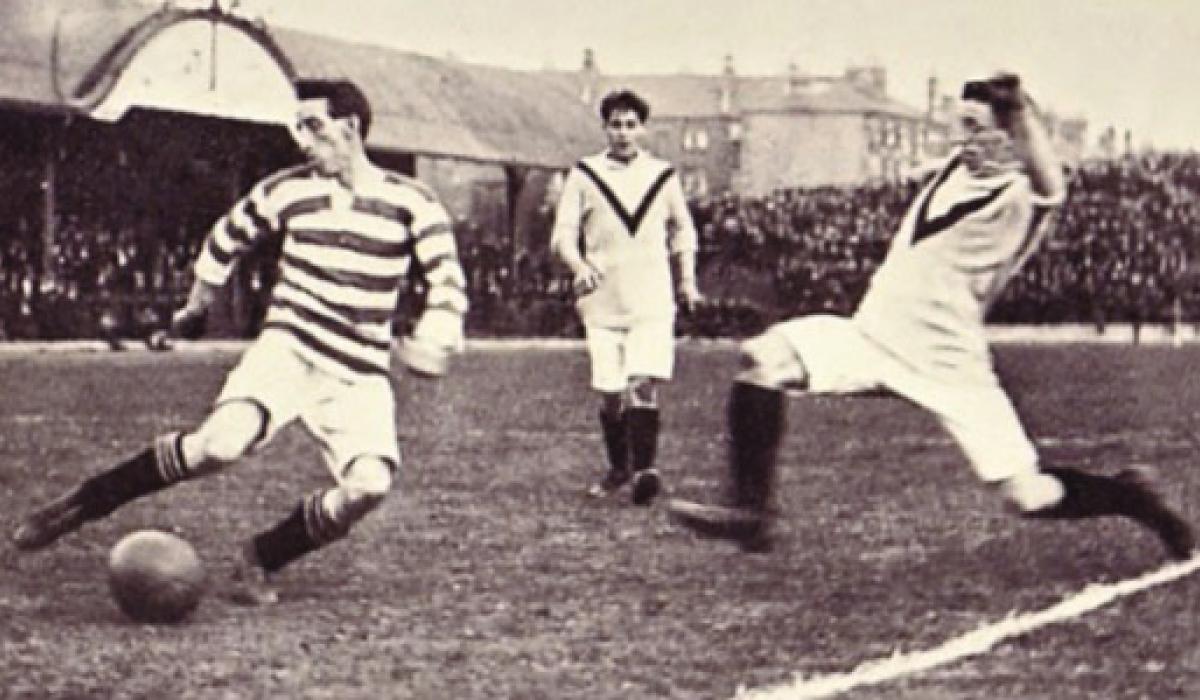
Patsy Gallacher showing typical impishness on the wing for Celtic against Airdrieonians
Gallacher would go on to become one of Celtic’s most celebrated figures. Over 15 years at the club, he made 432 league appearances and scored 187 league goals, finishing with 200 goals in 491 total matches. Only six players to this day have scored more. He helped Celtic win six league titles, four Scottish Cups, four Glasgow Cups, and 11 Glasgow Charity Cups.
Known for his dazzling dribbling, quick turns, and creative brilliance, he was given nicknames like “The Mighty Atom,” “the will-o’-the-wisp,” and “the vital spark.” Jimmy E Handley wrote in The Celtic Story that “commentators ran out of metaphors trying to describe him, such was his unique and elusive style.”
Gallacher was no ordinary player and had an unconventional relationship with training. Maley allowed him to skip most sessions, convinced that training only served to make players lose weight - which Gallacher, being so light already, couldn’t afford. One story from the early 1920s describes Gallacher sneaking out of a team hotel past curfew by dressing as a chambermaid, complete with a high-pitched voice, sashaying past Maley, who unknowingly held the door open for him.
His most iconic moment came in the 1925 Scottish Cup Final at Hampden Park in front of 75,317. Celtic were playing Dundee, and Gallacher scored a goal that would become legendary.
Starting just inside Dundee’s half, he dribbled past several defenders, swaying and stumbling but staying upright. When he was finally brought down inside the six-yard box, it seemed the move was over. But with the ball still trapped between his feet, Gallacher somersaulted into the net, taking the ball with him and scoring one of the most unorthodox and memorable goals in Scottish football history. No footage of the goal exists, although it kept the cartoonists busy. That match has since become known as “the Patsy Gallacher final.”-1744819750707.jpeg)
Patsy Gallacher's goal in the 1925 Scottish Cup final, as depicted in the Scottish press
However, it was McGrory was scored the winner that day at Hampden. He was the son of Henry McGrory and Catherine Coll, who were married in St Baithin’s Church, St Johnston, on May 3, 1866. After moving to Scotland, their son, James Edward, known as Jimmy, was born on April 26, 1904, in 179 Millburn Street, Garngad, in the East End of Glasgow.
David Potter, Celtic historian, wrote: “The harsh life, already harsher thanks to the demands of the First World War, was made almost impossible for the McGrory family in 1916 when their mother died, leaving Jimmy’s father (himself a sick man) with seven children to bring up. But Jimmy could play football and soon found himself a place in the St Roch’s junior team, earning an extra £2 per week, which was a godsend to the family finances.”
McGrory joined Celtic in 1922, spending the 1923/24 on loan at Clydebank. He also played international football for Scotland, scoring six goals in only seven caps. After spending seven years in the Kilmarnock dugout, McGrory managed Celtic from 1945 to 1965, replaced by another immortal, Jock Stein.
-1744820040409.jpeg)
Jimmy McGrory is still the record goalscorer in British club football
He scored a total of 538 goals in 534 appearances for Celtic and Clydebank - 468 goals in 445 Celtic games - it remains the record for a goalscorer in British football.
He died on October 20, 1982, aged 78, in the Southern General Hospital in Glasgow. He was laid to rest at St Peter's Dalbeth, on London Road near Celtic Park.
Gallacher’s time at Celtic ended not with celebration but with quiet dismissal. In July 1926, the board retired him without his knowledge. After a season plagued by injury, and in a bid to cut wages, the club decided not to bring him back, ending 15 years of remarkable service in a way that many supporters and historians view as deeply disrespectful.
He continued his playing career with Falkirk for six more years. Life off the pitch, however, brought its own struggles. His wife died in 1929 during the birth of their sixth child, and Gallacher had to carry on raising the family alone.
Two of his sons, Willie and Tommy, became professional footballers, with Tommy playing for Dundee. His grandson, Kevin Gallacher, would go on to play for Scotland, score in the 1988 Scottish Cup Final, and win the English Premier League with Blackburn Rovers in 1995.
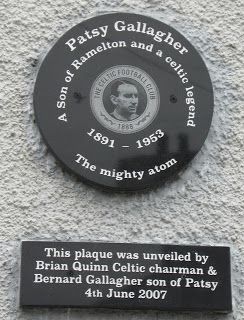
A memorial plaque for Patsy Gallacher in his hometown of Ramelton
Patsy’s great-granddaughter, Amy Gallacher, currently plays for Celtic and scored a last-minute winning goal against Hibernian in 2024 on the final day of the Scottish Women’s Premier League to win the title on goal difference.
In his later years, Patsy Gallacher returned to work in the shipyards and ran the International Bar in Clydebank. After his death from cancer in 1953 at the age of 62, his family discovered hundreds of unpaid tabs hidden away in the bar - Gallacher had preferred to hide them rather than press his customers to pay during Glasgow’s leaner times.
As for the rumour that he once played for Rangers, it's true - sort of. Gallacher played in a benefit match for Rangers player Andy Cunningham, but when the final whistle blew, he took off his jersey to reveal a Celtic one underneath. Even the Rangers supporters were said to have laughed. In the hearts of Celtic fans, Gallacher remains forever the elusive, magical “Mighty Atom” - a Donegal boy who lit up Glasgow and the game itself.
In 2007, eight members of the Lisbon Lions - the Celtic team that won the European Cup in 1967 - were present when a memorial plaque was unveiled at the childhood home of Gallacher in Ramelton by Celtic Chairman Brian Quinn and Patsy’s son Bernard Gallagher.
Just five months and four miles from when Gallacher was born, William - or Billy - Ballintrae Gillespie came into this world in Kerrykeel on August 6, 1891, the eldest son of seven children - four girls and three boys - of Robert Gillespie, a Royal Irish Constabulary sergeant from Portrush, Co Antrim, and his wife Eliza from Tyrone.
Gillespie was five years old when his father retired, and the family moved to Rosemount Avenue in Derry city. By the age of 16, Billy began playing with Institute FC, based in the Drumahoe, and developed a reputation as a skilful forward, with Linfield offering a trial match in 1910, only for Billy to sign professionally on the advice of secretary-manager Frank Scott-Walford for Leeds City FC in the old English Second Division. Gillespie’s father insisted that football was a precarious career choice.
Alongside Athlone’s Joe Enright, Gillespie made his Leeds debut in September 1910 against Blackpool, although a first-team spot was never assured. After 10 goals in 24 games over 15 months, Leeds decided to sell Gillespie to Sheffield United in December 1911.
“In reality, the transfer has been forced by the trend of recent events,” Scott-Walford said in the Yorkshire Evening Post. “Gates of late at Elland Road have not been sufficient to pay the ordinary expenses of the club, and when Sheffield United weighed in with what is stated to be a bigger fee than has ever before been paid for the transfer of a Leeds City player, the management felt that the interests of the club demanded its acceptance.
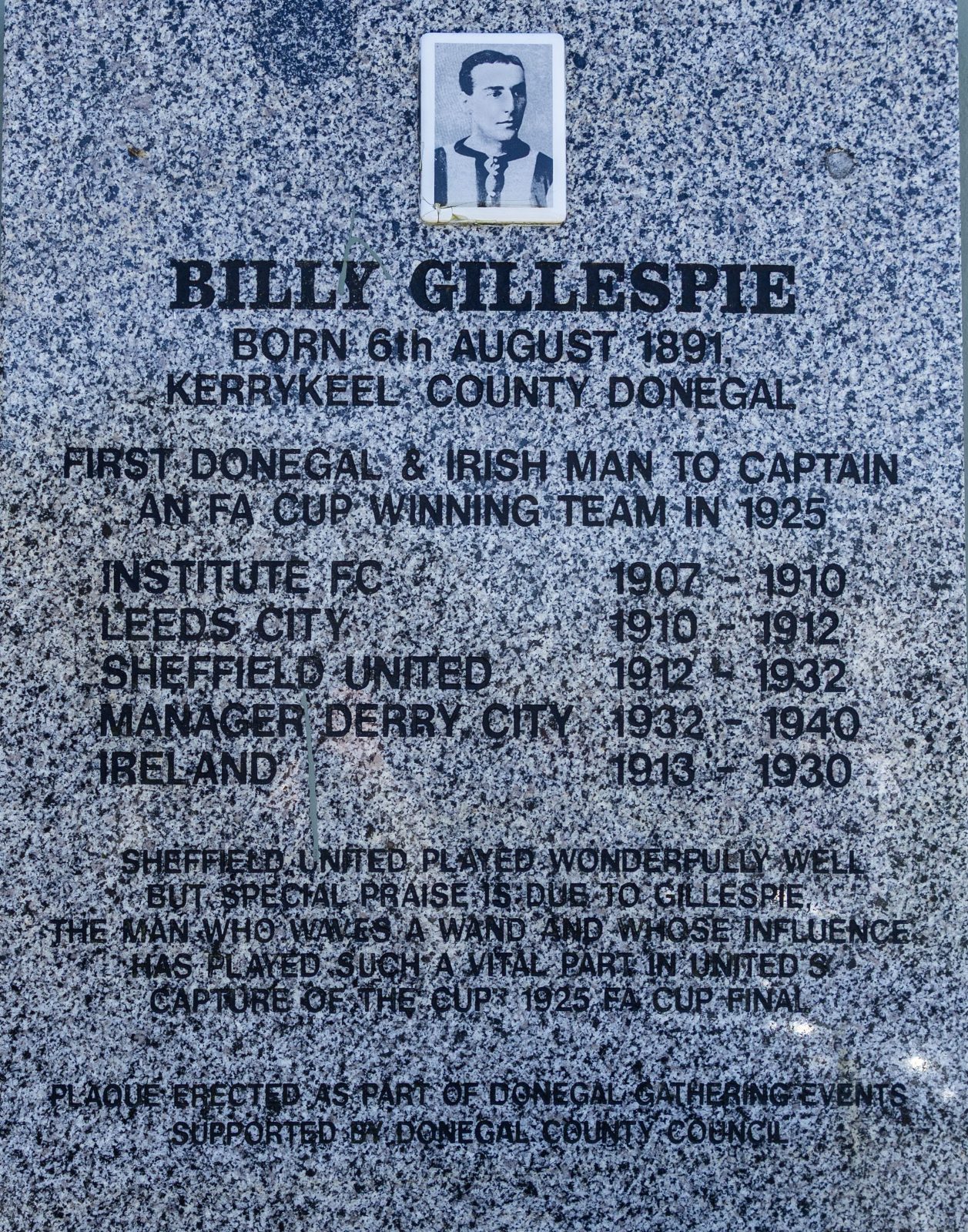
A plaque in memory of Billy Gillespie at Rabs Park, Kerrykeel. Photo: Joe Boland
“We have reason to believe that the fee is something approaching or something exceeding £400 and if that be so, the acceptance of Sheffield United's cheque will go some way towards tiding over Leeds United's financial embarrassments.”
Gillespie was proving to be an instant hit. He scored on his Sheffield United debut on St Stephen’s Day 1911, a 2-2 draw at Newcastle United. He would stay at the club for 20 years.
With Gillespie making headlines for both club and country, Leeds City were nearing the end. It faced a sanction for paying its players during wartime - which had been made illegal - and by 1919, after the club's directors failed to co-operate with the subsequent FA inquiry, were dissolved. And with that, Leeds United was born.
By St Valentine’s weekend, 1913, Gillespie was making his international debut for Ireland, clad in royal blue jerseys with white shorts, against England.
“This match was originally scheduled to be played in England, as had been the case for many years, to play each other on a home and away routine,” England Football Online recalls. “However, at the 1912 IFAB (International Football Association Board), on the motion of Richard Gough, seconded by Charles Crump, a vote of sympathy was accorded the Council of the Irish Association in its troubled times.”
“Special train after special train deposited its load in Belfast for the game and by the kick-off, the crowd at Windsor Park was close to 30,000, the biggest ever seen at an international match in Ireland,” the Evening Herald said.
England had never lost to Ireland in 31 matches - winning 28 and drawing three, evening winning the first 13-0 back in 1881. They’d scored 150 times against Ireland and conceded just 19.
READ NEXT: Champions Glenea United remember the late, great John O’Brien
As expected, the visitors took the lead on 35 minutes, through a Charlie Buchan header. Ireland, by then, were also a man down, as with substitutes not a thing in those days, with forward Jimmy McAuley from Huddersfield Town having hobbled off with a sprained ankle.
However, on 43 minutes, Gillespie managed to head an equaliser following a punch by England goalkeeper Reginald Williamson with the ball adjudged to have crossed the line before Robert Benson - also of Sheffield United - attempted to clear, only to see the ball nestle in the net.
Then, two minutes before the hour-mark, following a centre by Frank Thompson, Gillespie hit a low drive past Williamson, “causing an indescribable outburst of cheers from the crowd” to give Ireland a famous 2-1 victory.
It all came 75 years before Euro 88, when Ray Houghton, whose father John was from Buncrana, scored the only goal in the 1-0 win over England, with the sheet kept clean by an immense performance by Packie Bonner, from Cloughglass in the Rosses at Stuttgart’s Neckarstadion.
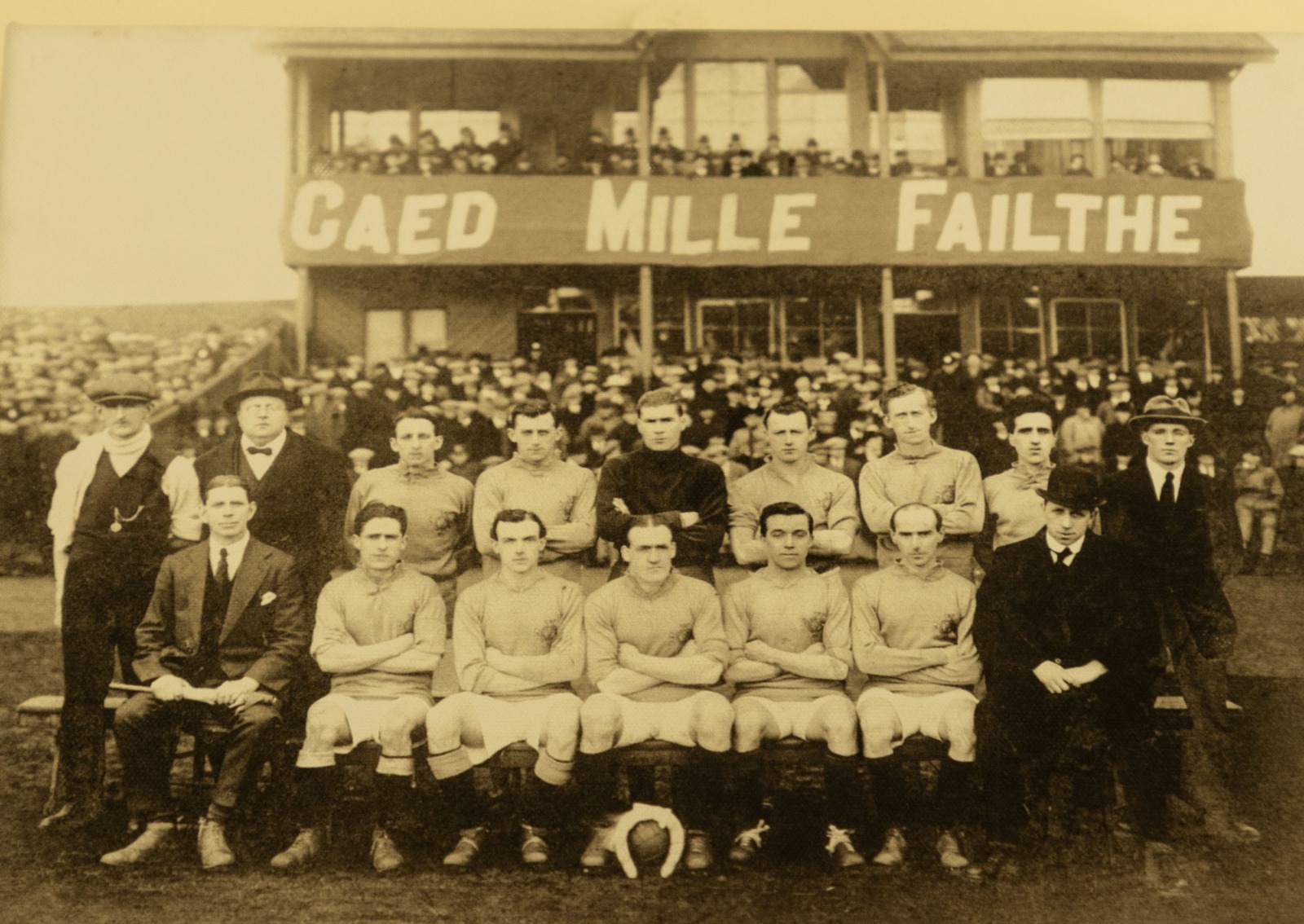
The Ireland team, with Billy Gillespie from Kerrykeel front right of the players
In 1914, Ireland won the British Championship for the first time, with Gillespie on board, having defeated England and Wales and drawn with Scotland. He and Gallacher were capped together in March 1919 away to Scotland in Ireland’s 100th international.
In all, Gillespie would score seven times in 13 games against England and continued to play for the Belfast-led Irish Football Association team, which would become known as Northern Ireland, following the partition of 1921 and the establishment of the Football Association of Ireland in Dublin.
In an international career that saw him win 25 caps over 17 years up to 1930, his 13 goals was a record that stood until David Healy finally surpassed it in 2004.
Sheffield United won the 1915 FA Cup final - the last to be played before the suspension of football following the outbreak of World War I, due to a broken leg, and he would spend time as a gunner in the Irish Horse Artillery. The Blades were 3-0 victors over Chelsea at Old Trafford in Machester, which was chosen as an alternative venue to Crystal Palace so as not to disrupt the London traffic.
Ten years later, though, 92,000 packed into Wembley Stadium for only the third FA Cup final played at the venue. With Gillespie, by now 33, as captain, a single goal from Fred Tunstall was enough to seal a 1-0 win over Cardiff City. “I’m the happiest man in Britain,” Gillespie said as he accepted the cup in the Royal Box. Even in defeat, Cardiff’s players were carried shoulder-high from the field, and two years later, they would defeat Arsenal to win the FA Cup.
“Sheffield United were led throughout the final by the supreme strategy of Gillespie, the first ever Irishman to captain a Cup-winning team, and whose influence has played such a vital part in his side’s capture of the Cup,” the Sporting Chronicle reported.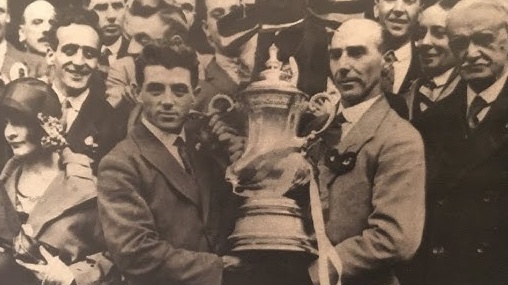
Goalscorer Fred Tunstall and captain Billy Gillespie of Sheffield United with the FA Cup in 1925
In 1927, the BBC broadcast a league match on radio for the first time, and Gillespie scored in a 1–1 draw with Arsenal at Highbury. He eventually left Sheffield United in 1932 aged 40, having played 448 league games for the club and scored 127 league goals - in total, he played 563 games and scored 161 goals.
When he returned to Ireland in 1932, Gillespie came home to become player-manager of Derry City. Part of the deal was that he take with him a red-and-white striped jersey, the colours which the club still wears today.
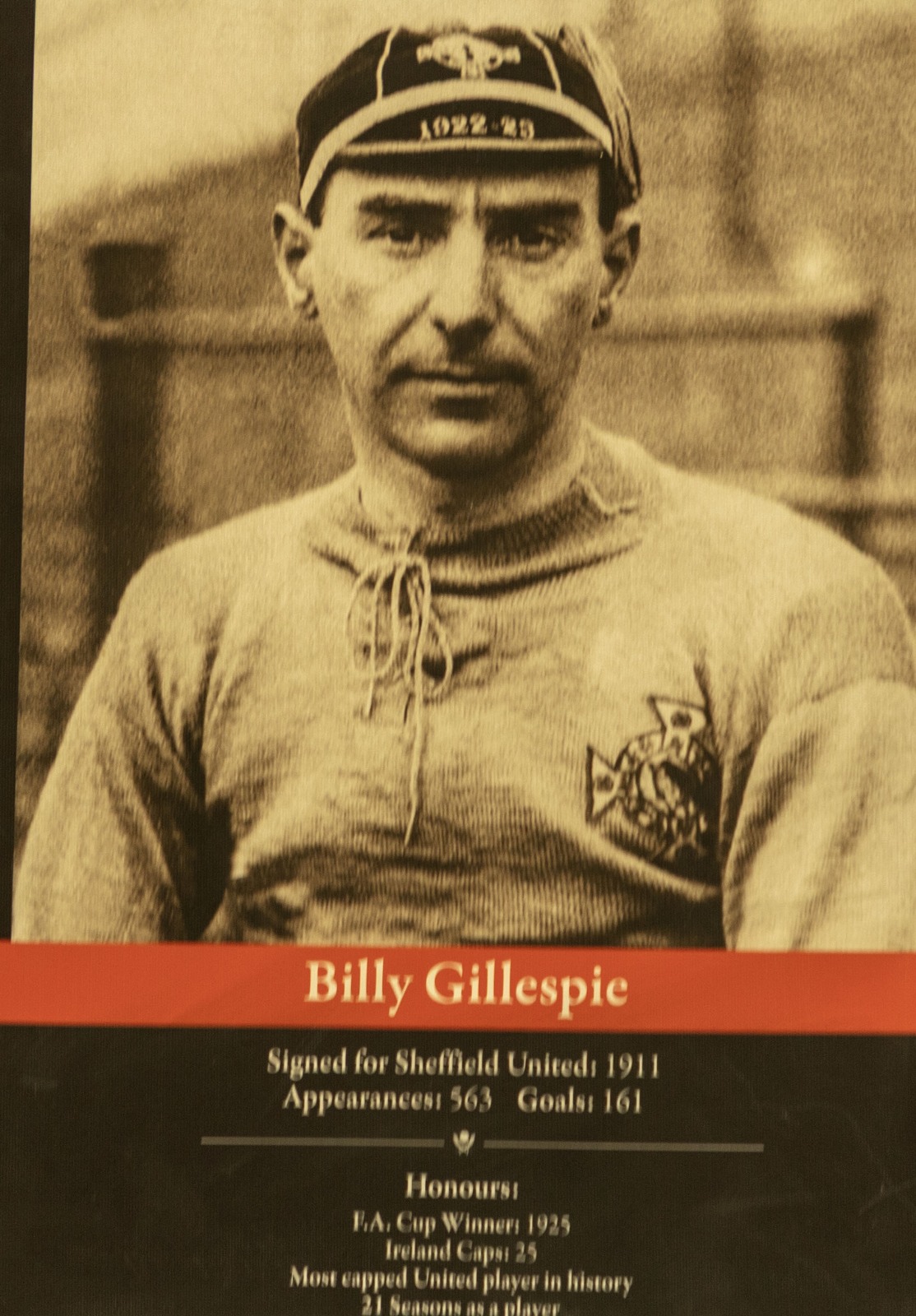
A memorial of Billy Gillespie in Kerrykeel. Photo: Joe Boland
“Leaving Derry in May 1941, he returned with his wife Rosie and three children to live in Sheffield, where he worked at Hadfields munitions works,” the Dictionary of Irish Biography reads. “During the war, his unoccupied house in the Abbey Lane district of Sheffield received a direct hit from a German bomb.
“After the death of his wife, he moved in 1948 to Bexley, Kent. He remained a much-respected figure in football. In May 1981, just two months before his death, he was featured on BBC TV's Football Focus. He recalled: ‘My proudest moment was receiving the cup from King George V in 1925. I still have my medal and the gold watch which Sheffield United presented to each of the players. It was a great day, but we had an even better night – we all got sloshed.’”
Billy Gillespie died in 1981, just a month before he would have turned 90. In September 2013, a commemorative plaque was unveiled by his granddaughter Jane Bull at Rab's Park, Kerrykeel, the local sports field where he first played football. He, like Gallacher and McGrory, will never be forgotten.

Subscribe or register today to discover more from DonegalLive.ie
Buy the e-paper of the Donegal Democrat, Donegal People's Press, Donegal Post and Inish Times here for instant access to Donegal's premier news titles.
Keep up with the latest news from Donegal with our daily newsletter featuring the most important stories of the day delivered to your inbox every evening at 5pm.

This publication supports the work of the Press Council of Ireland and Office of the Press Ombudsman, and our staff operate within the Code of Practice of the Press Council. You can obtain a copy of the Code, or contact the Council, at www.presscouncil.ie, Lo-call 1800 208 080 or email: info@presscouncil.ie.