

‘Why visits like Letterkenny matter to me’
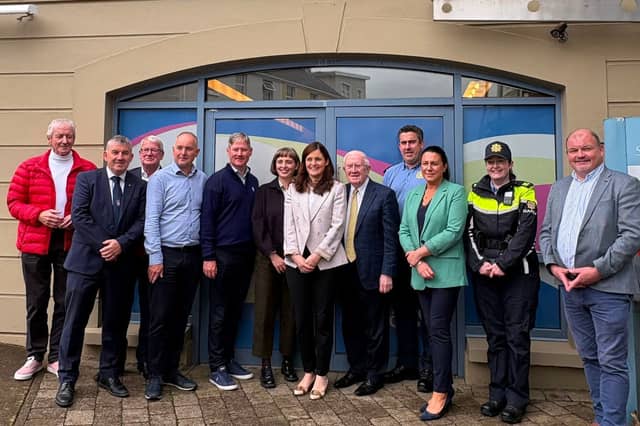

Catherine Ardagh TD, Minister of State at the Department of Justice, Home Affairs and Migration with responsibility for International Law, Law Reform and Youth Justice speaks of her visit to Donegal last month
We’re all still coming to terms with the enormity and the complexity of what happened on the M9 in Co Kildare in the middle of August.
So many precious lives devastated and ended in an instance. So many families left to try and make sense of it, what happened that brought us to this awful moment near Moone in the small hours of the night.
As it happens, I was in Donegal when I heard the news the following morning, surrounded by family and thinking immediately of the excitement in the car innocently making their way to Dublin airport when they were struck head on.
My thoughts remain with Alma, Niamh and Ella and seven year old Yemi.
In late May this year I had the honour of being appointed as Minister with responsibility for Youth Justice and Youth Diversion, the objective is to engage as many young people in the many brilliant services we provide right around the country and keep them away from a life of crime.
When an incident like this happens, it reminds us of the need for these services which are mainly very successful in their work. Re-engaging many kids back into education, hobbies of all sorts, sport and engaging with family life and keeping them out of our detention services.
All of this made my visit to the Letterkenny Youth Diversion Project particularly timely.
I met staff working in youth diversion, early intervention and family support. I was really struck by their commitment, their knowledge of the young people they work with and the amount of time and energy that goes into helping a young person change direction.
I also got to see some of the innovative ways they are engaging with young people. They have excellent car and lorry simulators and are also working with agricultural and forklift machinery simulators. These are practical ways of reaching young people who may not necessarily thrive in a classroom and giving them an opportunity to develop skills and see a different future for themselves.
I subsequently visited the Sligo/Leitrim Youth Diversion Project and saw that same commitment from the staff there.
The difficulty is that we don’t hear enough about the successes and the frankly brilliant work provided by these projects and the brilliant work of the people in the Department of Justice.
When a young person gets back into education, starts training, gets a job or simply stops offending, it doesn’t make the news. Neither does the crime that never happens because somebody got to that young person at the right time.
Youth Diversion is working. Despite year on year growth in the population aged 12 to 17, the number of children coming into the Diversion Programme has generally fallen and has remained at around 8,000 in recent years.
That doesn’t mean we don’t have serious challenges. We do. There are pressures around detention capacity at Oberstown and there are young people involved in very serious and persistent offending. Communities have every right to expect us to respond firmly to that.
I have discussed the wider Youth Justice response with Minister Jim O’Callaghan and I will meet this week with the Minister for Children Norma Foley because this cannot be dealt with by Justice alone, the Department of Education clearly have a role too.
If a young person involved in serious offending has fallen out of education, we need to ask what happened before they reached the criminal justice system. When did they disengage? Why did they disengage? Who knew about it? Could we have intervened earlier?
Justice, Education, Children, Family services, Health and other State agencies all have a part to play.
That is particularly important now as we start to look at what comes after our current Youth Justice Strategy, which runs to 2027. Research is under way and there will be extensive engagement across Government and with Gardaí, youth justice workers, educators, families, community organisations and young people themselves.
That is also why visits like Letterkenny matter to me. I want to hear from the people doing this work every day about what is working, what isn’t and what we need to do differently.
The ultimate aim is that we have fewer victims, less crime and that we can reach that young person who’s in danger and offer a better chance in life.
What I saw in Letterkenny showed me just how valuable that work is, and how important it is that we build on it.
My time in Donegal also coincided with the tragic passing of Noreen and James McHugh and I want to send my condolences to their family. Tough days lie ahead but I hope you’ll find comfort in the direction and love they shared while they were here.