

It Occurs to Me: Commemorating Patrick MacGill


Patrick MacGill’s first novel, Children of the Dead End, sold ten thousand copies in a fortnight, in the same year that James Joyce’s Dubliners sold 499 copies, 120 of them bought by Joyce himself
This weekend, the Patrick MacGill Festival in Glenties will feature a variety of events, starting on Friday evening with a screening of Child of The Dead End, a 2009 drama documentary about MacGill, starring Stephen Rea which will be introduced by the director, Desmond Bell.
Saturday will begin with a guided walk through the historic landscape of Glenties, followed by two talks exploring Patrick MacGill’s extraordinary life and times by MacGill scholar José Manuel Pulido and myself.
On Saturday evening, a host of local musicians and performers will provide an unforgettable night of music, drama and poetry, inspired by the poems and novels of Patrick MacGill, one of Donegal’s most famous writers. The festival will conclude with a prize giving ceremony on Sunday for winners of the poetry and short story competitions for schools in the area. The Highlands Hotel is the venue for the events.
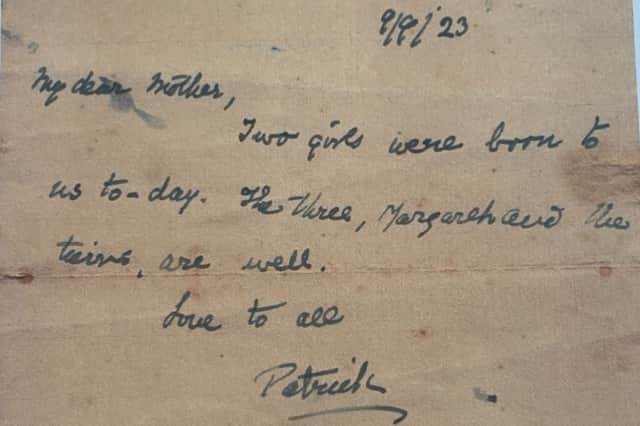
The attached copy of a letter was presented to me some years ago by Dr Mary McGowan, granddaughter of Patrick MacGill. In it, from his then London address, he announces the birth of twins Patricia and Christine.
Two years after the inaugural Summer School set up in his memory in Glenties in 1981, I stood by his graveside in St Patrick’s Cemetery Cemetery in Fall River, Massachusetts, with his daughter Patricia and son-in-law Owen.
MacGill had managed to survive as a popular novelist until 1930 but then emigrated with his wife Margaret and their three daughters, his timing being unfortunate as the Depression had just kicked in after the stock market crash of 1929.
As his daughter Christine recalled at that very first Summer School in 1981, “the subsequent years were dominated by much pain and poverty” resulting in most of Patrick's books being sold to pay bills.
Patricia passed away in 2008, and not only do I vividly recall the warmth and hospitality of their family home in Fall River, but how she had inherited her father’s passion for social justice. While she was still nursing her sixth baby, she travelled to Washington for the civil rights march at which Martin Luther King delivered his famous “I Have A Dream” speech. In her obituary, it said: “At home, she continued her pre-marriage practice of taking in those with nowhere to go. She and her husband were known throughout the city as the people to go to if someone needed a place to stay, for a day, for a weekend, for a month or for three years.”
Patrick died on the same day President Kennedy was assassinated, thus ensuring his passing was hardly noted, just as his once famed reputation had slipped into obscurity.
Digging: mud, blood and tears
The title of my talk on Saturday afternoon is Patrick MacGill: 'Trench' warfare...from Shovel to Rifle. I’ll contrast his writings about hard labour and 'digging' in Ireland and Scotland, with his observations on the digging of trenches in the first world war. The Blackwater Reservoir in Kinlochleven was built between 1905 and 1909 by around 2,000 to 3,000 navvies - many of them Irish - using hand tools rather than heavy machinery. Patrick MacGill was one of them. It was originally constructed to power the local British Aluminum Company smelter in Kinlochleven...it now supplies hydroelectric energy to the national grid and the smelter in Fort William. In Children of the Dead End, he wrote with a visceral passion: “If a man throws red muck over a wall today and throws it back again tomorrow, what the devil is it to him if he keeps throwing that same muck over the wall for the rest of his life, knowing not why or wherefore, provided he gets paid sixpence an hour for his labour.
READ NEXT: It Occurs to Me: The Donegal Pubs in Derry
“There were so many tons of earth to be lifted and thrown somewhere else; we lifted them and threw them somewhere else: so many cubic yards of iron-hard rocks to be blasted and carried away; we blasted and carried them away, but never asking questions and never knew what results we were labouring to bring about…We were men despised when we were most useful, rejected when we were not needed, and forgotten when our troubles weighed upon us heavily.”
September 28th last, was the 111th anniversary of the wounding of MacGill at the Battle of Loos in Belgium.
A stretcher bearer with the London Irish Rifles he was a casualty of ‘friendly fire’, a consequence of the British Army’s use of chlorine gas which blew back towards their own ranks. Of the 285,000 British casualties on the Western Front in 1915, almost 60,000 were slaughtered at Loos. MacGill noted in his novel, The Big Push, that “from the door of a house in Loos I had seen our men, who had attempted to cross the street, wiped out like flies”. The great first world war poet, Wilfred Owen, who was killed in 1918, wrote: “My subject is War, and the pity of War. The Poetry is in the pity", and in his own poems, MacGill rivals Owen’s direct descriptive style:
“The dead men lay on the shell-scarred plain,
Where Death and the Autumn held their reign -
Like banded ghosts in the heavens grey
The smoke of the powder paled away;
Where riven and rent the spinney trees
Shivered and shook in the sullen breeze,
And there, where the trench through the graveyard wound
The dead men's bones stuck over the ground
By the road to Loos in the morning.”
The dead men’s bones he tripped over were not only of comrades...MacGill had no hatred of the German soldiers, writing: “Of those who are England’s enemies, I know, even now, very little. I cannot well pass judgment on a nation through seeing distorted lumps of clotting and mangled flesh pounded into the muddy floor of a trench.”
As a writer, England had been good to him, his only enemies being those back home who abhorred his warts-and-all chronicling of grinding poverty and clerical power. In the same year he was injured and sent home from the war, he published The Rat-Pit, and said in the preface that he was “highly gratified” by the success attained by Children of the Dead End in Britain and abroad and added “Only in Ireland, my native country, has the book given offence.” The previous year, his first novel, Children of the Dead End, sold ten thousand copies in a fortnight. In the same year, James Joyce’s Dubliners sold 499 copies, 120 of them bought by Joyce himself. Forty years ago, I sat in the back of a bus taking us on a tour of MacGill’s ancestral homeland. The guide was local auctioneer and raconteur, Thomas Brennan. Thomas had been talking the talk day and daily, so on this occasion, whether out of boredom or shrewd business acumen, he said: “MacGill went to school there...his brother’s house is up here on the left...and I have a nice wee bungalow for sale around the next corner.” Even an avowed socialist like MacGill would have joined the chorus of laughter ‘Up the Glen’ that balmy July afternoon.
Donegal’s Drumcree?
On July 12, 1829 , a large crowd of Orangemen attempted to march through Donegal Town in protest against Catholic Emancipation, and were intent on destroying the local Catholic Church. At the same time, a huge crowd of about 3,000 local Catholics, armed with picks, scythes, and guns, gathered to stop them on the Donegal to Clar road.
To avoid a major riot, the local landlord, John Hamilton (from St Ernan’s), rode on horseback between the surrounding towns to read the Riot Act and to disperse both sides peacefully. Hamilton was a nephew of the Duke of Wellington, and in The Story of St Ernan’s, George Seaver wrote: “His exertions for the welfare of his tenantry during the terrible years of the Potato Famine were such that not one became an inmate of the union workhouse or died of starvation, and the only death that occurred on his property was attributable to other causes. It must have been during these years that as a measure of finding employment he encircled the entire island with a ‘famine wall’ 10 foot high, and extended the same operation to the opposite shore.”
Father John Doherty was the parish priest of Donegal Town and, despite his general opposition to the landlord system, told the Derry Journal in October 1880: “In all Ireland there never was, nor is there, a more considerate and humane landlord than the good and kind hearted proprietor of St Ernan’s.
“I know the pulse of his tenants well, and I know of my own knowledge that they honour him, respect him, and love him for personal kindness and friendliness towards them, and for his sympathy in all their worldly fortunes and mishaps. They regard him more in the light of a friend and benefactor, like his Master ‘going and doing good’, than as a landlord.”