RIP: Tragic news for family as body of missing man is found after Garda search
Search


22 Feb 2026

Please allow ads as they help fund our trusted local news content.
Kindly add us to your ad blocker whitelist.
If you want further access to Ireland's best local journalism, consider contributing and/or subscribing to our free daily Newsletter .
Support our mission and join our community now.
To continue reading this article, you can subscribe for as little as €0.50 per week which will also give you access to all of our premium content and archived articles!
Alternatively, you can pay €0.50 per article, capped at €1 per day.
Thank you for supporting Ireland's best local journalism!

Monsignor James Horan was the driving force behind the development of an airport in Knock

May will mark 40 years since the official opening of what is now known as Ireland West Airport.
The milestone anniversary for the airport that was opened as Connacht Regional Airport will allow the opportunity for those involved over the four decades, along with the people of Mayo in general, to reflect on the achievement of its founding and its development into becoming the country’s fastest-growing airport.
The airport’s managing director, Joe Gilmore, says the story of its founding, driven by Monsignor James Horan, “captures people’s imagination”.
“I think that as the years pass, the story of where the airport came from and how it came about becomes even more iconic and more remarkable. That effectively a parish priest and some local people could achieve the building of an international airport in a location that was termed a foggy, boggy hill by a Government minister at the time.
“We have been fortunate over the last 10 to 15 years that I have been there to just be the flag-bearers for those people, who were remarkable and deserve great credit for what they have done.”
The Claremorris native has been part of the story of the airport since 2009, having arrived in the middle of the financial crisis, when the airport was “struggling for survival, for viability”.

Joe Gilmore has been the airport’s managing director since 2009
The intervening years have seen lows such as the 2010 ash cloud crisis and the pandemic, and highs which include the visit of Pope Francis in 2018 and US President Joe Biden in 2023.
‘Benefits clear to see’
For Gilmore, the drive, ambition, commitment and achievements of those that came before him have brought benefits across the region “that are clear to see”.
Those benefits include the employment of more than 200 people directly at the airport, 50 to 60 people working for third-party providers such as car rental companies and airlines, and an estimated 3,000 jobs in support services.
READ NEXT: Donegal director set for short film premiere at Dublin International Film Festival
The estimated annual spend by the more than 250,000 people who visited the region through the airport is around €200m.
“They visited counties like Donegal, and right across Leitrim and Longford in their thousands and many of those would not come to those more western and remote counties unless there was an airport in reasonable proximity to them,” he said.
“Our survey shows that one in three of the 250,000 that came through the airport last year would not have travelled unless there was an airport for them to fly directly into.”
Government support vital
The opening of the airport in 1986 came about after a massive fundraising campaign, which raised around IR£4m after government support was cut.
But the success and growth of the airport in recent years have been greatly helped by the support of successive governments, Gilmore says.
“Thankfully, over the last 10 to 15 years in particular, the key development has been really that governments recognise the value that the airport can bring to the region, and is bringing to the region, and that we are recognised as one of the four main airports along with Dublin, Cork and Shannon. We are part of the National Planning Framework and National Development Plan and that guarantees investment funding to us under the Regional Airports Programme.
“That programme over the last 15 years, at least, has given us a certainty of funding for our critical capital projects to maintain the airport and try and develop it.
“We have to acknowledge that from the government, because without that, we would struggle to be there. Because we are not at the scale of the larger airports that have enough business and cash flows and make enough profit to be able to help fund the significant cost there is to run an airport.”
Examples of the type of capital works required to develop the airport recently and to make it more pleasant for passengers are the construction of a covered walkway at the terminal, part of around €8m capital works carried out last year.
This year will see around €6m spent on a range of works, including an electrical upgrade and air traffic control upgrades.
Between 2026 and 2030, the airport is expected to spend up to €35m on capital works, with the biggest element of that being the expansion and reconfiguration of aircraft stands to accommodate new, larger modern aircraft
Charity programme
As well as the indirect benefits from the airport, there is also a direct and targeted benefits through the airport’s charity programme, which last year saw €54,000 presented to six nominated charities selected by airport employees: Connacht SBHI Branch (Spina Bifida Hydrocephalus), Dillon Quirke Foundation, Mayo Roscommon Hospice, Order of Malta (Knock Branch), The National Breast Cancer Research Institute, and Western Alzheimers, with each receiving a cheque worth €9,000.
A highlight of the charity programme is the runway fun-run, which takes place every September.
“We are very proud of it, “ Gilmore says. “We get the greatest support from our staff and the general public, who contribute.
“To celebrate our 40th, we are trying to make that charity programme bigger and better.”
40th anniversary
There is a planned series of events throughout the year to mark the 40th anniversary of the official opening, including the launch of a new logo, which will culminate on May 28 with a gala charity event at the airport. That will include participation from people involved with the airport’s development through the decades.
“There will be a revisit down memory lane with various people who were involved with the airport many years ago to map out the journey all the way to the present.”
‘Tremendous support’ of Donegal
The airport lies one hour and 40 minutes from Donegal Town, and Gilmore acknowledges the “tremendous support” the airport gets from the people of Donegal.
“We are always happy to take any feedback we can from them.”
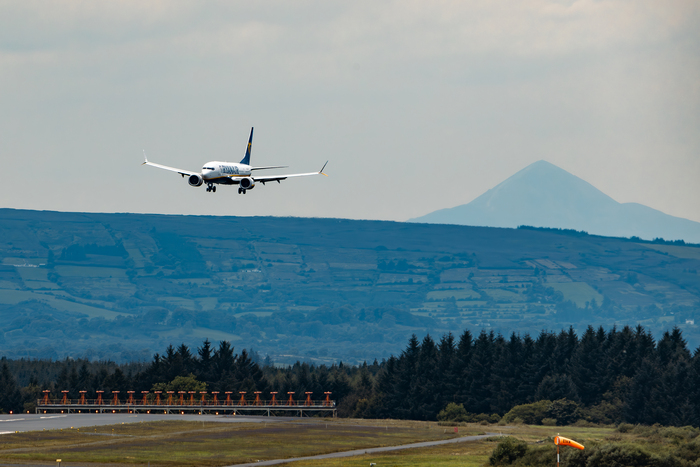
Ireland West Airport has become key to developing tourism in the west and north-west
Donegal County Council is one of the local authorities that gives financial support to the airport, an acknowledgement of its importance to the county.
The data the airport collects shows that more than 35,000 outbound passengers from Donegal used the airport last year. The most popular destinations used by Donegal residents flying out of Ireland West Airport in 2025 were London, Liverpool, Faro and Alicante.
READ NEXT: Donegal author publishes new book with story of ‘resilience and determination’
Upwards of 12,000 visitors from overseas visited Donegal using the airport as a gateway last year and research conducted for the airport by RedC showed that visitors to Donegal spent the most nights on average in the west and north west - an average of seven nights - there when visiting the region.
The research also showed that 70% of overseas visitors who visit Donegal do so for holiday purposes, highlighting the strong economic benefit the airport provides, particularly for the hospitality and tourism sector in Donegal
Sliabh Liag and Glenveagh National Park are identified as key highlights for holidaymakers when visiting Donegal.
Wild Atlantic Way
In recent years, the Wild Atlantic Way has emerged as an important driver in bringing increased tourism to counties like Donegal.
Ireland West Airport lies less than an hour from access to the 2,600 km tourist route that runs from Kinsale in Cork to Malin Head, and the airport cooperates with tourism agencies and local authorities along the route.
“We have a regional partnership with each of the local authorities that are invested in the airport and each year we do overseas promotion with them and we include Tourism Ireland in that.
“Last year in May and June, up to 60 tourism-related businesses and executives from the local tourism offices did a three-day road show in Cologne and Milan where we have the direct routes from and we got 150 tour operators from Germany and Italy to attend.”
Increase in passenger numbers
The growing draw of the airport is reflected in increasing passenger numbers.
A 13.5% increase in passenger numbers in 2025 saw a continuation of the growth of recent years at the airport, which now serves 21 international destinations. The year was its busiest year on record with passenger numbers reaching over 946,000, up from the previous record of 834,000 in 2024.
This year will see an ongoing focus on increasing capacity on routes such as Faro, Malaga, Milan and Liverpool, as well as the search for new routes.
“In terms of growing numbers and volume, from an airport point of view, while we would like to be able to get new destinations, we know that the existing services work.”
UK market key
Access to and from the UK is key to the airport, Gilmore says. Ireland West Airport has nine UK destinations - Heathrow, Stanstead, Luton, Bristol, Edinburgh, Birmingham, Nottingham, Manchester and Liverpool - and the 732,501 passengers who used those services last year was an increase of 10% compared to 2024 and a new record for UK traffic to and from the airport.
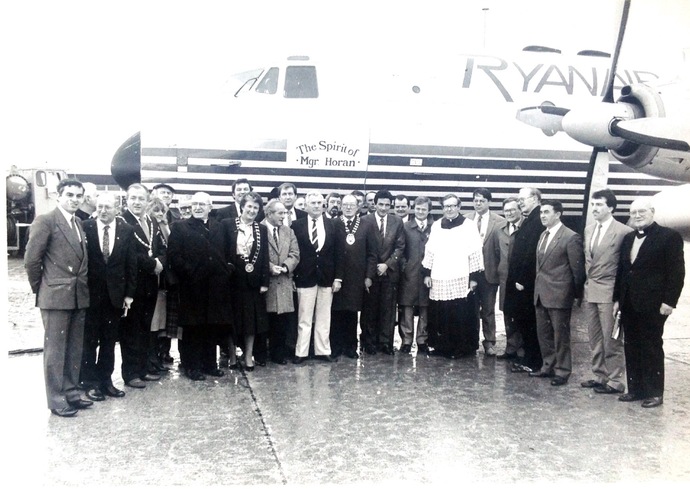
The airport provided the west of Ireland’s first direct air link with London in 1986 and the city remains vital to its success
“That makes up 75% to 80% of our overall traffic. It is quite a comprehensive coverage destination-wise for an airport of our size to the UK.”
And the three flights to London airports reflect the importance of the city to the airport.
“We have had something like 16 million passengers through the airport since it opened and of those, about 8 million are the London market. It has been a very important market for us.”
Hinterland
The airport’s location is proving a big draw for passengers from south Donegal, to Galway and beyond.The increasing passenger numbers and the growing success of the airport is linked to the size of the airport’s hinterland, Gilmore believes.
“We have a broad geographic hinterland. We have 1.2million people living within about 90 minutes of the airport. While we are a rural airport, obviously, we have a large hinterland including large towns such as Galway and Sligo.”
Convenience
And it is the convenience and ease of use of the airport that is appealing to its growing hinterland.
“The surveys we have done for passengers - for over 90% it is the convenience and ease of access of the airport. We have over 3,000 carpark spaces and they are all within a five-minute walk of the terminal. So you are not dealing with the challenges that you are at a much larger airport.
“More and more people, I think, want to use regional airports for their convenience.”

Subscribe or register today to discover more from DonegalLive.ie
Buy the e-paper of the Donegal Democrat, Donegal People's Press, Donegal Post and Inish Times here for instant access to Donegal's premier news titles.
Keep up with the latest news from Donegal with our daily newsletter featuring the most important stories of the day delivered to your inbox every evening at 5pm.

This publication supports the work of the Press Council of Ireland and Office of the Press Ombudsman, and our staff operate within the Code of Practice of the Press Council. You can obtain a copy of the Code, or contact the Council, at www.presscouncil.ie, Lo-call 1800 208 080 or email: info@presscouncil.ie.