Search


04 Apr 2026
Search
04 Apr 2026

Please allow ads as they help fund our trusted local news content.
Kindly add us to your ad blocker whitelist.
If you want further access to Ireland's best local journalism, consider contributing and/or subscribing to our free daily Newsletter .
Support our mission and join our community now.
To continue reading this article, you can subscribe for as little as €0.50 per week which will also give you access to all of our premium content and archived articles!
Alternatively, you can pay €0.50 per article, capped at €1 per day.
Thank you for supporting Ireland's best local journalism!

Donegal 1972 - first time county took home Anglo Celt cup

A look through the Donegal panel that captured the Anglo Celt for the very first time in 1972 makes interesting reading. A big number only played for a small number of years for the county.
It was a time of change. There had been two Ulster final appearances in the '60s - (1963 and 1966) and many from that era were moving on. The yearly diet of one championship game was beginning to be the norm again - 1969, '70 and '71.
This had been the history of Donegal GAA from their first appearance in the Ulster championship in 1906 with just two games on 15 occasions between that and the first breakthrough in 1963. (And on two of those occasions it was a protest and an abandoned match that forced a second game).
The Donegal starting team of 1972 contained a big number of players who had short intercounty careers - among them Michael Sweeney, who made a breakthrough in the semi-final but then injury curtailed further involvement. Others like John Boyce, Alan Kane, Daniel McGeehan, Mickey McMenamin and Joe Winston only played for a short number of years.
At 20 years of age, Martin Carney, a student at UCG, did not foresee anything different in 1972. He had attended Donegal's first Ulster final in 1963 with his father "and I could take you to the exact spot where we watched the game," he says. "God love him, John Murphy, told me afterwards that the same selectors had selected both the minor and senior teams. These things would be alien to young people nowadays," says Carney.
"The young people of today don't realise that they are living in an era of exceptional footballers and a time of exceptional interest in the game.
"Look, there were exceptional footballers around at the time. I was brought up in Ballyshannon and there was a great passion for the game with some household names like The Natch, Red Jack, Mick Melly and guys like that. My own father played football with Donegal and with Limerick. There was the De La Salle brothers, we were very, very lucky in that respect.
"But there were huge swathes of the county where there was no awareness of GAA. Let it be said, at the end of the day I was extremely lucky. I came from a pocket where the tradition and the knowledge of it in particular and the iconic figures in the town that we could look up to were plentiful."
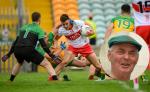
Carney had progressed from minor and U-21 teams very quickly on to the Donegal senior team but expectations of challenging again were not high.
"When we beat Down in the first round that year 1-8 to 0-8, we were totally unconsidered at the time. Many people looked on that defeat as Sean O'Neill and Dan McCartan's last outing for Down, but they played on for another few years.
"We were not fancied at all. We went on to take Cavan in a replay. And that's where Mickey Sweeney came on the scene and played particularly well.
"I was lucky enough to play out in the half-forward line, but he came at a time that anyone who played in the full-forward line earned his crust. Because it was Hell's Kitchen. There were no niceties at all. The full-back line generally, on every team, were selected for the most part because of their aggression and their ability to strike fear into their opponents.
"And if you ask anyone from the era they will tell you that.
"The other thing about the time, and I don't know who came up with the concept, but the games were 80 minutes then. That was at a time when the emphasis on fitness was nothing like what it is today.
"There were men praying for a happy death going through the last 10 minutes of games at that time, because they were so far through," said Carney, who felt this was an area that Brian McEniff came to the fore.
"He had an awareness of tactical substitutions but at that time they were a rarity. But he was one of the innovative coaches/managers. I couldn't speak highly enough about him, apart from the fact that he gave me a job in the Holyrood as a barman in 1969," jokes Carney.
Speaking of Michael Sweeney, Carney says he played MacRory Cup with him in St Eunan's College in Letterkenny. "He had speed, was a good finisher and had good movement. Full-forwards at the time were generally a target man.
"Michael Sweeney would have been a different style as he relied on wit and movement to ply his trade. He was the antithesis of what the full-forward was at the time in that he was wiry, light and elusive.
"I remember Seamus Bonar in full-forward in 1974 against Antrim and he scored four goals. Seamus was an edge of the square full-forward which was the typical full-forward of that particular time.
"They talk later on of The Bomber and Kieran Donaghey, but they were following in a line of target men that was the norm in Gaelic football," says Carney.
"In today's game, primarily you look for an athlete and try to make a footballer out of him."

Returning to the Donegal panel of 1972, looking back Martin Carney feels there were two players not available who could have made a major difference.
"If we had Neilly Gallagher Mickey McLoone in 1972, it could have made that extra difference. Neilly was an exceptional player and Mickey was always my hero. I was lucky to have players like him in the town who I could aspire to and try to emulate."
McLoone missed out through injury while Neilly Gallagher only returned from work in Scotland the following year.
"I remember vividly in 1971, my first year in Galway, hearing that McLoone was having a cartilage operation in Merlin Park hospital. I visited him and saw the cartilage in a jam jar at the side of the bed. He never really played football after that. It was just regarded as a bust knee. A bust knee could mean anything from a cartilage to an interior cruciate. There was no expertise about cartilage and cruciates in comparison to today."
After playing just one match in Ulster in three successive years, what was the difference in 1972?
"That is a good question," says Carney. "The common denominator is probably McEniff. The concept of player-manager was unheard of. He was filled with that sense of optimism, the art of what was possible.
"There was an anti-St. Joseph's thing in the county but McEniff could look beyond that and get people on board. He could convince you black was white in pursuit of winning," said Carney, who named nine St Joseph's players who were on the panel in 1972.
"St Joseph's did Donegal no harm. The culture of winning maybe gave us a bit of confidence. There was plenty of rivalry with St Eunan's and MacCumhaill's, who were both formidable clubs. Gaoth Dobhair had excellent players but they had trouble keeping players at home," he said, adding that Anton Carroll was a big influence. "He had those leadership qualities and got a lot of the Dublin boys on board. Kieran McCready was central to organising the Dublin based lads."
Of the 1972 final itself, Carney has a memory "of a small guy on me, Mickey Hughes, and I didn't get a kick of the ball!"
It was a time of great rivalry between Donegal and Tyrone, which continued in the following two years with the infamous meeting in MacCumhaill Park in 1973: "The most volatile game I ever played in," says Carney. "We couldn't get to the dressing room after the game with the Tyrone crowd trying to get at us, even after winning. There was a call for Donegal to play in Connacht at a subsequent Co Board meeting."
While the rivalry remains to this day, the nastiness of 1973 was, thankfully, not repeated.
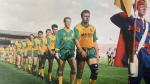
Carney had obviously great regard for his fellow St Joseph's players on the team including play-anywhere Pauric McShea, who was converted from a forward to a full-back."Donal Monaghan was an exceptional footballer at corner back and Andy Curran was very, very handy.
"Anthony Gallagher was an outstanding centre-half-back, one of three brothers James and Paddy, who lived opposite the entrance to O'Donnell Park. Anthony went on to play in Down with Bryansford.
"Frankie McFeely was coming to the end of his years with the county but was a very thoughtful player, constructive in the use of the ball," says Carney, who felt that Anton Carroll was a big influence on the change in Donegal. "He was a very good teammate, aggessive and took no prisoners, something that in the Gaoth Dobhair lads.
"I played on the same wing as Brian McEniff and I benefitted from that as the two of us were always able to play well as a unit. Declan O'Carroll at left-half-forward was an elegant footballer, probably more suited to midfield while Seamie Granaghan was so dynamic. He was aggressive and full of energy. When he put the head down he was difficult to stop.
"Seamus Bonar was a once-off, a great finisher. He gave great service to the county, on and off the field. A fabulous teammate, he was taken far too soon," says Carney.

Subscribe or register today to discover more from DonegalLive.ie
Buy the e-paper of the Donegal Democrat, Donegal People's Press, Donegal Post and Inish Times here for instant access to Donegal's premier news titles.
Keep up with the latest news from Donegal with our daily newsletter featuring the most important stories of the day delivered to your inbox every evening at 5pm.

This publication supports the work of the Press Council of Ireland and Office of the Press Ombudsman, and our staff operate within the Code of Practice of the Press Council. You can obtain a copy of the Code, or contact the Council, at www.presscouncil.ie, Lo-call 1800 208 080 or email: info@presscouncil.ie.